Class 9 RD Sharma Solutions Chapter 15 Areas of Parallelograms and Triangles Exercise 15.3 | Set 2 (original) (raw)
Last Updated : 9 Mar, 2022
Question11. If P is any point in the interior of a parallelogram ABCD, then prove that area of the triangle APB is less than half the area of parallelogram.
Solution:
According to the question
ABCD is a parallelogram and P is any point in the interior of parallelogram
Prove: ar(ΔAPB) < 1/2 ar(|| gm ABCD)
Proof:
Construction: Draw DN ⊥ AB and PM ⊥ AB
Now, we find the area of ∥gm ABCD
= AB × DN,
Now, the area of ΔAPB
= (1/2) (AB × PM)
Now, PM < DN
AB × PM < AB × DN
(1/2)(AB × PM) < (1/2)(AB × DN)
ar(ΔAPB) < 1/2 ar(∥ gm ABCD)
Hence proved
Question 12. If AD is a median of a triangle ABC, then prove that triangles ADB and ADC are equal in area. If G is the mid-point of the median AD, prove that ar(ΔBGC) = 2ar(ΔAGC).
Solution:
According to the question
AD is a median of a triangle ABC
Now, construct AM ⊥ BC
It is given that AD is the median of ΔABC
So, BD = DC
BD = AM = DC × AM
(1/2)(BD × AM) = (1/2)(DC × AM)
ar(ΔABD) = ar(ΔACD) ....(i)
In ΔBGC,
GD is the median
So, ar(ΔBGD) = ar(ΔCGD) .....(ii)
In ΔACD,
CG is the median
So, ar(ΔAGC) = ar(ΔCGD) ........(iii)
From equation (ii) and (iii), we get
ar(ΔBGD) = ar(ΔAGC)
But, ar(ΔBGC) = 2ar(ΔBGD)
Hence, ar(ΔBGC) = 2ar(ΔAGC)
Hence proved
Question 13. A point D is taken on the side BC of a ΔABC, such that BD = 2DC. Prove that ar(ΔABD) = 2ar(ΔADC).
Solution:
According to the question
BD = 2DC(In ΔABC)
Prove that ar(ΔABD) = 2ar(ΔADC).
Proof:
Now draw a point E on BD such that BE = ED
Since, BE = ED and BD = 2 DC
So, BE = ED = DC
As we know that, in triangles, median divides the triangle into two equal triangles.
In ΔABD,
AE is the median.
So, ar(ΔABD) = 2ar(ΔAED) .....(i)
In ΔAEC,
AD is the median.
So, ar(ΔAED) = 2ar(ΔADC) ....(ii)
From eq(i) and (ii), we get
ar(ΔABD) = 2ar(ΔADC)
Hence proved
Question 14. ABCD is a parallelogram whose diagonals intersect at O. If P is any point on BO, prove that:
(i) ar(ΔADO) = ar(ΔCDO).
(ii) ar(ΔABP) = 2ar(ΔCBP).
Solution:
According to the question
ABCD is the parallelogram, whose diagonals intersect at O
So, AO = OC and BO = OD
(i) Prove that ar(ΔADO) = ar(ΔCDO)
Proof:
In ΔDAC,
DO is a median.
So, ar(ΔADO) = ar(ΔCDO)
Hence proved
(ii) Prove that ar(ΔABP) = 2ar(ΔCBP)
Proof:
In ΔBAC,
BO is a median.
So, ar(ΔBAO) = ar(ΔBCO) .....(i)
In ΔPAC,
PO is a median.
So, ar(ΔPAO) = ar(ΔPCO) .....(ii)
Now, subtract eq(ii) from (i), we get
ar(ΔBAO) − ar(ΔPAO) = ar(ΔBCO) − ar(ΔPCO)
ar(ΔABP) = 2ar(ΔCBP)
Hence proved
Question 15. ABCD is a parallelogram in which BC is produced to E such that CE = BC. AE intersects CD at F.
(i) Prove that ar(ΔADF) = ar(ΔECF).
(ii) If the area of ΔDFB = 3 cm2, find the area of ∥ gm ABCD.
Solution:
According to the question
ABCD is a parallelogram in which BC is produced to E
such that CE = BC and AE intersects CD at F
(i) Prove that ar(ΔADF) = ar(ΔECF)
Proof:
In ΔADF and ECF,
∠ADF = ∠ECF (Alternate interior angles)
AD = EC (Because, AD = BC = CE)
∠DFA = ∠CFA (Vertically opposite angle)
So, by AAS congruence
ΔADF ≅ ΔECF
By c.p.c.t
DF = CF
Hence, ar(ΔADF) = ar(ΔECF)
Hence proved
(ii) From the question area of ΔDFB = 3 cm2,
Find the area of ||gm ABCD
Now, DF = CF (Proved above)
BF is a median in Δ BCD.
ar(ΔBCD) = 2ar(ΔDFB)
ar(ΔBCD) = 2 × 3 cm2 = 6 cm2
Now we find the area of a parallelogram = 2ar(ΔBCD)
= 2 × 6 cm2 = 12 cm2
Hence the area of parallelogram is 12 cm2
Question 16. ABCD is a parallelogram whose diagonals AC and BD intersect at O. A line through O intersects AB at P and DC at Q. Prove that ar(ΔPOA) = ar(ΔQOC).
Solution:
Prove: ar(ΔPOA) = ar(ΔQOC)
In ΔPOA and QOC,
∠AOP = ∠COQ (Vertically opposite angle)
AO = OC
∠PAC = ∠QCA (Alternate angle)
So, by ASA congruence criterion, we have
ΔPOA ≅ ΔQOC
Hence ar(ΔPOA) = ar(ΔQOC)
Hence proved
Question 17. ABCD is a parallelogram. E is a point on BA such that BE = 2EA and F is point on DC such that DF = 2FC. Prove that AECF is a parallelogram whose area is one third of the area of parallelogram ABCD.
Solution:
Prove: ar(∥gm AECF) = 1/3 ar(||gm ABCD)
Proof:
First construct FG ⊥ AB
Now, according to the question
BE = 2 EA and DF = 2FC
AB - AE = 2 AE and DC - FC = 2 FC
AB = 3 AE and DC = 3 FC
AE = (1/3) AB and FC = (1/3)DC .......(i)
But AB = DC
So, AE = FC (Opposite sides of the parallelogram)
AE = FC and AE ∥ FC
So, AECF is a parallelogram
Now, we find the area of parallelogram AECF
= AE × FG
Put the value of AE from eq(i), we get
ar(||gm AECF) = 1/3 AB × FG
3ar (||gm AECF) = AB × FG ....(ii)
and ar(||gm ABCD) = AB × FG ....(iii)
From eq(ii) and (iii), we get
3ar(||gm AECF) = ar(||gm ABCD)
Hence ar(||gm AECF) = 1/3 ar(||gm ABCD)
Hence proved
Question 18. In a triangle ABC, P and Q are respectively the mid points of AB and BC and R is the midpoint of AP. Prove that:
(i) ar(ΔPBQ) = ar(ΔARC).
(ii) ar(ΔPRQ) = 1/2 ar(ΔARC).
(iii) ar(ΔRQC) = 3/8 ar(ΔABC).
Solution:
According to the question
ABC is a triangle, in which P, Q, and R are the mid-points of AB, BC and AP
(i) Prove that ar(ΔPBQ) = ar(ΔARC)
Proof:
CR is the median of ΔCAP
So, ar(ΔCRA) = (1/2) ar(ΔCAP) ....(i)
CP is the median of a ΔCAB
So, ar(ΔCAP) = ar(ΔCPB) ....(ii)
So, from eq(i) and (ii), we conclude that
ar(ΔARC) = (1/2) ar(ΔCPB) ....(iii)
Now, PQ is the median of a ΔPBC
So, ar(ΔCPB) = 2ar(ΔPBQ) ....(iv)
From eq(iii) and (iv), we conclude that
ar(ΔARC) = ar(ΔPBQ**)** ....(v)
Hence proved
(ii) Now QP and QR are the medians of triangles QAB and QAP
So, ar(ΔQAP) = ar(ΔQBP) ....(vi)
And ar(ΔQAP) = 2ar(ΔQRP) ....(vii)
From eq(vi) and (vii), we conclude that
ar(ΔPRQ) = (1/2) ar(ΔPBQ) ....(viii)
And from eq (v) and (viii), we conclude that
ar(ΔPRQ) = (1/2) ar(ΔARC)
Hence proved
(iii) Now, LR is a median of ΔCAP
So, ar(ΔARC) = (1/2) ar(ΔCAD)
= 1/2 × (1/2) ar(ΔABC)
= (1/4) ar(ΔABC)
and RQ is the median of ΔRBC.
So, ar(ΔRQC) = (1/2) ar(ΔRBC)
= (1/2) {ar(ΔABC) − ar(ΔARC)}
= (1/2) {ar(ΔABC) – (1/4) ar(ΔABC)}
= (3/8) ar(ΔABC)
Hence proved
Question 19. ABCD is a parallelogram. G is a point on AB such that AG = 2GB and E is point on DC such that CE = 2DE and F is the point of BC such that BF = 2FC. Prove that:
(i) ar(ADEG) = ar(GBCE)
(ii) ar(ΔEGB) = (1/6) ar(ABCD)
(iii) ar(ΔEFC) = (1/2) ar(ΔEBF)
(iv) ar(ΔEGB) = 3/2 × ar(ΔEFC)
(v) Find what portion of the area of parallelogram is the area of ΔEFG.
Solution:
According to the question
ABCD is a parallelogram
So, AG = 2 GB, CE = 2 DE and BF = 2 FC
Now, draw a parallel line to AB that pass through point F and a perpendicular line to AB from C.
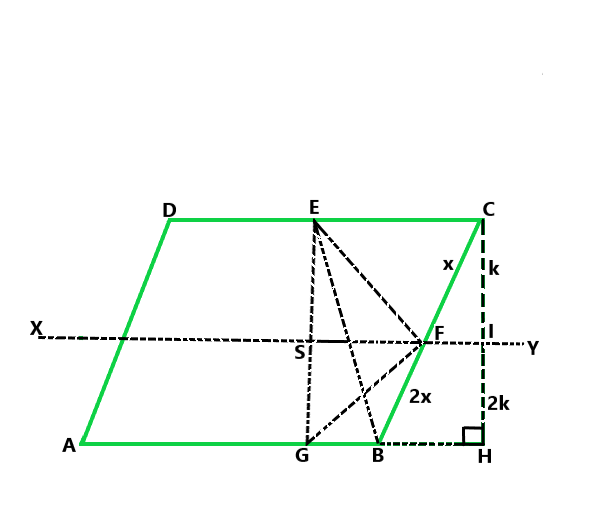
(i) Prove that ar(ADEG) = ar(GBCE)
Since it is given that ABCD is a parallelogram
So, AB = CD and AD = BC
Now, let us consider the two trapezium ADEG and GBCE
Since AB = DC, EC = 2DE, AG = 2GB
So, ED = (1/3) CD = (1/3) AB and EC = (2/3) CD = (2/3) AB
AG = (2/3) AB and BG = (1/3) AB
So, DE + AG = (1/3) AB + (2/3) AB = AB and EC + BG = (2/3) AB + (1/3) AB = AB
Since these two trapeziums have same heights, also their sum of two parallel sides are equal,
So, the area of trapezium = sum of parallel side/2 x height
Hence, ar(ADEG) = ar(GBCE)
Hence proved
(ii) Prove that ar(ΔEGB) = (1/6) ar(ABCD)
From the above we know that
BG = (1/2) AB
So, ar(ΔEGB) = (1/2) × GB × height
ar(ΔEGB) = (1/2) × (1/3) × AB × height
ar(ΔEGB) = (1/6) × AB × height
Then, ar(ΔEGB) = (1/6) ar(ABCD)
Hence proved
(iii) Prove that ar(ΔEFC) = (1/2) ar(ΔEBF)
As we know that the height of triangle EFC and EBF are equal,
So, ar(ΔEFC) = (1/2) × FC × height
ar(ΔEFC) = (1/2) × (1/2) × FB × height
ar(ΔEFC) = (1/2) ar(EBF)
Then, ar(ΔEFC) = (1/2) ar(ΔEBF)
Hence proved
(iv) Prove that ar(ΔEGB) = 3/2 × ar(ΔEFC)
Let us consider the trapezium EGBC
So, ar(EGBC) = ar(ΔEGB) + ar(ΔEBF) + ar(ΔEFC)
Now put all these values, we get
(1/2) ar(ABCD) = (1/6) ar(ABCD) + 2ar(ΔEFC) + ar(ΔEFC)
(1/3) ar(ABCD) = 3 ar(ΔEFC)
ar(ΔEFC) = (1/9) ar(ABCD)
Now from option (ii), we get,
ar(ΔEGB) = (1/6) ar(ΔEFC)
ar(ΔEGB) = (3/2) × (1/9) ar(ABCD)
ar(ΔEGB) = (3/2) ar(ΔEFC)
Hence, ar(ΔEGB) = (3/2) ar(ΔEFC)
Hence proved
(v) From the figure, we have FB = 2CF,
So, Let us considered CF = x and FB = 2x.
Now, we take triangle CFI and CBH which are similar triangle.
So, by the property of similar triangle, we get
CI = k and IH = 2k
Now, we take ΔEGF in which,
ar(ΔEFG) = ar(ΔESF) + ar(ΔSGF)
ar(ΔEFG) = (1/2) SF × k + (1/2) SF × 2k
ar(ΔEFG) = (3/2) SF × k .......(i)
Now,
ar(ΔEGBC) = ar(SGBF) + ar(ESFC)
ar(ΔEGBC) = (1/2)(SF + GB) × 2k + (1/2)(SF + EC) × k
ar(ΔEGBC) = (3/2) k × SF + (GB + (1/2)EC) × k
ar(ΔEGBC) = (3/2) k × SF + (1/3 AB + (1/2) × (2/3) AB) × k
(1/2) ar(ΔABCD) = (3/2) k × SF + (2/3) AB × k
ar(ΔABCD) = 3k × SF + (4/3) AB × k
ar(ΔABCD) = 3k × SF + 4/9 ar(ABCD)
k × SF = (5/27)ar(ABCD) .......(ii)
From eq(i) and (ii), we conclude that
ar(ΔEFG) = (3/2) × (5/27) ar(ABCD)
ar(ΔEFG) = (5/18) ar(ABCD)
Hence proved
Question 20. In figure, CD || AE and CY || BA.
(i) Name a triangle equal in area of ΔCBX
(ii) Prove that ar(ΔZDE) = ar(ΔCZA)
(iii) Prove that ar(BCZY) = ar(ΔEDZ)
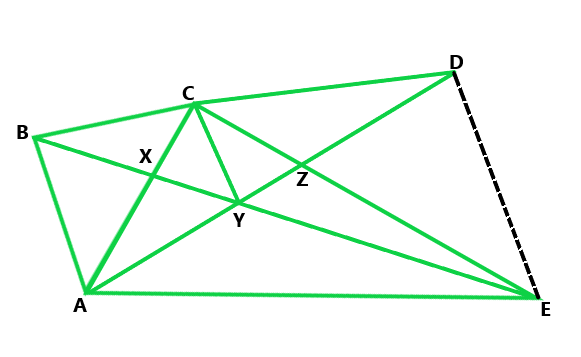
Solution :
According to the question
CD || AE and CY || BA
(i) Here, triangle BCA and triangle BYA are on the same base BA and
between same parallel lines BA and CY.
So, ar(ΔBCA) = ar(ΔBYA) ....(i)
Now as we know that ar(ΔBCA) = ar(ΔCBX) + ar(ΔBXA)
ar(ΔBYA) = ar(ΔBXA) + ar(ΔAXY)
So, put all these values in eq(i), we get
ar(ΔCBX) + ar(ΔBXA) = ar(ΔBXA) + ar(ΔAXY)
So, ar(ΔCBX) = ar(ΔAXY)
(ii) Here, triangles ACE and ADE are on the same base AE and
between same parallels CD and AE
So, ar(ΔACE) = ar(ΔADE) .....(ii)
Now as we know that ar(ΔACE) = ar(ΔCZA) + ar(ΔAZE)
and ar(ΔADE) = ar(ΔAZE) + ar(ΔDZE)
So, put all these values in eq(ii), we get
ar(ΔCZA) + ar(ΔAZE) = ar(ΔAZE) + ar(ΔDZE)
ar(ΔCZA) = ar(ΔDZE) ......(iii)
Hence proved
(iii) As we know that ar(ΔCBX) = ar(ΔAXY)
Now, add ar(ΔCYG) on both sides, we get
ar(ΔCBX) + ar(ΔCYZ) = ar(ΔCAY) + ar(ΔCYZ)
ar(BCZY) = ar(ΔCZA) ....(iv)
From eq(iii) and (iv), we conclude that
ar(BCZY) = ar(ΔDZE)
Hence proved