Class 9 RD Sharma Solutions Chapter 15 Areas of Parallelograms and Triangles Exercise 15.3 | Set 3 (original) (raw)
Last Updated : 19 Apr, 2021
Question 21. In figure, PSDA is a parallelogram in which PQ = QR = RS and AP || BQ || CR. Prove that ar (ΔPQE) = ar(ΔCFD).
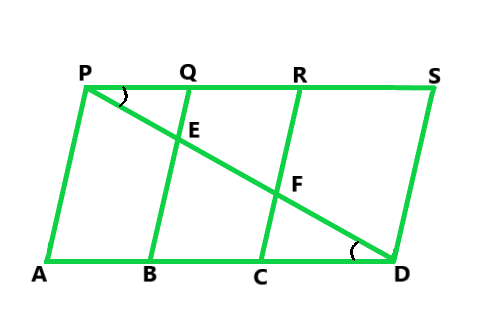
Solution:
According to the question
PSDA is a parallelogram
So, AP || BQ || CR || DS and AD || PS
PQ = CD .....(i)
Prove that (ΔPQE) = ar(ΔCFD)
Proof:
In ΔBED,
C is the midpoint of BD and CF || BE
So, F is the midpoint of ED
Hence, EF = PE
Similarly, EF = PE
Therefore, PE = FD .....(ii)
In ΔPQE and CFD,
PE = FD
∠ EPQ = ∠FDC (Alternate angles)
PQ = CD
So, by SAS congruence, we have
ΔPQE ≅ ΔDCF
Hence, ar(ΔPQE) = ar(ΔDCF)
Question 22. In figure, ABCD is a trapezium in which AB || DC and DC = 40 cm and AB = 60 cm. If X and Y are, respectively, the mid-points of AD and BC, prove that:
(i) XY = 50 cm
(ii) DCYX is a trapezium
(iii) ar(trap. DCYX) = (9/11) ar(XYBA).
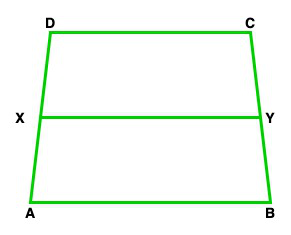
Solution:
(i) Join DY and produce it to meet AB produced at P.
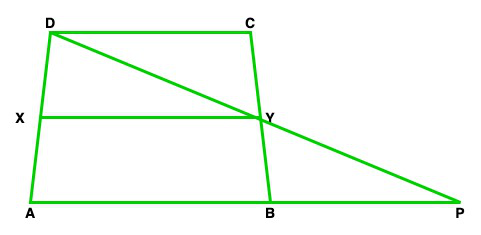
In ΔBYP and CYD
∠BYP = ∠ CYD (Vertically opposite angles)
∠DCY = ∠ PBY (As, DC || AP)
BY = CY
So, by ASA congruence,
ΔBYP ≅ ΔCYD
By C.P.C.T
DY = YP and DC = BP
As we know that, Y is the midpoint of DP
also, X is the midpoint of AD
So, XY || AP and XY || (1/2) AP
XY = (1/2) (AB + BP)
XY = (1/2) (AB + DC)
XY = (1/2) (60 + 40) =50 cm
(ii) Given that,
XY || AP
XY || AB and AB || DC
XY || DC
Hence, DCYX is a trapezium
(iii) As we know that X and Y are the mid-points of Ad and BC.
So, trapezium DCYX and ABYX are of the same height
Let us assume, the height of the trapezium is h cm
Now,
ar(trap. DCXY) = (1/2)(DC + XY) × h
ar(trap. DCXY) = (1/2) (50 + 40) × h cm2 = 45 h cm2
ar(trap. ABYX) = (1/2)(AB + XY) × h
ar(trap. ABYX) = (1/2)(60 + 50) × h cm2 = 55h cm2
ar(trap. DCYX) ar(trap. ABYX) = 45h/55h = 9/11
Hence, ar(trap. DCYX) = 9/11 ar(trap. ABYX)
Question 23. In figure, ABC and BDE are two equilateral triangles such that D is the midpoint of BC. AE intersects BC in F. Prove that:
(i) ar(ΔBDE) = (1/4) ar(ΔABC)
(ii) ar(ΔBDE) = (1/2) ar(ΔBAE)
(iii) ar(ΔBFE) = ar(ΔAFD)
(iv) ar(ΔABC) = 2 ar(ΔBEC)
(v) ar(ΔFED) = 1/8 ar(ΔAFC)
(vi) ar(ΔBFE) = 2 ar(ΔEFD)
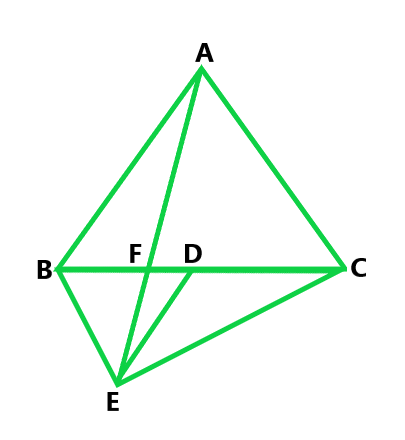
Solution:
According to the question
ABC and BDE are two equilateral triangles.
Let us considered AB = BC = CA = x. Then, BD = x/2 = DE = BE
(i) Given that,
ar(ΔABC) = √3/4 x2 ....(i)
ar(ΔBDE) = √3/4 (x/2)2 = 1/4 x √3/4 x2
Now put the value of √3/4 x2 from eq(i), we get
Hence, ar(ΔBDE) = 1/4 ar(ΔABC)
Hence proved
(ii) Given that,
ΔABC and BED are equilateral triangles
So, ∠ ACB = ∠DBE = 60°
BE || AC (Alternative angles are equal)
As we know that ΔBAF and ΔBEC are on the same base BE
and between same parallels BF and AC.
So, ar(ΔBAE) = ar(ΔBEC)
ED is a median of ΔEBC
So, ar(ΔBAE) = 2ar(ΔBDE)
Hence, ar(ΔBDE) = (1/2) ar(ΔBAE)
(iii) Given that,
ΔABC and BDE are equilateral triangles
So, ∠ABC = 60° and ∠BDE = 60°
∠ABC = ∠BDE
AB || DE (Alternate angles are equal)
As we know that ΔBED and ΔAED are on the same base ED and
between same parallels AB and DE.
So, ar(ΔBED) = ar(ΔAED)
ar(ΔBED) − ar(ΔEFD) = ar(ΔAED) − ar(ΔEFD)
Hence, ar(ΔBEF) = ar(ΔAFD)
(iv) Given that,
ED is the median of tΔBEC
So, ar(ΔBEC) = 2ar(ΔBDE)
ar(ΔBEC) = 2 × (1/2) ar(ΔABC) (Proved above)
ar(ΔBEC) = (1/2) ar(ΔABC)
Hence, ar(ΔABC) = 2ar(ΔBEC)
(v) ar(ΔAFC) = ar(ΔAFD) + ar(ΔADC)
ar(ΔBFE) + (1/2) ar(ΔABC)
ar(ΔBFE) + (1/2) × 4ar(ΔBDE)
ar(ΔBFE) = 2ar(ΔFED) .....(iii)
ar(ΔBDE) = ar(ΔBFE) + ar(ΔFED)
2ar(ΔFED) + ar(ΔFED)
3ar(ΔFED) ....(iv)
From eq (ii), (iii) and (iv), we get
ar(ΔAFC) = 2ar(ΔFED) + 2 × 3 ar(ΔFED) = 8 ar(ΔFED)
Hence, ar(ΔFED) = (1/8) ar(ΔAFC)
(vi) Let's assume that h be the height of vertex E, corresponding to the side BD in ΔBDE and
H be the height of vertex A, corresponding to the side BC in ΔABC
As we proved above
ar(ΔBDE) = (1/4) ar(ΔABC)
(1/2) × BD × h = (1/4) (1/2 × BC × h)
BD × h = (1/4)(2BD × H)
h = (1/2) H ....(i)
From part (iii), we get
ar(ΔBFE) = ar(ΔAFD)
ar(ΔBFE) = (1/2) × FD × H
ar(ΔBFE) = (1/2) × FD × 2h
ar(ΔBFE) = 2((1/2) × FD × h)
Hence, ar(ΔBFE) = 2ar(ΔEFD)
Question 24. D is the midpoint of side BC of ΔABC and E is the midpoint of BD. If O is the midpoint of AE, Prove that ar(ΔBOE) = (1/8) ar(ΔABC).
Solution:
According to the question
D is the midpoint of sides BC of Δ ABC,
E is the midpoint of BD and O is the midpoint of AE,
So, AD and AE are the medians of ΔABC and ΔABD
Hence, ar(ΔABD) = (1/2) ar(ΔABC) .....(i)
and ar(ΔABE) = (1/2) ar(ΔABD) .......(ii)
Also, OB is the median of triangle ABE
So, ar(ΔBOE) = (1/2) ar(ΔABE)
From eq (i), (ii) and (iii), we conclude that
ar(ΔBOE) = (1/8) ar(ΔABC)
Hence proved
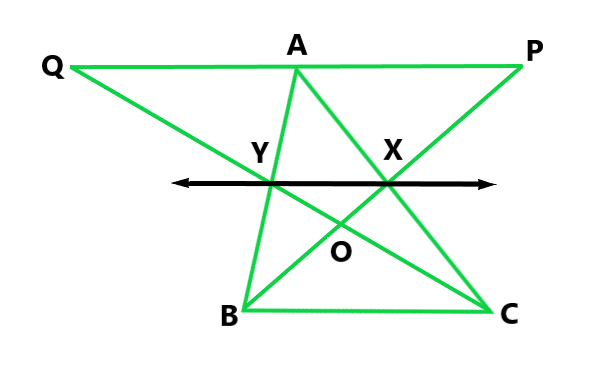
Question 25. In figure, X and Y are the mid points of AC and AB respectively, QP || BC and CYQ and BXP are straight lines. Prove that ar(ΔABP) = ar(ΔACQ).
Solution:
According to the question
X and Y are the mid-points of AC and AB
So, XY || BC
Prove: ar(ΔABP) = ar(ΔACQ)
Proof:
From the figure, we conclude that ΔBYC and BXC are on the same base BC and
between the same parallels XY and BC
So, ar(ΔBYC) = ar(ΔBXC)
ar(ΔBYC) − ar(ΔBOC) = ar(ΔBXC) − ar(ΔBOC)
ar(ΔBOY) = ar(ΔCOX)
ar(ΔBOY) + ar(ΔXOY) = ar(ΔCOX) + ar(ΔXOY)
ar(ΔBXY) = ar(ΔCXY) .....(i)
From the figure we conclude that the quadrilaterals XYAP and XYAQ are on
the same base XY and between same parallels XY and PQ.
So, ar(quad. XYAP) = ar(quad XYQA) ....(ii)
Now, add eq(i) and (ii), we get
ar(ΔBXY) + ar(quad. XYAP) = ar(ΔCXY) + ar(quad XYQA)
ar(ΔABP) = ar(ΔACQ)
Hence proved
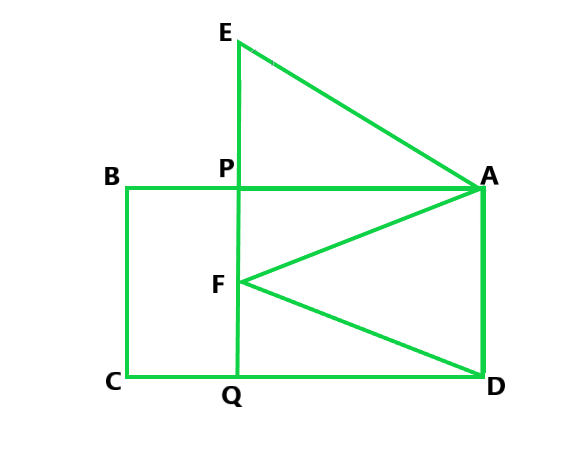
Question 26. In figure, ABCD and AEFD are two parallelograms. Prove that
(i) PE = FQ
(ii) ar(ΔAPE) : ar(ΔPFA) = ar(ΔQFD) : ar(ΔPFD)
(iii) ar(ΔPEA) = ar(ΔQFD)
Solution:
According to the question
ABCD and AEFD are two parallelograms
(i) Prove that PE = FQ
Proof:
In ΔEPA and FQD
∠PEA = ∠QFD (Corresponding angles)
∠EPA=∠FQD (Corresponding angles)
PA = QD (Opposite sides of parallelogram)
So, by AAS congruence
ΔEPA ≅ ΔFQD
Hence, by C.P.C.T
EP = FQ
Hence proved
(ii) Prove that ar(ΔAPE) : ar(ΔPFA) = ar(ΔQFD) : ar(ΔPFD)
From the figure we conclude that ΔPEA and ΔQFD stand on equal bases
PE and FQ lies between the same parallels EQ and AD
So, ar(ΔPEA) = ar(ΔQFD) ......(i)
From the figure we conclude that ΔPEA and ΔPFD stand on the same
base PF and between same parallels PF and AD
Therefore, ar(ΔPFA) = ar(ΔPFD) ......(ii)
Now divide eq(i) by eq(ii), we get
Hence, ar(ΔPEA) : ar(ΔPFA) = ar(ΔQFD) : ar(ΔPFD)
Hence proved
(iii) Prove that ar(ΔPEA) = ar(ΔQFD)
Proof:
As we proved above that
ΔEPA ≅ ΔFQD
Hence, ar(ΔPEA) = ar(ΔQFD)
Hence proved
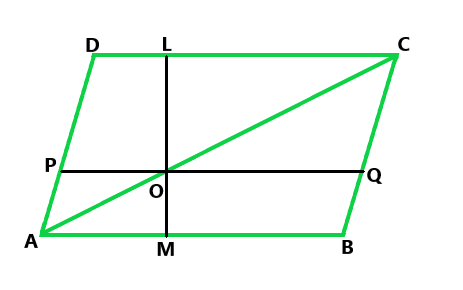
Question 27. In figure, ABCD is a parallelogram. O is any point on AC. PQ || AB and LM || AD. Prove that: ar(||gm DLOP) = ar(||gm BMOQ).
Solution:
According to the question
ABCD is a parallelogram and PQ || AB and LM || AD
Prove that ar(||gm DLOP) = ar(||gm BMOQ)
Proof:
Here, the diagonal AC of a parallelogram divides it into two triangles of equal area
So, ar(ΔADC) = ar(ΔABC)
ar(ΔAPO) + ar(||gm DLOP) + ar(ΔOLC)
ar(ΔAOM) + ar(||gm BMOQ) + ar(ΔOQC) ......(i)
From the figure, AO and OC are diagonals of parallelograms AMOP and OQCL
So, ar(ΔAPO) = ar(ΔAMO) ......(ii)
And ar(ΔOLC) = ar(ΔOQC) ......(iii)
Now subtracting eq(ii) and (iii) from (i), we get
ar(||gm DLOP) = ar(||gm BMOQ)
Hence proved
Question 28. In a triangle ABC, if L and M are points on AB and AC respectively such that LM || BC. Prove that:
(i) ar(ΔLCM) = ar(ΔLBM)
(ii) ar(ΔLBC) = ar(ΔMBC)
(iii) ar(ΔABM) = ar(ΔACL)
(iv) ar(ΔLOB) = ar(ΔMOC)
Solution:
According to the question
ABC is a triangle and L and M are points on AB and AC respectively such that LM || BC
(i) Here, Δ LMB and LMC are on the same base LM and between the same parallels LM and BC.
Hence, ar(ΔLMB) = ar(ΔLMC)
(ii) Here**,** ΔLBC and MBC are on the same base BC and between same parallels LM and BC.
Hence, ar(ΔLBC) = ar(ΔMBC)
(iii) Here, we have
ar(ΔLMB) = ar(ΔLMC) (Proved above)
ar(ΔALM) + ar(ΔLMB) = ar(ΔALM) + ar(ΔLMC)
Hence, ar(ΔABM) = ar(ΔACL)
(iv) Here, we have
ar(ΔLBC) = ar(ΔMBC) (Proved above)
ar(ΔLBC) − ar(ΔBOC) = ar(ΔMBC) − ar(ΔBOC)
Hence, ar(ΔLOB) = ar(ΔMOC).
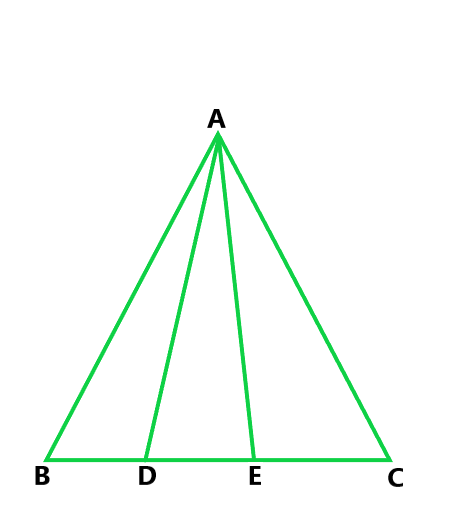
Question 29. In figure, D and E are two points on BC such that BD = DE = EC. Show that ar(ΔABD) = ar(ΔADE) = ar(ΔAEC).
Solution:
In the triangle ABC, draw a line || through A parallel to BC.
BD = DE = EC (Given)
Now from the figure, triangles ABD and AEC are on the same base AC and
between the same parallels l and BC. Hence, the area of triangles ABD and AEC is equal.
Hence, ar(ΔABD) = ar(ΔADE) = ar(ΔAEC).
Question 30. In figure, ABC is a right angled triangle at A, BCED, ACFG and ABMN are squares on the sides BC, CA, and AB respectively. Line segment AX ⊥ DE meets BC at Y. Show that
(i) ΔMBC ≅ ΔABD
(ii) ar(BYXD) = 2ar(ΔMBC)
(iii) ar(BYXD) = ar(ABMN)
(iv) ΔFCB ≅ ΔACE
(v) ar(CYXE) = 2ar(ΔFCB)
(vi) ar(CYXE) = ar(ACFG)
(vii) ar(BCED) = ar(ABMN) + ar(ACFG)
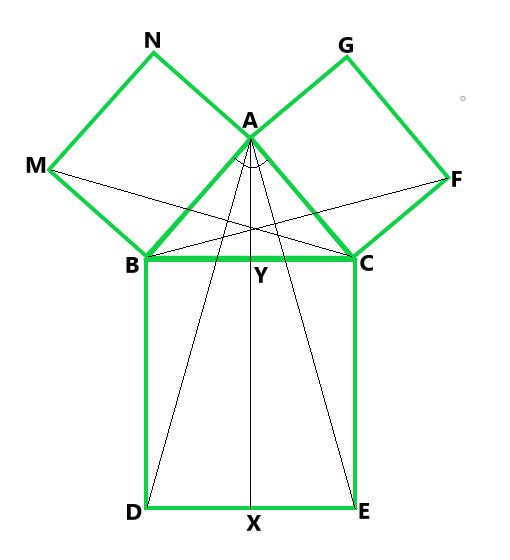
Solution:
According to the question
ABC is a right-angled triangle at A, BCED, ACFG, and ABMN are squares on the sides BC, CA, and AB
(i) In ΔMBC and ΔABD,
MB = AB,
BC = BD,
∠MBC = ∠ABD
So, by SAS congruence, we have
ΔMBC ≅ ΔABD
Hence, ar(ΔMBC) = ar(ΔABD)
(ii) From the figure, triangle ABC and rectangle BYXD are on the same base BD
and between the same parallels AX and BD.
So, ar(ΔABD) = (1/2) ar(rect BYXD)
ar(rect BYXD) = 2ar(ΔABD)
From part (i)
Hence, ar(rect BYXD) = 2ar(ΔMBC) ......(i)
(iii) From the figure, triangles MBC and square MBAN are on the same base MB and
between the same parallels MB and NC.
So, 2ar(ΔMBC) = ar(MBAN) ......(ii)
From eq(i) and (ii), we get
Hence, ar(sq. MBAN) = ar(rect BYXD)
(iv) In ΔFCB and ACE,
FC = AC
CB = CE
∠FCB = ∠ACE
So, by SAS congruence,
Hence, ΔFCB ≅ ΔACE
(v) As we proved above
ΔFCB ≅ ΔACE
So, ar(ΔFCB) = ar(ΔACE)
From the figure, triangle ACE and rectangle CYXE are on the same base CE
and between same parallels CE and AX.
So, 2ar(ΔACE) = ar(CYXE)
Hence, 2ar(ΔFCB) = ar(ΔCYXE) .....(iii)
(vi) From the figure, triangle FCb and rectangle FCAG are on the same base FC
and between the same parallels FC and BG.
So, 2ar(ΔFCB) = ar(FCAG) ......(iv)
From eq(iii) and (iv), we get
ar(CYXE) = ar(ACFG)
(vii) In ΔACB, we have
Using Pythagoras theorem
BC2 = AB2 + AC2
BC × BD = AB × MB + AC × FC
Hence, ar(BCED) = ar(ABMN) + ar(ACFG)