Class 9 RD Sharma Solutions Chapter 16 Circles Exercise 16.4 (original) (raw)
Last Updated : 23 Jul, 2025
In Class 9 RD Sharma, Chapter 16 focuses on the properties and theorems related to the circles. Exercise 16.4 of this chapter deals with the practical problems and applications involving the circles including the tangents, secants and angles.
What is a Circle?
A circle is a fundamental geometric shape defined as the set of the all points in the plane that are equidistant from the fixed point called the center. This fixed distance is known as the radius. The properties of a circle are essential for the understanding various geometrical concepts including the angles, arcs and chords. Key terms associated with the circles include the circumference the diameter and the sector.
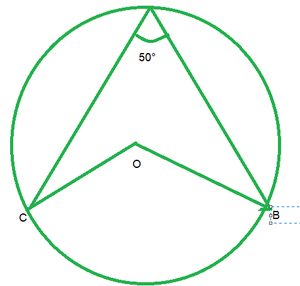
Question 1. In Fig., O is the centre of the circle. If ∠APB∠APB= 50°, find ∠AOB and ∠OAB.
**Solution:
∠APB=50°
By degree measure theorem
∠AOB=2APB
∠APB=2*50°=100°
since OA=OB [Radius of circle]
Then ∠OAB=∠OBA [Angles opposite to equal sides]
Let ∠OAB=x
In △OAb, by angle sum property
∠OAB+∠OBA+∠AOB=180°
x+x+100°=180°
2x=180°-100°
2x=80°
x=40°
∠OAB=∠OBA=40°
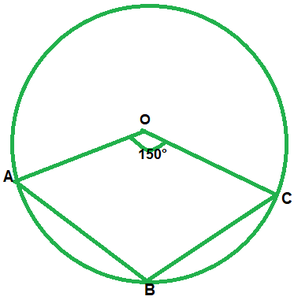
Question 2. In Fig., it is given that O is the centre of the circle and ∠AOC = 150°. Find ∠ABC.
**Solution:
∠AOC = 150°
∠AOC +reflex ∠AOC = 360° [complex angle]
150°+reflex ∠AOC = 360°
reflex ∠AOC=210°
2∠ABC=210° [By degree measure theorem]
∠ABC=210°/2=105°
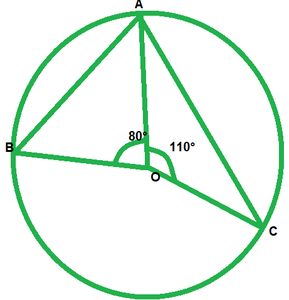
Question 3. In Fig., O is the centre of the circle. Find ∠BAC.
**Solution:
We have ∠AOB=80°
And ∠AOC=110°
Therefore, ∠AOB+∠AOC+∠BOC=360° [complete angle]
80+100+∠BOC=360°
∠BOC=360°-80°-110°
∠BOC=70°
By degree measure theorem
∠BOC=2∠BAC
170=2∠BAC
∠BAC=170°/2=85°
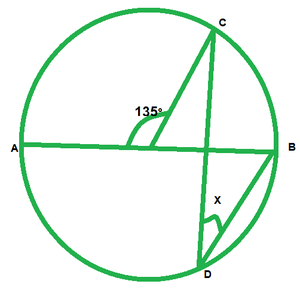
Question 4. If O is the centre of the circle, find the value of x in each of the following figures.
**Solution:
**i)
∠AOC=135°
∠AOC+BOC=185° [Linear pair of angles]
135°+∠BOC=180°
∠BOC=180°-135°=45°
By degree measure theorem
∠BOC=2∠COB
45=2x
x=45°/2=22\frac{1}{2}
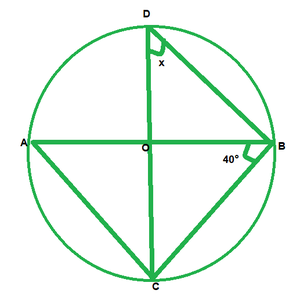
**ii)
We have
∠ABC=40°
∠ACB=90° [Angle in semicircle]
In △ABC, by angle sum property
∠CAB+∠ACB+∠ABC=180°
∠CAB+90°+40°=180°
∠CAB=180°-90°-40°
∠CAB=50°
Now,
∠CDB=∠CAB [Angle is same in segment]
x=50°
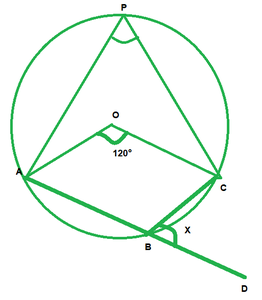
**iii)
We have,
∠AOC=120°
By degree measure theorem
∠AOC=2∠APC
120°=2∠APC
∠APC=120°/2=60
∠APC+∠ABC=180° [Opposite angles of cyclic quadrilaterals]
60°+∠ABC=180°
∠ABC=180°-60°
∠ABC=120°
∠ABC+∠DBC=180° [Linear pair of angles]
120°+x=180°
x=180°-120°=60°
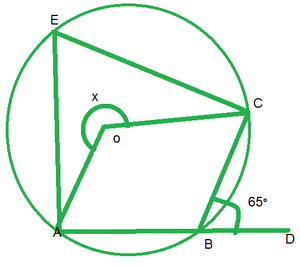
**iv)
We have
∠CBD=65°
∠ABC+∠CBD=180° [Linear pair of angles]
∠ABC=65°=180°
∠ABC=180°-65°=115°
reflex ∠AOC=2∠ABC [By degree measure theorem]
x=2*115°
x=230°
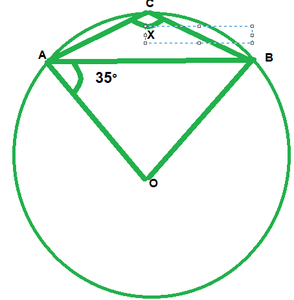
**v)
We have,
∠OAB=35°
Then, ∠OBA=∠OAB=35° [Angles opposite to equal radii]
In △AOB, by angle sum property
∠AOB+∠OAB+∠OBA=180°
∠AOB+35°+35°=180°
∠AOB=180°-35°=110°
∠AOB+reflex ∠AOB=360° [complex angle]
110+reflex∠AOB=360°
reflex∠AOB=360°-110°=250°
By degree measure theorem reflex∠AOB=2∠ACB
250°=2x
x=250°/2=125°
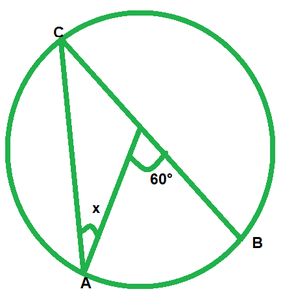
**vi)
We have,
∠AOB=60
By degree measure theorem reflex
∠AOB=2∠ACB
60=2∠ACB
∠ACB=60°/2=30° [Angle opposite to equal radii]
x=30°
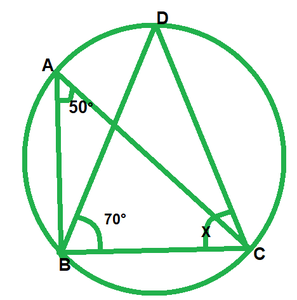
**vii)
We have,
∠BAC=50° and ∠DBC=70°
∠BDC=∠BAC=50° [Angle in same segment]
In △BDC, by angle sum property
∠BDC+∠BCD+∠DBC=180°
50°+x+70°=180°
x=180°-50°-70°=60°
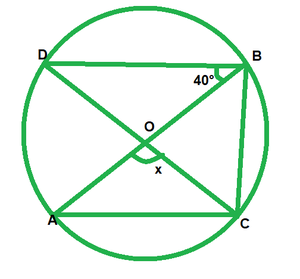
**viii)
We have,
∠DBO=40° and ∠DBC=90° -------[Angle in a semi circle]
∠DBO+∠OBC=90°
40°+∠OBC=90°
∠OBC=90°-40°=50°
By degree measure theorem
∠AOC=∠OBC
x=2*50°=100°
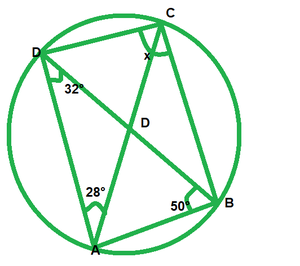
**ix)
In ∆DAB, by angle sum property
∠ADB+∠DAB+∠ABD=180°
32°+∠DAB+50°=180°
∠DAB=180°-32°-50°
∠DAB=98°
Now,
∠OAB+∠DCB=180° [opposite angle of cyclic quadrilateral]
98°+x=180°
x=180°-98°=82°
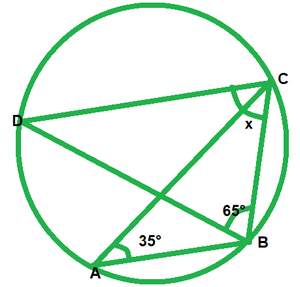
**x)
We have,
∠BAC=35°
∠BDC=∠BAC=35° [Angle in same segment]
In ∆BCD, by angle sum property
∠BDC+∠BCD+∠DBC=180°
35°+x+65°=180°
x=180°-35°-65°=80°
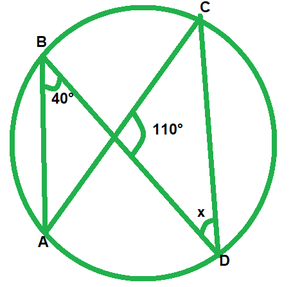
**xi)
We have,
∠ABD=40°
∠ACD=∠ABD=40° [Angle in same segment]
In ∆PCD, by angle sum property
∠PCD+∠CPO+∠PDC=180°
40°+110°+x=180°
x=180°-150°
x=30°
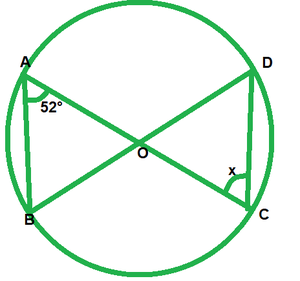
**xii)
Given that,
∠BAC=52°
Then ∠BDC=∠BAC=52° [Angle in same segment]
Since OD=OC
Then ∠ODC=∠OCD [ Opposite angle to equal radii]
x=52°
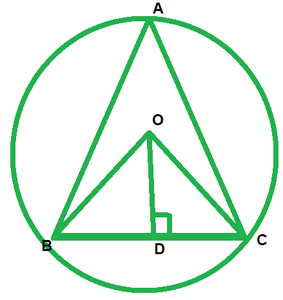
Question 5. O is the circumcenter of the triangle ABC and OD is perpendicular on BC. Prove that ∠BOD = ∠A.
**Solution:
We have to prove that ∠BOD=∠A
since, circum center is the intersection of perpendicular bisector of each side of the triangle. Now according to figure A,B,C are the vertices of ∆ABC
In ∆BOC, OD is perpendicular bisector of BC.
so, BD=CD
OB=OC --------(Radius of the same circle)
And,
OD=OD -----[common]
Therefore,
∆BDO≅∆CDO (SSS concurrency criterion )
∠BOD=∠COD (by cpct)
We know that angle formed any chord of the circle at the center is twice of the angle formed at the circumference by same chord
Therefore,
∠BAC=\frac{1}{2} ∠BOC
∠BAC=\frac{1}{2}*2∠BOD
∠BAC=∠BOD
Therefore,
∠BOD=∠A
Question 6. In Fig., O is the centre of the circle, BO is the bisector of ∠ABC. Show that AB = AC.
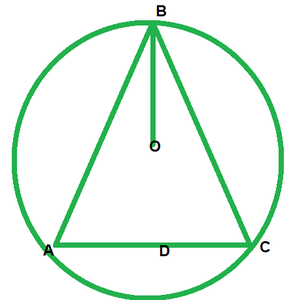
**Solution:
Given, BO is the bisector of ∠ABC
To prove: AB=BC
Proof: Since, BO is the bisector of ∠ABC.
Then, ∠ABO=∠CBO ----(i)
Since, OB=OA [Radius of circle]
Then, ∠ABO=∠DAB --------(ii) [opposite angles to equal sides]
Since OB=OC [Radius of circle]
Then, ∠OAB=∠OCB --------(iii) [opposite angles to equal sides]
compare equations (i), (ii) and (iii)
∠OAB=∠OCB -------(iv)
In ∆OAB and ∆OCB
∠OAB=∠OCB [From(iv)]
∠OBA=∠OBC [Given]
OB=OB [common]
Then
∆OAB≅∆OCB [By AAS condition]
Therefore, AB=BC [CPCT]
Question 7. In Fig., O is the centre of the circle, prove that ∠x = ∠y + ∠z.
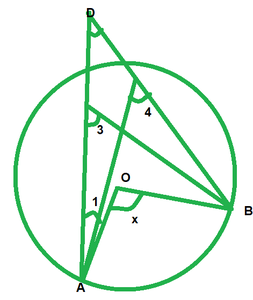
**Solution:
We have,
∠3=∠4 [Angles in same segment]
∠x=2∠3 [By degree measure theorem]
∠x=∠3+∠3⇒∠x=∠3+∠4 --------(i) [∠3=angle 4]
But ∠y=∠3+∠1 [By exterior angle property]
⇒∠3=∠y-∠1 ----(ii)
from (i) and (ii)
∠x=∠y-∠1+∠4
∠x=∠y+∠4-∠1
∠x=∠y+∠z+∠1-∠1 [By exterior angle property]
∠x=∠y+∠z
Question 8. In Fig., O and O' are centres of two circles intersecting at B and C. ACD is a straight line, find x.

**Solution:
By degree measure theorem
∠AOB=2∠ACB
130°=2∠ACB⇒∠ACB=130°/2=65
∠ACB+∠BCD=180° [Linear pair of angles]
65°+∠BCD=180°
∠BCD=180-65=115
By degree measure theorem
reflex∠BOD=2∠BCD
reflex∠BOD=2*115°=230°
Now, reflex∠BOD+∠BOD=360° [complex angle]
230°+x=360°
x=360°-230°
x=130°
Question 9. In Fig., O is the centre of a circle and PQ is a diameter. If ∠ROS = 40°, find ∠RTS.
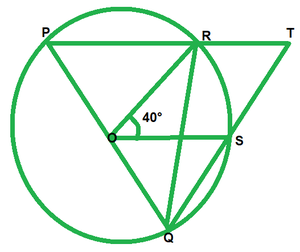
**Solution:
Since PQ is diameter
Then,
∠PRQ=90° [Angle in semi circle]
∠PRQ+∠TRQ=180° [Linear pair of angle]
90+∠TRQ=180
∠TRQ=180°-90°=90°
By degree measure theorem
∠ROS=2∠RQS
40=2∠RQS
∠RQS=40°/2=20°
In ∆RQT, by angle sum property
∠RQT+∠QRT+∠RTS=180°
20°+90°+∠RTS=180°
Question 10. In Fig., if ∠ACB = 40°, ∠DPB = 120°, find ∠CBD.
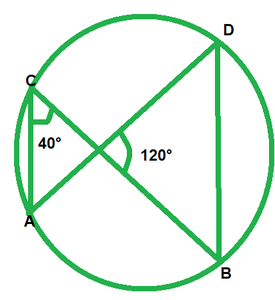
**Solution:
We have,
∠ACB=40°; ∠DPB=120°
∠APB=∠DCB=40° [Angle in same segment]
In ∆POB, by angle sum property
∠PDB+∠PBD+∠BPD=180°
40+∠PBD+120°=180°
∠PBD=180°-40°-120°
∠PBD=20°
∠CBD=20°
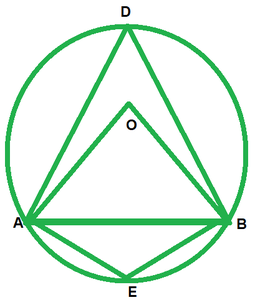
Question 11. A chord of a circle is equal to the radius of the circle. Find the angle subtended by the chord at a point on the minor arc and also at a point on the major arc.
**Solution:
Construction: O is center and r is radius and given that chord is equal to radius of circle.
Now in ∆AOB we have
AO=OB=BA (It is given that chord is equal to radius of circle)
so, ∆AOB is an equilateral triangle
∠AOB=60°
So, ∠AOB=2∠ADB (The angle subtended by an arc of a circle at the center is double the angle subtended by it at any point on the remaining part of the circle)
Then ∠ADB=30°
So,
∠AEB=\frac{1}{2}(Reflex∠AOB)\\ =\frac{1}{2}(360°-60°)\\ =150°
Therefore,
∠ADB=30° and ∠AEB=150°
**Read More :