Class 9 RD Sharma Solutions Chapter 17 Constructions Exercise 17.3 (original) (raw)
Last Updated : 23 Jul, 2025
In Class 9 Mathematics, Chapter 17 focuses on Constructions an essential aspect of geometry that involves drawing geometric figures using only a compass and a straightedge. This chapter introduces students to the various types of constructions such as the constructing angles perpendicular lines and bisectors. Exercise 17.3 of this chapter specifically deals with the practical problems related to geometric constructions which help in honing the skills necessary for the accurate and precise drawing of geometrical figures.
Constructions
Constructions in geometry refer to the method of creating geometric figures based on specific conditions using a compass and a straightedge. This chapter covers fundamental constructions such as:
- Constructing Angles: The Drawing angles of specific measures using the compass and a straightedge.
- Perpendicular Lines: The Constructing lines that intersect at a right angle.
- Bisectors: The Drawing lines that divide angles or segments into two equal parts.
- Triangles and Quadrilaterals: Constructing triangles and quadrilaterals based on the given conditions such as the side lengths and angles.
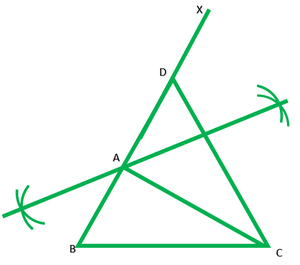
Question 1. Construct a Δ ABC in which BC = 3.6 cm, AB + AC = 4.8 cm, and ∠B = 60°.
**Solution:
Steps of Construction:
1. Draw a line segment BC = 8.6cm.
2. Draw ∠B = 60°.
3. Now, with centre B and radius = 4.8cm, draw an arc that intersects line XB at point D.
4. Join DC.
5. Now, draw a perpendicular of DC that intersects DB at point A.
6. Join AC.
So, Δ ABC is the triangle.
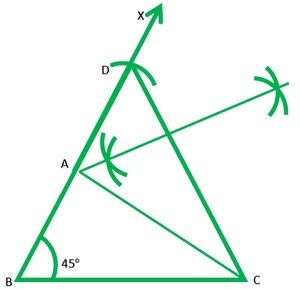
Question 2. Construct a Δ ABC in which AB + AC = 5.6 cm, BC = 4.5 cm and ∠B = 45°.
**Solution:
Steps of Construction:
1. Draw a line segment BC = 4.5cm.
2. Draw ∠B = 45°.
3. Now, with centre B and radius = 5.6cm, draw an arc that intersect line BC at point O.
4. Join DC.
5. Now, draw the perpendicular bisector of DC that intersect line BC at point A.
6.Join AC.
So, Δ ABC is the triangle.
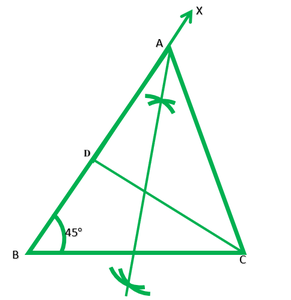
Question 3. Construct a Δ ABC in which BC = 3.4 cm, AB − AC = 1.5 cm and ∠B = 45°.
**Solution:
Steps of Construction:
1. Draw a line segment BC = 3.4cm.
2. Draw ∠B = 45°.
3. Now, with centre B and radius = 1.5cm, draw an arc that intersect line BX at point D.
4. Join DC.
5. Now, draw a perpendicular bisector of DC that intersects line BX at point A.
6. Join AC.
So, Δ ABC is the triangle.
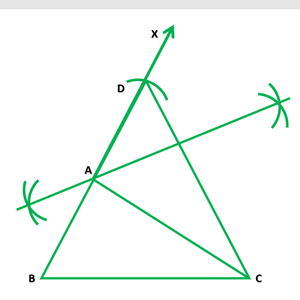
Question 4. Using ruler and compasses only, construct a ΔABC, given base BC = 7 cm, ∠ABC = 60° and AB + AC = 12 cm.
**Solution:
Steps of Construction:
1. Draw a line segment BC = 7cm.
2. Draw ∠B = 60°
3. Now, with centre B and radius = 12cm, draw an arc that intersects line BX at point D.
4. Join DC.
5. Now, draw the perpendicular bisector of DC that intersects line BD at point A.
6. Join AC.
So, Δ ABC is the triangle.
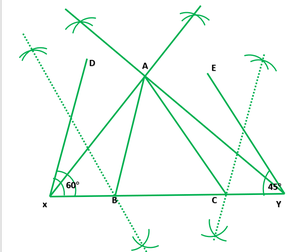
Question 5. Construct a triangle whose perimeter is 6.4 cm, and angles at the base are 60° and 45°.
**Solution:
Steps of Construction:
1. Draw a line segment XY = 6.4cm.
2. Draw the angle bisectors of∠EYY = 45°
3. Now, draw the angle bisector of∠BXY and ∠EYX that intersect each other at point A.
4. Draw the perpendicular bisector of lines AX and AY that intersect line XY at points B and C.
5. Join AB and AC.
So, Δ ABC is the triangle.
Question 6. Using ruler and compasses only, construct a Δ ABC from the following data:
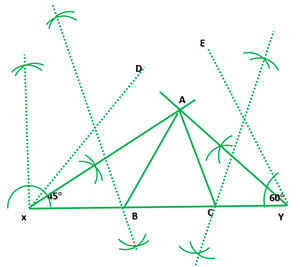
AB + BC + CA = 12 cm, ∠B = 45° and ∠C = 60°.
**Solution:
Steps of Construction:
1. Draw a line segment XY = 12cm.
2. Draw∠X = ∠B = 45° and ∠Y = ∠C = 60°
3. Now, draw the angle bisectors of angles of DXY and EYX that intersects each other at point A.
4. Draw the perpendicular bisector of AX and AY that intersect line XY at points B and C.
5. Join AB and AC.
So, Δ ABC is the triangle.
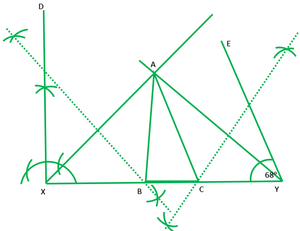
Question 7. Construct a right-angled triangle whose perimeter is equal to 10 cm and one acute angle equal to 60°.
**Solution:
Steps of Construction:
1. Draw a line segment XY = 10cm.
2. Draw ∠X = ∠B = 90 and ∠Y = ∠C = 60
3. Now, draw the angle bisector of ∠DXY and ∠EXY that intersect each other at point A.
4. Draw the perpendicular bisectors of AX and AY which intersects line XY at points B and C.
5. Join AB and AC.
So, Δ ABC is the triangle.
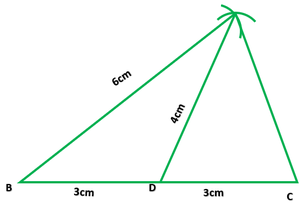
Question 8. Construct a triangle ABC such that BC = 6 cm, AB = 6 cm and median AD = 4 cm.
**Solution:
Steps of Construction:
1. Draw a line segment BC = 6 cm
2. Now, take mid-point D of line BC.
3. With centre B and D and radius 6cm and 4cm, draw two arcs that intersects each other at point A.
4. Now, join AB, AD, and AC.
So, Δ ABC is the triangle.
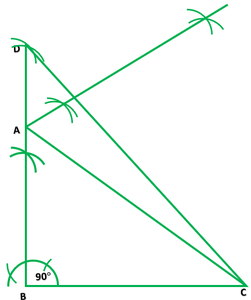
Question 9. Construct a right triangle ABC whose base BC is 6 cm and the sum of hypotenuse AC and other side AB is 10 cm.
**Solution:
Steps of Construction:
1. Draw a line segment BC = 6cm.
2. Now, at point B draw and angle of 90°
3. Now, with centre B and radius = 10cm, draw an arc that intersect line XB at point D.
4. Join DC.
5. Draw the perpendicular bisector of DC that intersects line DB at point A.
6. Join AC.
So, Δ ABC is the triangle.
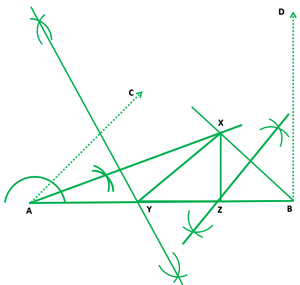
Question 10. Construct a triangle XYZ in which ∠Y = 30°, ∠Z = 90° and XY + YZ + ZX = 11.
**Solution:
Steps of Construction:
1. Draw a line segment AB = 11cm.
2. Draw ∠A =∠Y = 30 and ∠B = ∠Z = 90
3. Now, draw the angle bisectors of ∠DAB and ∠EBA that intersect each other at point X.
4. Draw the perpendicular bisectors of XA and XB that intersect line AB at points Y and Z.
5. Join XY and XZ.
So, Δ XYZ is the triangle.
Read more :
Conclusion
Chapter 17 of RD Sharma's Class 9 Mathematics book is crucial for the developing a strong foundation in the geometric constructions. Exercise 17.3 reinforces the skills necessary for the accurate constructions which are essential for the solving more complex geometric problems. Mastery of these techniques not only helps in the academic assessments but also in the practical applications of the geometry in real life.