Class 9 RD Sharma Solutions Chapter 8 Introduction to Lines and Angles Exercise 8.2 | Set 1 (original) (raw)
Last Updated : 4 Sep, 2024
Chapter 8 of RD Sharma's Class 9 Mathematics textbook focuses on the "Introduction to Lines and Angles". This chapter introduces fundamental concepts of the geometry including the lines, angles and their properties. Exercise 8.2 | Set 1 presents a series of problems designed to deepen the understanding of these concepts by the applying them to the various geometric scenarios. This exercise is crucial for building a solid foundation in geometry that will be essential for the more advanced mathematical studies.
Introduction to Lines and Angles
The Lines and angles are foundational elements in geometry that describe the relationships between the different geometric shapes. A line is a straight one-dimensional figure extending infinitely in both the directions while an angle is formed when two lines meet at a point. Understanding these concepts involves recognizing the different types of angles and lines as well as learning how to calculate and apply their properties in the geometric problems.
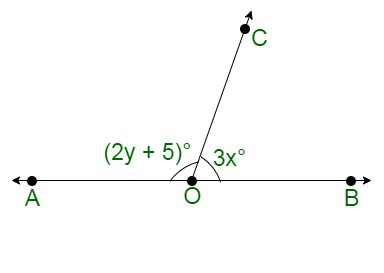
**Question 1: In the below Fig. OA and OB are opposite rays:
****(i) If x = 25°, what is the value of y?**
****(ii) If y = 35°, what is the value of x?**
**Solution:
****(i)** Given:
x = 25
In the figure;
∠AOC and ∠BOC are forming a linear pair
So, ∠AOC + ∠BOC = 180°
In the figure;
∠AOC = 2y + 5 and ∠BOC = 3x
∠AOC + ∠BOC = 180°
(2y + 5) + 3x = 180
(2y + 5) + 3 (25) = 180
2y + 5 + 75 = 180
2y + 80 = 180
2y = 100
y = \frac{100}{2} = 50
Hence,
y = 50°
****(ii)** Given:
y = 35°
In the figure;
∠AOC + ∠BOC = 180° {Linear pair angles}
(2y + 5) + 3x = 180
(2(35) + 5) + 3x = 180
75 + 3x = 180
3x = 105
x = 35
Therefore, x = 35°
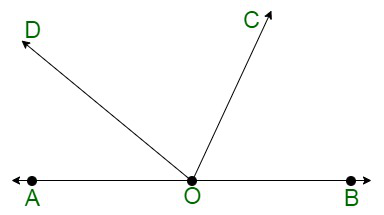
**Question 2. In the below figure, write all pairs of adjacent angles and all the linear pairs.
**Solution:
In the figure;
Pairs of adjacent angles are:
(∠AOC, ∠COB);
(∠AOD, ∠BOD);
(∠AOD, ∠COD);
(∠BOC, ∠COD)
∠AOD + ∠BOD = 180° {Linear pair}
and
∠AOC+ ∠BOC = 180° {Linear pair}
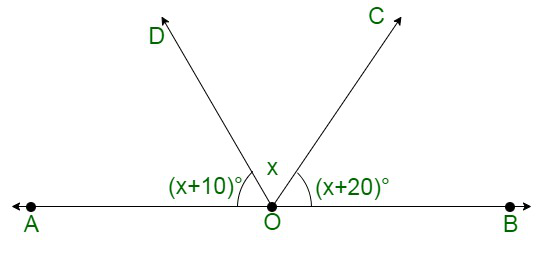
**Question 3. In the given figure, find x. Further find ∠BOC, ∠COD, and ∠AOD.
**Solution:
In the figure;
∠AOD and ∠BOD are forming linear pair,
Thus,
∠AOD+ ∠BOD = 180°
And,
∠AOD + ∠BOC + ∠COD = 180°
Given:
∠AOD = (x+10)°,
∠COD = x°
and
∠BOC = (x + 20)°
(x + 10) + x + (x + 20) = 180°
3x + 30 = 180°
3x = 180 – 30
x = \frac{150}{3}
x = 50°
Here,
∠AOD = (x+10) = 50 + 10 = 60
∠COD = x = 50°
∠BOC = (x+20) = 50 + 20 = 70°
Therefore,
∠AOD = 60°,
∠COD = 50°
and
∠BOC=70°
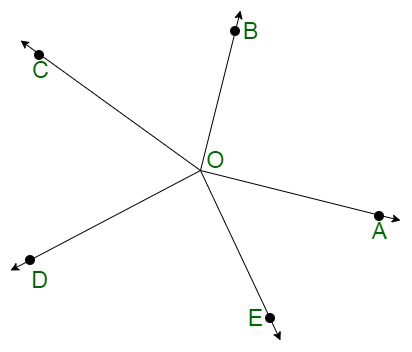
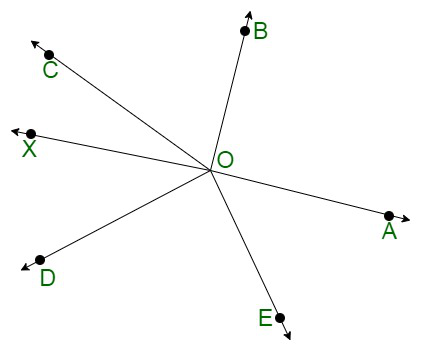
**Question 4. In figure, rays OA, OB, OC, OD, and OE have the common endpoint 0. Show that ∠AOB+∠BOC+∠COD+∠DOE+∠EOA=360°.
**Solution:
Given:
Rays OA, OB, OC, OD and OE have the common endpoint O.
Construct: Draw an opposite ray OX to ray OA, which make a straight line AX.
In the figure:
∠AOB + ∠BOX = 180° {Linear pair}
Or,
∠AOB + ∠BOC + ∠COX = 180° ..........(i)
Also,
∠AOE + ∠EOX = 180° {Linear pair}
Or,
∠AOE + ∠DOE + ∠DOX = 180° ...........(ii)
After adding equations, (i) and (ii), we will get;
∠AOB + ∠BOC + ∠COX + ∠AOE + ∠DOE + ∠DOX = 180° + 180°
∠AOB + ∠BOC + ∠COD + ∠DOE + ∠EOA = 360°
Hence, Proved.
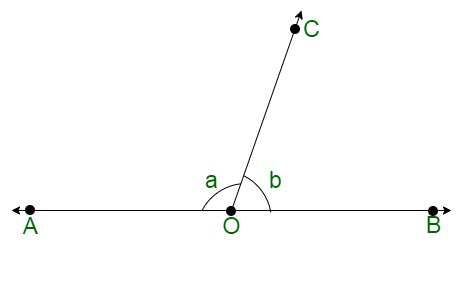
**Question 5. In figure, ∠AOC and ∠BOC form a linear pair. If a – 2b = 30°, find a and b?
**Solution:
Given:
∠AOC and ∠BOC are forming a linear pair.
a + b = 180°…....(i)
a – 2b = 30° …....(ii) {given}
After subtracting equation (ii) from (i), we will get
a + b – a + 2b = 180 – 30
3b = 150
b = \frac{150}{3}
b = 50°
Thus,
a – 2b = 30°
a – 2(50) = 30°
a = 30 + 100
a = 130°
Hence,
a = 130°
b = 50°
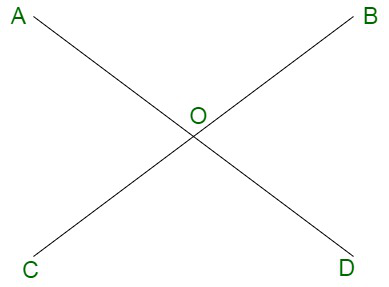
**Question 6. How many pairs of adjacent angles are formed when two lines intersect at a point?
**Solution:
Here, the four pairs of adjacent angles are formed when two lines intersect each other at a single point.
So here Let two lines AB and CD intersect at point O as shown below in the figure
Thus, the 4 pair of adjacent angles are :
(∠AOD, ∠DOB),
(∠DOB, ∠BOC),
(∠COA, ∠AOD)
and
(∠BOC, ∠COA)
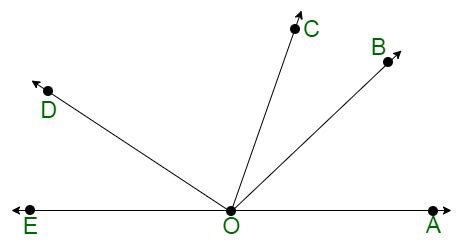
**Question 7. How many pairs of adjacent angles, in all, can you name in the **figure given?
**Solution:
The number of Pairs of adjacent angles, from the following figure are;
∠EOC and ∠DOC
∠EOD and ∠DOB
∠DOC and ∠COB
∠EOD and ∠DOA
∠DOC and ∠COA
∠BOC and ∠BOA
∠BOA and ∠BOD
∠BOA and ∠BOE
∠EOC and ∠COA
∠EOC and ∠COB
Thus, we have 10 pairs of adjacent angles.
**Question 8. In figure, determine the value of x.
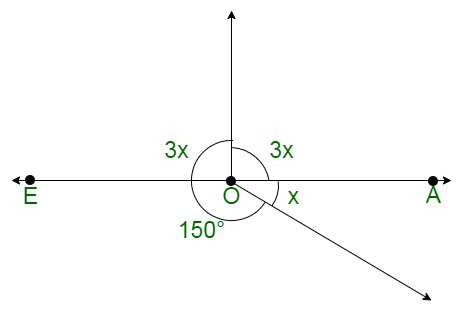
**Solution:
As we know that, the sum of all the angles around a point O is equal to 360°.
Thus,
3x + 3x + 150 + x = 360°
7x = 360° – 150°
7x = 210°
x = \frac{210}{7}
x = 30°
Hence, the value of x is 30°.
**Question 9. In figure, AOC is a line, find x.
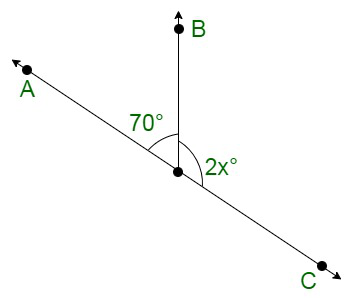
**Solution:
In the following figure,
∠AOB + ∠BOC = 180° {Linear pairs}
70 + 2x = 180
2x = 180 – 70
2x = 110
x = \frac{110}{2}
x = 55°
Hence, the value of x is 55°.
**Question 10. In figure, POS is a line, find x.
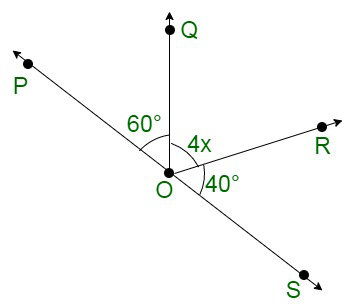
**Solution:
In the following figure;
∠POQ + ∠QOS = 180° {Linear pair}
∠POQ + ∠QOR +∠SOR = 180°
60° + 4x + 40° = 180°
4x = 180° -100°
4x = 80°
x = 20°
Thus, the value of x is 20°.
Conclusion
Exercise 8.2 | Set 1 of Chapter 8 provides the essential practice ground for the students to apply their knowledge of lines and angles. By solving these problems students can strengthen their understanding of how lines and angles interact and how their properties are used to the solve geometric problems. Mastery of these concepts is vital for the progressing to the more complex topics in geometry.