Completing the Square (original) (raw)
Last Updated : 23 Mar, 2026
Completing the square is a method used to solve quadratic equations, simplify expressions, and rewrite them in a way that makes them easier to solve or analyze. It involves turning a quadratic expression into a perfect square trinomial.
Imagine we have a simple expression like x2 + bx. Having two instances of x in the same equation can make things tricky. So, how do we simplify this?
By drawing inspiration from geometry, we can transform it into a more manageable form, like this:
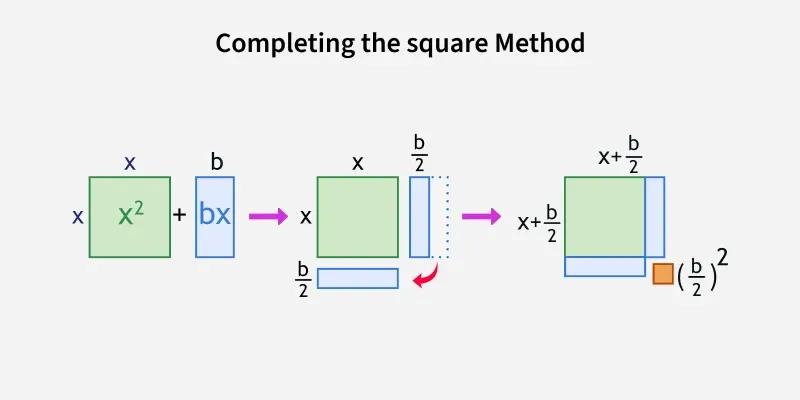
As shown, x + bx can be nearly turned into a square by rearranging it slightly. We can then "complete the square" by adding (b/2)2.
In algebra, the equation looks like this:
x + bx + (b/2) = (x + b/2)2
Therefore, by adding (b/2)2, we complete the square.
The result of (x + b/2)2 now only has x once, making it much simpler to handle.
Why Use Completing the Square?
- **Solving Quadratic Equations: It provides a method to determine the roots of any quadratic equation.
- **Graphing Parabolas: Helps to rewrite the quadratic function in vertex form, making it easier to identify the vertex and the axis of symmetry.
- **Understanding Properties: Reveals important characteristics of the quadratic function, such as its minimum or maximum value.
Formula
Completing the square formula is a methodology or procedure for finding the roots of specified quadratic equations, such as ax2 + bx + c = 0, where a, b, and c are all real values except a.
If, y = x2 + bx + c
Substitute b and c and solve to complete the square
y = \left(x + \frac{b}{2}\right)^2 + c - \left(\frac{b}{2}\right)^2
**For More General Cases
If the equation has a coefficient a in front of x2: ax2 + bx + c ⇒ a(x + m)2 + n
Factor out 'a' from the first two terms: a(x2 + (b/a)x) + c
Now complete the square inside the parenthesis: a((x + b/2a) − (b/2a)2) + c
Simplify: a(x + b/2a) + (c − b2/4a)
So the quadratic expression is rewritten as a(x + m) + n.
Where:
- n = c - (b2/4a)
- m = b/2a
This is useful when converting a quadratic equation into vertex form y = a(x − h) + k.
Steps to Solve Quadratic Equations Using Completing Square Method
For the given quadratic equation **ax 2 + bx + c = 0, to solve the quadratic equation using the complete the square method, follow the steps:
- **Step 1: Start with the Standard Form
- **Step 2: Move the Constant Term
- **Step 3: Divide by a
- **Step 4: Find the Number to Complete the Square
- **Step 5: Rewrite as a Perfect Square
- **Step 6: Solve for x
Following these steps, one can easily solve quadratic equations by completing the square method.
**Note: Sometime while using completing the square method one might encounter (-1) inside the roots and in that case the roots of the quadratic equation are complex.
**For example, factorize x2 + 2x - 3 = 0 using all the steps added above.
⇒ x2 + 2x = 3
⇒ x2 + 2x + (1)2 = 3 + (1)2
⇒ (x + 1)2 = 4
⇒ x + 1 = ± 2
⇒ x = ± 2 - 1
⇒ x = 1, -3
**Read More: Quadratic Equations using Completing the Square Method
How to Apply the Completing the Square Method?
Completing the Square Method is applied by following the steps added above.
**Example: Given the quadratic equation ax2 + bx + c = 0 (a not equal to 0).
By dividing everything by a, we get
x2 + (b/a)x + (c/a) = 0
This can alternatively be written as (b/2a) (by adding and subtracting)
[x + (b/2a)]2 – (b/2a)2 + (c/a) = 0
[x + (b/2a)]2 – [(b2 – 4ac)/4a2] = 0
[x + (b/2a)]2 = [(b – 4ac)/ 4a2]
If b² – 4ac ≥ 0, then taking the square root, we get
**x + (b/2a) = ± √(b 2 – 4ac)/ 2a
The quadratic formula is obtained by simplifying this further.
Solved Examples
**Example 1: Determine the roots of the quadratic equation x2 + 2x – 12 = 0 by using the method of completing the square.
**Solution:
Given Quadratic equation is x2 + 2x – 12 = 0
So as comparing the equation along with standard form,
where b = 2, and c = -12
Then (x + b/2)2 = -(c – b2/4)
By substituting the values we get
(x + 2/2)2 = -(-12 – (22/4) )
(x + 1)2 = 12 + 1
(x + 1)2 = 13
x + 1 = ± √13
x + 1 = ± 3.6So, x + 1 = +3.6 and x+1 = - 3.6
x = 2.6 , -4.6Therefore roots for the given equation are **2.6, -4.6.
**Example 2: Find the roots of the quadratic equation 2x2 - 4x - 20 = 0 by using the method of completing the square.
**Solution:
Given Quadratic equation is 2x2 - 4x - 20 = 0
Supplied equation is not in the form to which the method of completing squares is used, i.e. the x2 coefficient is not 1. To make it one, divide the entire equation by 2.
then x2 - 2x - 10 = 0So as comparing the equation along with standard form,
where b = - 2, and c = -10 then (x + b/2)2 = -(c – b2/4)by substituting the values we get
(x + (-2/2))2 = -( -10 – (22/4))
(x - 1)2 = 11
x - 1 = ± √11
x - 1 = ± 3.3So, x - 1 = + 3.3 and x -1 = -3.3
x = 4.3, -2.3Therefore roots for the given equation are **4.3, -2.3.
**Example 3: Solve using the completing the square formula for 3x2 - 9x - 27 = 0.
**Solution:
Given Quadratic equation is 3x2 - 9x - 27 = 0.
We can write it as x2 - 3x -9 =0
So as comparing the equation along with standard form, where b = - 3, and c = -9
then (x + b/2)2 = -(c – b2/4) by substituting the values we get
(x + (-3/2) )2 = -( -9 – (32/4) )
(x - 1.5 )2 = 11.25
x - 1.5 = ± √11.25
x - 1.5 = ± 3.35So, x - 1.5 = + 11.25 and x -1 = -11.25
x = 12.75, -10.25Therefore roots for the given equation are **12.75, -10.25.
**Example 4: Determine the number that needs to be added to x2 - 4x to make it a perfect square trinomial using the completing square formula.
**Solution:
Given expression is x2- 4x
As Comparing the given expression along with ax2 + bx + c, a = 1; b = -4
Term that should be added to make the above expression a perfect square trinomial using the formula is,
(b/2a)2 = (-4/2(1))2
(b/2a)2 = 4Therefore the number that needs be added to x2 - 4x to make it a perfect square trinomial is **4.
**Example 5: Determine the number that needs to be added to x2 + 22x to make it a perfect square trinomial using the completing square formula.
**Solution:
Given expression is x2 + 22x
As Comparing the given expression along with ax2 + bx + c,
a = 1 ; b = 22The term that should be added to make the above expression a perfect square trinomial using the formula is,
(b/2a)2 = ( 22/2(1) )2
(b/2a)2 = 121Therefore the number that needs to be added to x2 + 22x to make it a perfect square trinomial is **121.
Practice Questions
**Question 1: Complete the square for the quadratic expression: x2 + 8x + 15.
**Question 2: Solve the quadratic equation x2 + 4x + 3 = 0 by completing the square.
**Question 3: Rewrite the quadratic equation 2x2 + 12x + 7 = 0 in the form of a perfect square trinomial by completing the square.
**Question 4: Complete the square for the quadratic expression: x²2 - 6x + 11.
**Question 5: Solve the quadratic equation x²2 + 10x + 16 = 0 by completing the square.