Congruence of Triangles (original) (raw)
Last Updated : 21 Apr, 2026
Congruence of triangles is a concept in geometry used to compare two triangles. It is the condition in which all three corresponding sides and all three corresponding angles of the triangles are equal. Two triangles are said to be congruent if and only if they completely overlap each other when placed one over the other.
The symbol used to represent congruency is "≅."
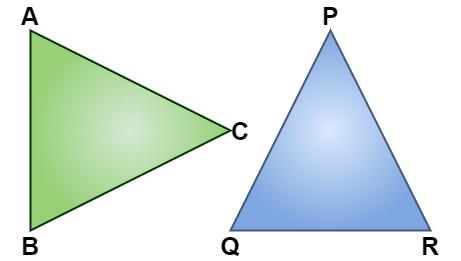
For example, if you have two triangles and you can place one on top of the other and they fit perfectly without any gaps or overlaps, then those triangles are said to be congruent.
CPCT Full Form
The full form of CPCT is Corresponding Parts of Congruent Triangles. This is a fundamental rule used to establish the equality of various parts of triangles based on their congruence.
It states that if two triangles are congruent, then each of their corresponding parts (angles and sides) are equal.
Congruence of Triangles Rules
The different criteria used to prove congruency between two triangles are
- **SSS Criteria: Side-Side-Side
- **SAS Criteria: Side-Angle-Side
- **ASA Criteria: Angle-Side-Angle
- **AAS Criteria: Angle-Angle-Side
- **RHS Criteria: Right angle- Hypotenuse-Side
They are also called the postulates or rules for the congruence of triangles.
**SSS (Side, Side, Side) Congruency Rule
In the SSS congruence rule, two triangles are said to be congruent if all three sides of a triangle are equal to the corresponding three sides of another triangle; then it satisfies the condition of SSS.
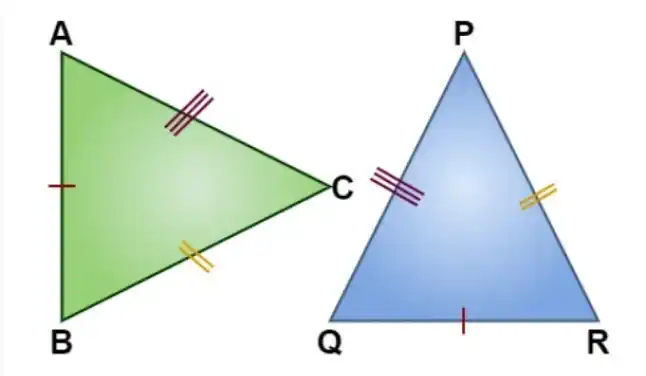
In the above-given figure, we can see that,
AB = QR,
BC = RP, and
CA = PQ.
Hence, Δ ABC ≅ Δ QRP
**SAS (Side, Angle, Side) Congruency Rule
In the SAS congruence rule, two triangles are said to be congruent if two sides and the angle included between the two sides are equal. Then it satisfies the condition of SAS.
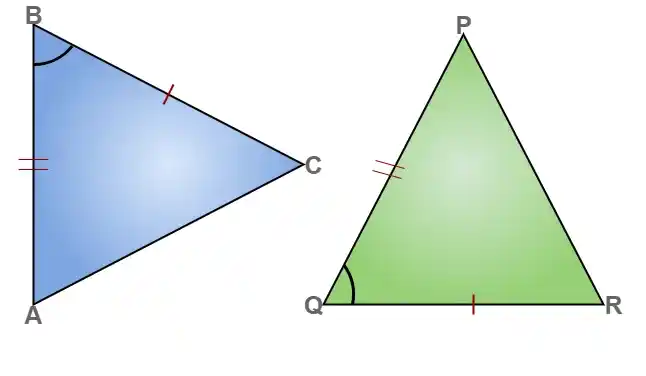
In the above-given figure, we can see that,
CB = RQ,
BA = QP, and
∠B = ∠Q.
Hence, Δ CBA ≅ Δ RQP.
**ASA (Angle, Side, Angle) Congruency Rule
In the ASA congruence rule, two triangles are said to be congruent if any two angles and the side included between the two angles of one triangle are equal to the angles and side of the corresponding triangle. Then the two triangles will satisfy the ASA congruency.
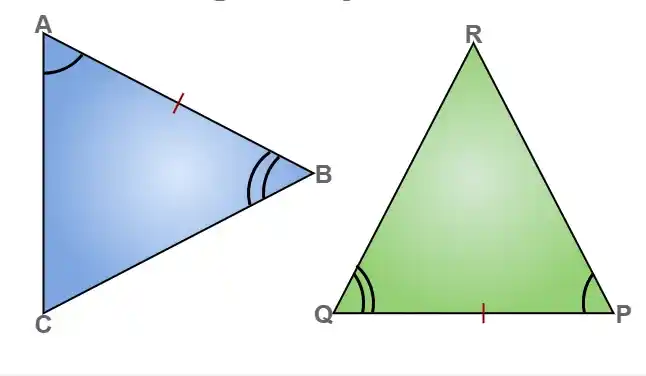
In the above-given figure, we can see that,
AB = PQ,
∠A = ∠P, and
∠B = ∠Q.
Hence, ΔABC ≅ ΔPQR.
**AAS (Angle, Angle, Side) Congruency Rule
In the AAS congruence rule, two triangles are said to be congruent. If any two angles of a triangle and a non-included side are equal to the two angles and side of the corresponding triangle, then it will satisfy the AAS congruency.
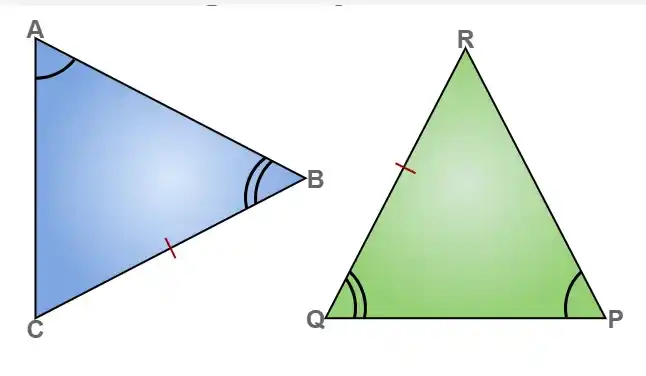
From the given figure, we can say that,
BC = QR,
∠A = ∠P, and
∠B = ∠Q
Hence, ΔABC ≅ ΔPQR.
**RHS (Right Angle-Hypotenuse-Side) Congruency Rule
The RHS congruency rule is only applicable on right-angle triangles. In the RHS congruency rule, if only two sides, i.e., the hypotenuse and one side of a right-angled triangle, are equal to the corresponding hypotenuse and side of another right-angled triangle, then we can say that the RHS Congruence Rule is satisfied and the triangles are congruent.
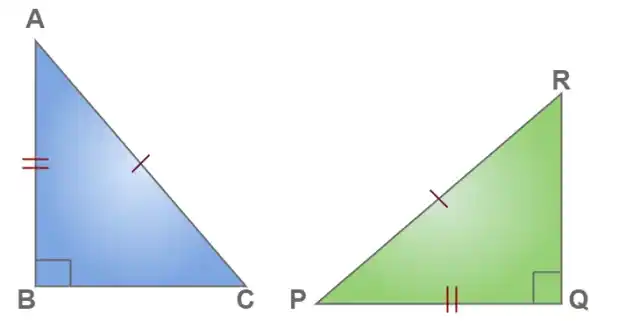
From the above-given example of a right-angled triangle, we get
∠B = ∠Q (right angles)
CA = RP and
AB = PQ.
Hence, ΔABC ≅ ΔPQR.
**Note- RHS criteria of congruence get satisfied only with a right-angled triangle.
Properties of Congruent Triangles
- They are the same in shape and size.
- They perfectly overlap each other if arranged in the proper orientation.
- Corresponding parts of congruent triangles are equal.
- They also have the same area.
Similar Triangles vs Congruent Triangles
| Similar Triangles | Congruent Triangles |
|---|---|
| Similar triangles are triangles in which the ratios of their corresponding sides are equal. | Congruent triangles are triangles that have all corresponding sides and angles equal. |
| They have the same shape but may differ in size. | They have the same shape and the same size. |
| Area of similar triangles may or may not be equal. | The area of congruent triangles is equal. |
| They do not completely overlap. | They completely overlap each other. |
| Similarity is proved by: AAA (Angle–Angle–Angle). | Congruency is proved by: SSS, SAS, ASA, AAS, RHS. |
Related Articles:
Solved Examples
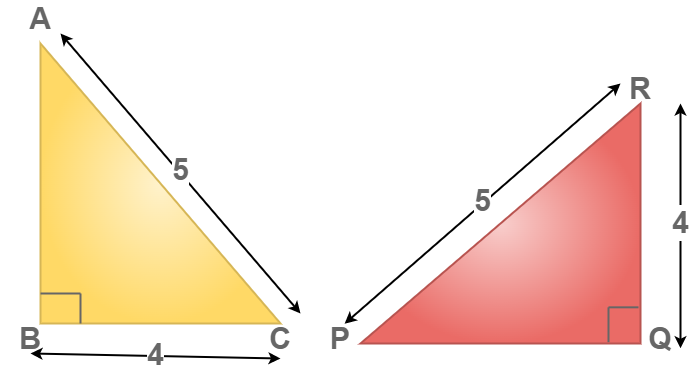
**Example 1: Check whether the given triangles are congruent or not. Also, write the congruency criteria for congruency in triangles.
**Solution:
To identify the congruency in the above triangle.
BC = QR = 4 units (given)
CA = RP = 5 units (given)
∠ABC = ∠PQR = 90°
Now, we can conclude that Δ ABC ≅ Δ PQR by the RHS congruency condition.
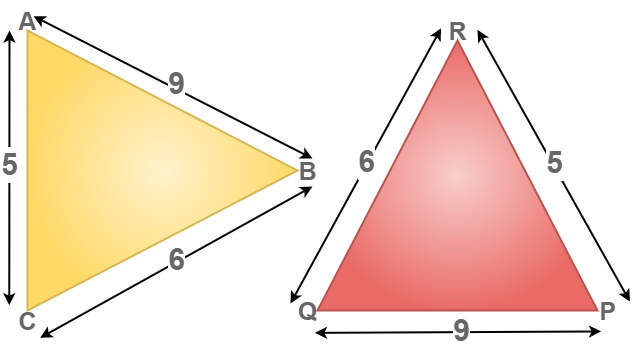
**Example 2: Check whether the given triangles are congruent or not. Also, write the congruency criteria for congruency in triangles.
**Solution:
To identify the congruency in the above triangle.
BC = QR = 6 units (given)
CA = RP = 5 units (given)
AB = PQ = 9 units (given)
Now, we can conclude that Δ ABC ≅ Δ PQR by the SSS congruency condition.
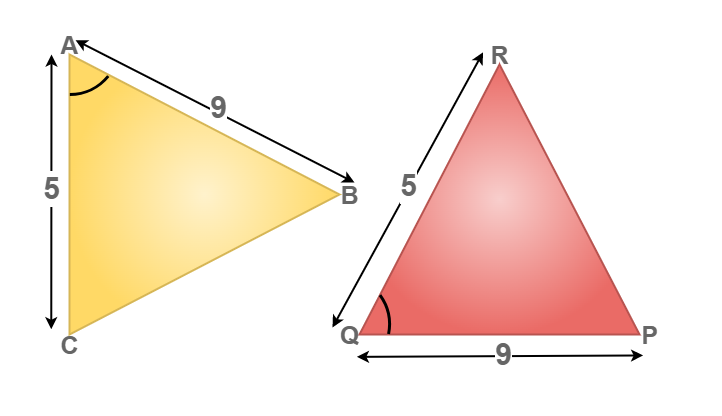
**Example 3: Check whether the given triangles are congruent or not. Also, write the congruency criteria for congruency in triangles.
**Solution:
To identify the congruency in the above triangle.
AC = QR = 5 units (given)
∠BAC = ∠PQR (given)
BA = PQ = 9 units (given)
Now, we can conclude that Δ BAC ≅ Δ PQR by theSAS congruency condition.
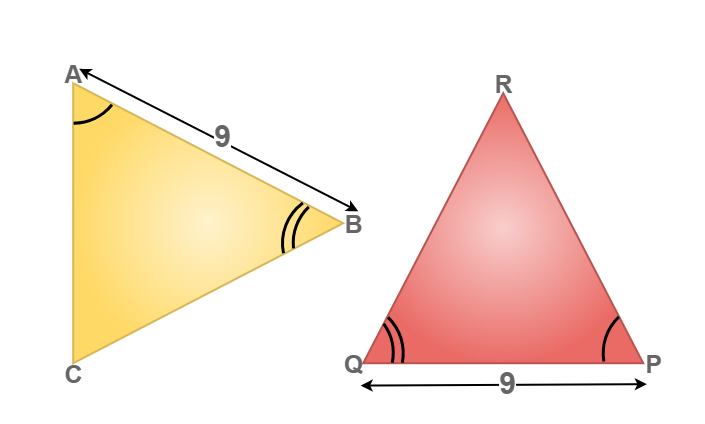
**Example 4: Check whether the given triangles are congruent or not. Also, write the congruency criteria for congruency in triangles.
**Solution:
To identify the congruency in the above triangle.
∠BAC = ∠PQR (given)
BA = PQ = 9 units (given)
∠CAB = ∠QPR (given)
Now, we can conclude that Δ BAC ≅ Δ PQR by the ASA congruency condition.
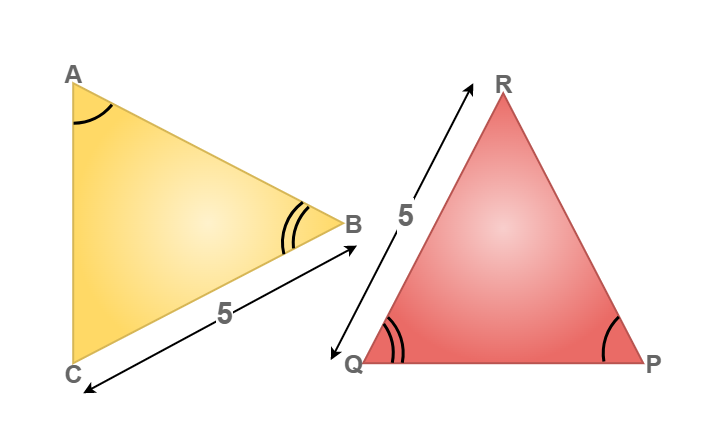
**Example 5: Check whether the given triangles are congruent or not. Also, write the congruency criteria for congruency in triangles.
**Solution:
To identify the congruency in the above triangle.
BC = QR = 5 units (given)
∠ABC = ∠PQR (given)
∠BAC = ∠QPR (given)
Now, we can conclude that Δ ABC ≅ Δ PQR by theAAS congruency condition.
Practice Problems
**Q1. Prove that Δ XYZ ≅ Δ PQR given that XY = PQ, YZ = QR, and XZ = PR.
**Q2. Given that ∠A = ∠D, AB = DE, and ∠B = ∠E, show that Δ ABC ≅ Δ DEF.
**Q3. Verify the congruence of triangles if AC = DF, ∠CAB = ∠DFE, and AB = DE.
**Q4. Determine if Δ PQR ≅ Δ XYZ given that ∠P = ∠X, ∠Q = ∠Y, and PQ = XY.
**Q5. Prove that Δ ABC ≅ Δ DEF if AB = DE, BC = EF, and ∠B = ∠E.
**Q6. Check if the triangles are congruent using the RHS criterion given that ∠A = ∠D (right angles), AB = DE, and AC = DF.
**Q7. Show that Δ GHI ≅ Δ STU given that GH = ST, HI = TU, and ∠GHI = ∠STU.
**Q8. Determine if Δ LMN ≅ Δ OPQ given that LM = OP, MN = PQ, and ∠L = ∠O.
**Q9. Prove that Δ KLM ≅ Δ NOP if ∠KLM = ∠NOP, KL = NO, and ∠LMK = ∠OPN.
**Q10. Given that ∠A = ∠D, AB = DE, and ∠B = ∠E, prove that Δ ABC ≅ Δ DEF using the congruence criteria.