Construction of Quadrilaterals Practice Questions (original) (raw)
Last Updated : 23 Jul, 2025
A quadrilateral is a four-sided polygon with four vertices and four edges. Constructing a quadrilateral involves connecting four points with straight lines to ensure the sides meet at the vertices, forming a closed shape.
In this article, we will learn how to construct a quadrilateral using its side, and angle and practice some questions.
Construction of Quadrilaterals
Construction of a quadrilateral involves creating a four-sided figure with specified lengths and angles.

This process requires basic geometric tools such as a ruler, compass, and protractor. The construction can be done in various ways, depending on the given conditions, such as side lengths, angles, and diagonals.
Steps For Construction of Quadrilaterals
A quadrilateral is drawn if various parameters of a quadrilateral are given, and the various methods are:
**Method 1: Given Four Sides (Quadrilateral of Arbitrary Shape)
To draw a quadrilateral if all four sides of a quadrilateral are given follow the steps added below:
**Step 1: Draw one side to the given length.
**Step 2: Use a compass to draw arcs from each end of the side, marking the lengths of the next two sides.
**Step 3: Draw the intersecting arcs to determine the position of the third vertex.
**Step 4: Repeat the process for the remaining side to complete the quadrilateral.
**Method 2: Given Two Sides and Three Angles (Triangle Method)
To draw a quadrilateral if two sides and three angles of a quadrilateral are given follow the steps added below:
**Step 1: Draw the base side.
**Step 2: Use the protractor to construct the given angles at each end of the base.
**Step 3: Draw the adjacent sides to the given lengths and angles.
**Step 4: Complete the figure by connecting the endpoints of the adjacent sides.
**Method 3: Given Two Diagonals and Three Sides (Diagonal Method)
To draw a quadrilateral if two diagonals and three sides of a quadrilateral are given follow the steps added below:
**Step 1: Draw one diagonal.
**Step 2: Use the compass to mark off the lengths of the three sides from the ends of the diagonal.
**Step 3: Draw arcs to find the positions of the third and fourth vertices.
**Step 4: Connect these points to complete the quadrilateral.
**Method 4: Given Two Adjacent Sides and Three Angles (ASA Method)
To draw a quadrilateral if two adjacent sides and three angles of a quadrilateral are given follow the steps added below:
**Step 1: Draw one side.
**Step 2: Use the protractor to measure and draw the adjacent angles.
**Step 3: Draw the adjacent side to the given length.
**Step 4: Complete the quadrilateral by connecting the remaining sides and verifying the last angle.
Construction of Quadrilateral Practice Questions with Solution
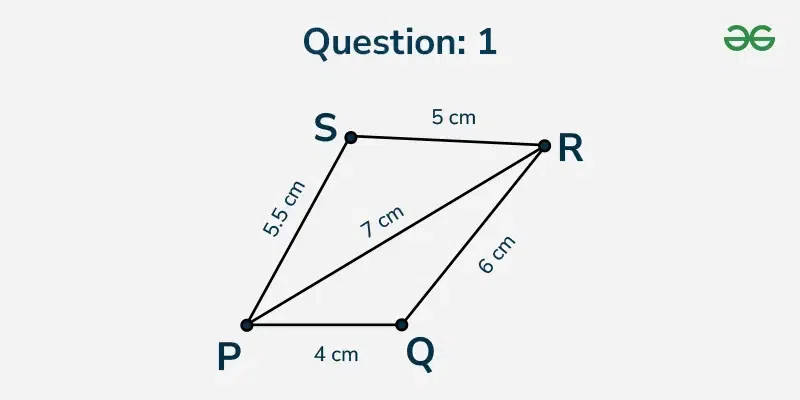
**Question 1: Construct a quadrilateral PQRS where PQ = 4 cm, QR = 6 cm, RS = 5 cm, PS = 5.5 cm and PR= 7 cm.
**Solution:
**Step 1: Draw Δ PQR using SSS construction condition.
**Step 2: With P as the centre, draw an arc of radius 5.5 cm.
**Step 3: With R as the centre, draw an arc of radius 5 cm.
**Step 4: S is the point of intersection of the two arcs. Also, mark S and complete PQRS.
PQRS is the required quadrilateral.
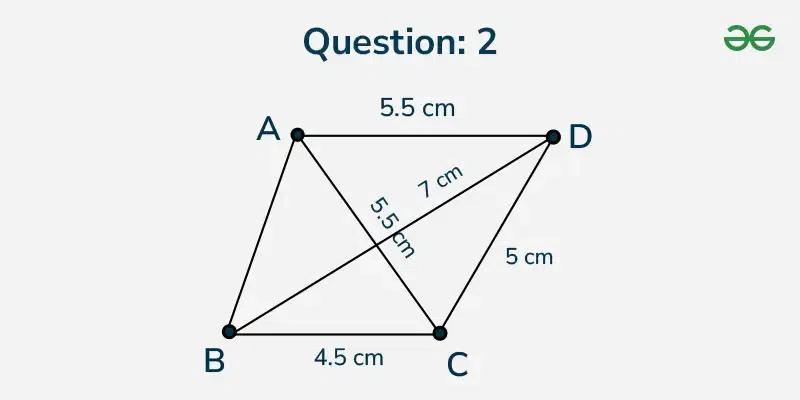
**Question 2: Construct a quadrilateral ABCD where BC = 4.5 cm, AD = 5.5 cm, CD = 5cm and the diagonal AC = 5.5 cm, diagonal BD = 7 cm.
**Solution:
**Step 1: Draw ΔACD using SSS construction condition
**Step 2: Taking D as the centre, draw an arc of radius 7 cm.
**Step 3: Now let C be the centre, draw an arc of radius 4.5 cm
**Step 4: Since B lies on both the arcs, B is the point intersection of the two arcs.
**Step 5: Mark B and complete ABCD.
ABCD is the required quadrilateral.
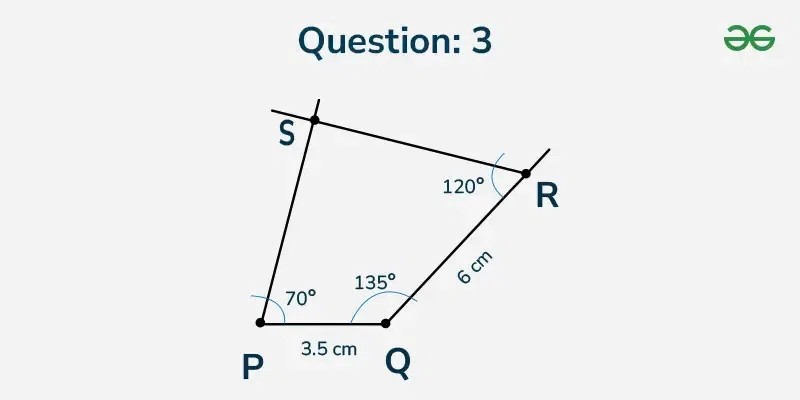
**Question 3: Construct a qudrilateral PQRS where PQ = 3.5 cm, QR = 6cm, P = 75° , Q= 135° and R = 120°
**Solution:
**Step 1: Draw PQ = 3.5 cm and construct PQX = 135.
**Step 2: Cut off QR = 6 cm.
**Step 3: Make QRY = 120°
**Step 4: Make QPZ = 75° at M.
**Step 5: Mark that point, where RY and PZ meet, as S
We get the required quadrilateral PQRS.
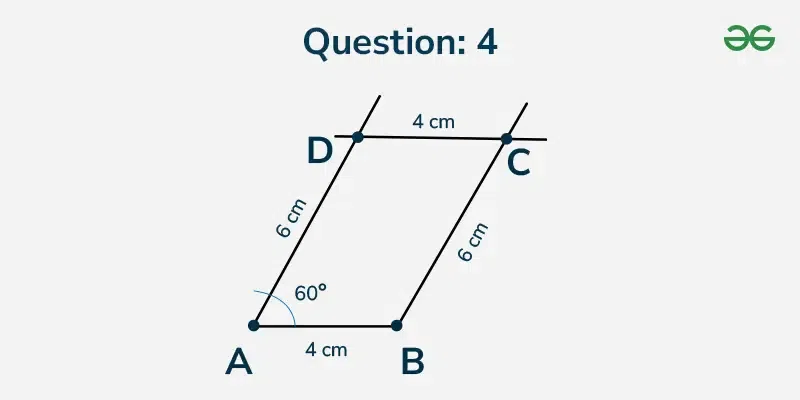
**Question 4: Construct a parallelogram ABCD with sides AB = 4 cm and AD = 6 cm and ∠A = 60.
**Solution:
**Step 1: Construct a line segment AB = 4 cm and construct a 60 angle at point A.
**Step 2: Now construct a line segment AD = 6 cm on the other arm of the angle. Then, place the sharp point of the compasses at B and make an arc 6 cm above B.
**Step 3: Stretch your compasses to 4 cm, place the sharp end at D and draw an arc to intersect the arc drawn in step 2.
**Step 4: Label the intersecting point C. Join C to D and B to C to form the parallelogram ABCD.
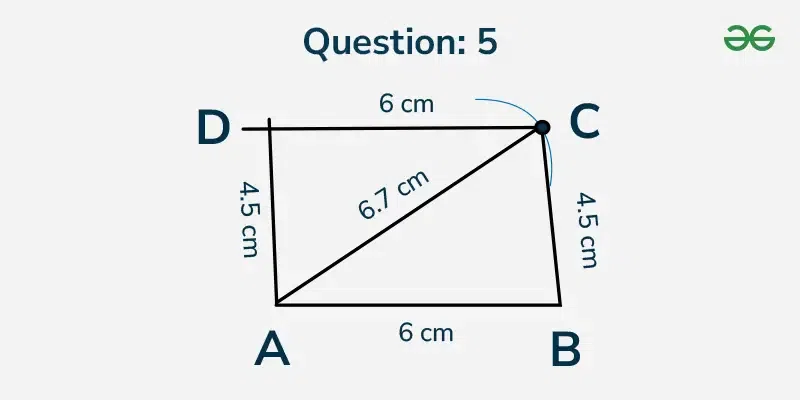
**Question 5: Construct a parallelogram ABCD in which AB = 6cm, BC = 4.5cm and diagonal AC = 6.7 cm.
**Solution:
**Step 1: Draw AB = 6 cm.
**Step 2: With A as centre and radius 6.7 cm, draw an arc.
**Step 3: With B as centre and radius, 4.5 cm draw another arc, cutting the previous arc at C.
**Step 4: Join BC and AC.
**Step 5: With A as centre and radius 4.5 cm, draw an arc.
**Step 6: With C as centre and radius, 6 cm draw another arc, cutting the previously drawn arc at D.
**Step 7: Join DA and DC
ABCD is the required parallelogram.
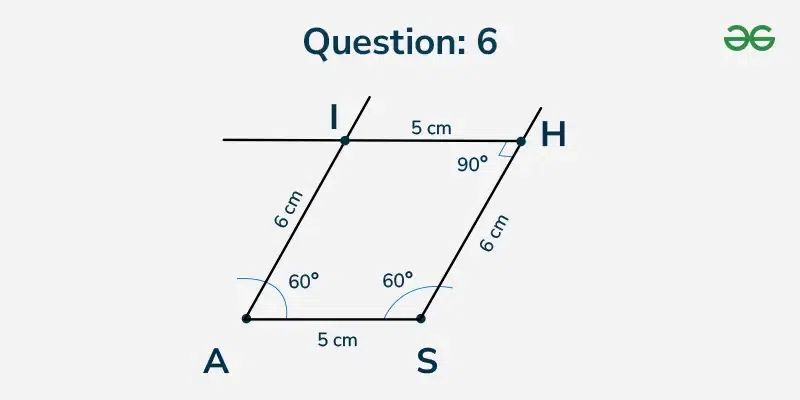
**Question 6: Construct a quadrilateral ASHI where AS = 5 cm, SH =6 cm,HI =4.5 cm, ∠S = 60 0 and ∠H = 90 0 .
**Solution:
**Step 1: Draw a rough sketch of quadrilateral ASHI
**Step 2: Draw line segment SH = 6 cm and construct the angle of 60 °with the help of a protractor on it. At a distance of 5 cm from S, mark a point A on the angle.
**Step 3: At point H, construct an angle of 90° with the help of a protractor and at a distance of 4.5 cm and mark a point I on it.
**Step 4: Join points I and A.
ASHI is the required quadrilateral.
Construction of Quadrilaterals Practcie Problems
**P1: Construct a quadrilateral PQRS where PQ = 5 cm, Oq = 7 cm, RS = 6 cm, PS = 5.2 cm and PR= 7 cm.
**P2: Construct a quadrilateral ASHI where AS = 6 cm, SH = 6 cm, HI = 5.5 cm, ∠S = 60 0 and ∠H = 90 0 .
**P3: Construct a qudrilateral PQRS where PQ = 3.8 cm, QR = 6cm, P = 75° , Q= 135° and R = 120°.
**P4: Construct a parallelogram ABCD with sides AB = 5 cm and AD = 6 cm and ∠A = 60.
**P5: Construct a parallelogram ABCD in which AB = 6.1cm, BC = 4.6cm and diagonal AC = 6.8 cm.
**P6: Construct a quadrilateral ABCD where BC = 4.6 cm, AD = 5.7 cm, CD = 5.1cm and the diagonal AC = 5.6 cm, diagonal BD = 8 cm.