Conversion of solids (original) (raw)
Last Updated : 23 May, 2026
In daily life, many solids are melted and reshaped into new forms, such as jewelry, candles, or toys. When a solid is converted from one shape to another without any loss of material, its volume remains the same.
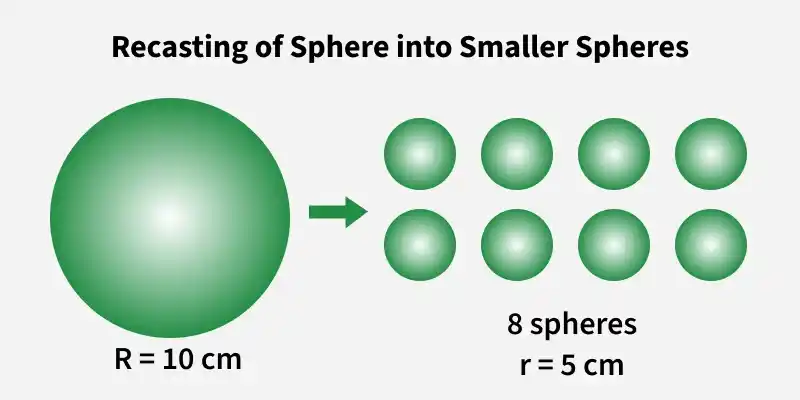
The figure below shows a sphere recast into smaller spheres without any loss of material. So, the total volume remains the same.
Volume of original solid = Volume of new solid
Solved Examples
**Example 1: A silver sphere ball of radius 10 cm is melted and recast into small spheres, each of radius 5 cm, so that children can play. How many small spheres can be obtained?
Say the number of small spheres obtained be x.
We know that the total volume will remain the same.
R = 10 cm (Radius of the big ball).
r = 5 cm (radius of the small ball).
Now, n × (Volume of a small ball) = Volume of a big metallic ball
x * (4/3) * π * r3 = (4/3) * π * R3
Hence we get: x = \frac{R^3}{r^3} \\
Therefore x is 8. Hence we can make 8 small balls out of 1 big ball.
**Example 2: We are given a cone made up of clay of height 30 cm. We have to make it in the shape of a cylinder of the same radius. Find the height of the cylinder.
Let h1 and h2 be the heights of a cylinder and cone respectively. Let r be the radius of the cone and also the radius of the cylinder as given in the question.
As we know that:
The volume of cylinder = Volume of cone.
πr2h1 = (1/3) πr2h2
h2 = 30 cm
h1= (30/3) = 10 cm
Therefore, the height of the cylinder is 10 cm
**Example 3: We have a cylindrical candle, 14 cm in diameter and 2 cm in length. It is melted to form a cuboid candle of dimensions 7 cm × 11 cm × 1 cm. How many Cuboidal candles can be obtained?
Dimensions of the cylindrical Candle:
Radius of cylindrical candle = 14/2 cm = 7 cm
Height/Thickness = 2 cm
Volume of one cylindrical candle = πr2h = π x 7 x 7 x (2) cm3 = 308 cm3
Volume of cuboid candle = 7 x 11 x 1 = 77 cm3
Hence, the number of Cuboidal candles = Volume of cylindrical candle/Volume of cuboid candle = 308/77 = 4. Hence we can get 4 Cuboidal shaped candles.
**Example 4: A cylindrical copper rod with a diameter of 2 cm and a length of 2 cm is drawn into a wire of length 72 m of uniform thickness. Determine the thickness of the wire.
Given that, the diameter of the Copper rod = 2 cm.
Radius = 1 cm.
Length of the copper rod = 2 cm
The volume of the copper Cylindrical material = π × (1)2 × 2 = 2π cm3
Length of new wire = 72 m = 72 × 100 = 7200 cm.
We know that the wire should be in a cylindrical shape.
If “r” is the radius of the cross-section of the wire, then the volume of the wire is given as:
The volume of the wire = π × r2 × 7200
Since the volume of the copper rod and the volume of the new wire should be equal, then we can write
⇒ π × r2 × 7200 = 2π
⇒ r = 1/60 cm.
Hence, the thickness of the wire should be the diameter of the cross-section of the new wire.
Thickness = (1/60) x 2 = 1/30 cm. Thus, the thickness of the wire is approximately equal to 0.0334 cm.
Unsolved Examples
**Example 1: A solid sphere has a radius of 7 cm. Find the volume of the sphere.
**Example 2: A solid cone and a solid cylinder have the same base radius of 3.5 cm and the same height of 10 cm. Find the ratio of their volumes.
**Example 3: A cylindrical water tank has a radius of 7 m and a height of 5 m. How many spherical balls of radius 0.5 m can be filled using the water from the tank?
**Example 4: A hollow cylindrical pipe has an internal radius of 3 cm, an external radius of 4 cm, and a length of 100 cm. Find the volume of metal used in making the pipe.
**Example 5: A solid sphere of radius 10 cm is placed inside a cylindrical container of radius 12 cm and height 15 cm. Find the volume of water required to fill the container after placing the sphere inside it.