Counting in Maths (original) (raw)
Last Updated : 27 Feb, 2026
Counting numbers are the numbers we use to count things in our everyday lives. They start from **1 and go on forever, like this:
1, 2, 3, 4, 5, 6, 7, . . .
These are also called natural numbers because they come naturally to us when we count objects, like apples, books, or stars.
Counting Numbers are defined as the set of numbers that we use to count things and these numbers are always positive.
Counting numbers are positive numbers, while integers contain both positive and negative numbers. Counting of numbers can be done in many different ways, for instance, reverse counting, counting by 2s (2, 4, 6, . . .), counting by 3s (3, 6, 9, . . .), counting by 5s (5, 10, 15, . . .), and so on.
**Key Features of Counting Numbers:
- Counting numbers do not include 0.
- Counting numbers do not include fractions, e.g., 1/2, 3/4, 5/6, etc.
- Counting numbers does not include negative numbers, e.g.: -1, -2, -3, etc.
- Counting numbers do not include decimals, e.g.: 0.85, 0.67, 3.97, etc.
Counting Numbers Examples
The example of counting numbers can be found everywhere, even in everyday life. From counting the days in the year to counting the candies distributed in the class, and so on. Let's look at some of the examples of counting numbers,
- Count the number of books you have. (Such as - 3 Science, 1 Math, 2 English Books).
- Count for the numbers from 1 to 100. (like 1, 2, 3, 4, 5,... 10 and then for 11 to 20 and so on).
- Count for the number of students in your class. (like 30, 40).
- Count for the number of players in a Cricket team (like 11 payers) and so on.
Counting Numbers 1 to 20
Counting numbers are always generated from 1 because 0 is never included in the counting numbers. Let's start counting numbers, and to begin, let's count numbers from 1 to 20, both in digits and in words.
| **1 ⇢ | One | **11 ⇢ | Eleven |
|---|---|---|---|
| **2 ⇢ | Two | **12 ⇢ | Twelve |
| **3 ⇢ | Three | **13 ⇢ | Thirteen |
| **4 ⇢ | Four | **14 ⇢ | Fourteen |
| **5 ⇢ | Five | **15 ⇢ | Fifteen |
| **6 ⇢ | Six | **16 ⇢ | Sixteen |
| **7 ⇢ | Seven | **17 ⇢ | Seventeen |
| **8 ⇢ | Eight | **18 ⇢ | Eighteen |
| **9 ⇢ | Nine | **19 ⇢ | Nineteen |
| **10 ⇢ | Ten | **20 ⇢ | Twenty |
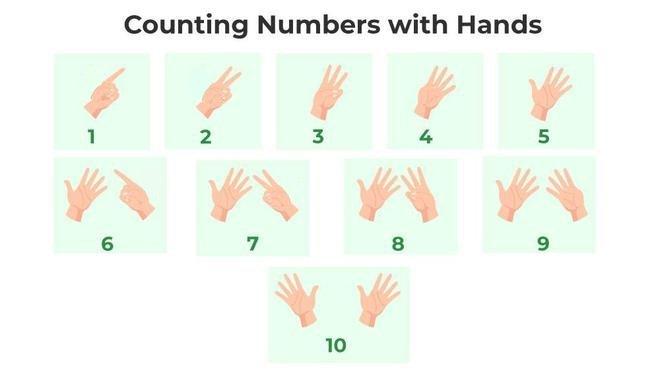
Counting Numbers with Hands
Since visual maths helps children grasp the concept easily, counting numbers with hands links the fingers to numbers, and it makes counting easier.
- Counting from 1 to 10 can be easily done with hands, and once this is learned properly.
- From 10 to 20 will be a repetition of the same fingers for counting.
How Are Counting Numbers Different from Whole Numbers?
Counting numbers and whole numbers are two related but distinct sets of numbers in mathematics:
| **Aspect | **Counting Numbers | **Whole Numbers |
|---|---|---|
| **Includes Zero | No | Yes |
| **Starting Point | 1 | 0 |
| **Examples | 1, 2, 3, 4, . . . | 0, 1, 2, 3, 4, . . . |
Counting Numbers Worksheet
**Question 1: Complete the following worksheet by counting the numbers by 5.
- **5, ?, 15, 20, ?
- **25, 30, ?, 40
- **1000, ?, 1010, 1015, 1020
**Answer:
As the numbers are counted by 5, adding 5 to the previous number will give the next number. Therefore, the answers are:
- 5, **10, 15, 20, **25
- 25, 30, **35, 40
- 1000, **1005, 1010, 1015, 1020
**Question 2: Write the counting numbers from:
- **10 to 20
- **100 to 1000 counting by 100
- **25 to 50
**Answer:
- Counting numbers from 10 to 20 ⇢ 10, 11, 12, 13, 14, 15, 16, 17, 18, 19, 20.
- Counting numbers from 100 to 1000 by 100 ⇢ 100, 200, 300, 400, 500, 600, 700, 800, 900, 1000.
- Counting numbers from 25 to 50 ⇢ 25, 26, 27, 28, 29, 30, 31, 32, 33, 34, 35, 36, 37, 38, 39, 40, 41, 42, 43, 44, 45, 46, 47, 48, 49, 50.
**Question 3: Write 11 counting numbers from 9.
**Answer:
11 counting numbers from 9 are 9, 10, 11, 12, 13, 14, 15, 16, 17, 18, 19.
**Question 4: Write only the even counting numbers from 1 to 20.
**Answer:
Even counting numbers will only include even numbers. Even numbers are the number that are completely divisible by 2 leaving 0 as a remainder. So, even counting numbers from 1 to 20 are:
2, 4, 6, 8, 10, 12, 14, 16, 18, 20
**Question 5: Write the odd counting numbers from 10 to 50.
**Answer:
Odd counting numbers will only include odd numbers. Odd numbers are the number that are not completely divisible by 2. So, odd counting numbers from 10 to 50 are:
11, 13, 15, 17, 19, 21, 23, 25, 27, 29, 31, 33, 35, 37, 39, 41, 43, 45, 47, 49.