Deductive Reasoning (original) (raw)
Last Updated : 11 Jun, 2026
Deductive Reasoning is a logical method of drawing specific conclusions from general statements or known facts. It follows a structured approach where accepted rules or premises are applied to particular situations to reach conclusions that are logically valid.
- Uses a top-down approach by moving from general principles to specific conclusions.
- Commonly used in mathematics, formal logic, problem-solving, and decision-making.
- Helps in analyzing arguments and identifying logically correct outcomes.
Types
The three different types of deductive reasoning which provide structured methods for drawing logical conclusions based on given premises are:
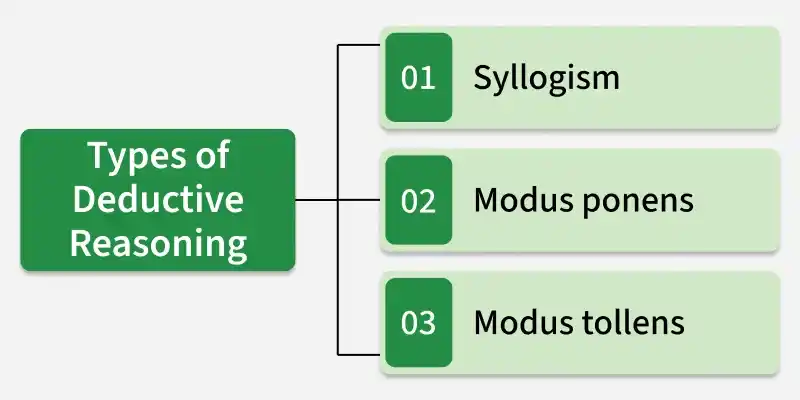
1. Syllogism
Syllogism is a type of deductive reasoning where a conclusion is drawn from two related premises. It usually consists of a major premise, a minor premise, and a conclusion. It follows a logical structure where if the premises are true, the conclusion must also be true.
**Example:
- Major premise: All humans are mortal.
- Minor premise: Socrates is a human.
- Conclusion: Therefore, Socrates is mortal.
2. Modus Ponens
Modus Ponens is a deductive reasoning rule that confirms a conclusion when a condition and its premise are true. It follows the pattern: If P, then Q; P is true; therefore, Q is true.
If the first premise (conditional statement) is true and the second premise (antecedent) is also true, then the conclusion (consequent) must logically follow.
**Example:
- Premise 1: If it rains, then the streets will be wet.
- Premise 2: It is raining.
- Conclusion: Therefore, the streets are wet.
3. Modus Tollens
Modus Tollens is another deductive reasoning pattern that denies the premise when the conclusion is false. It follows the pattern:If P, then Q; Q is false; therefore, P is false.
If the first premise (conditional statement) is true and the consequent is not true, then the antecedent must also be false
**Example:
- Premise 1: If it is a weekday, then John goes to work.
- Premise 2: John is not going to work.
- Conclusion: Therefore, it is not a weekday.
Working
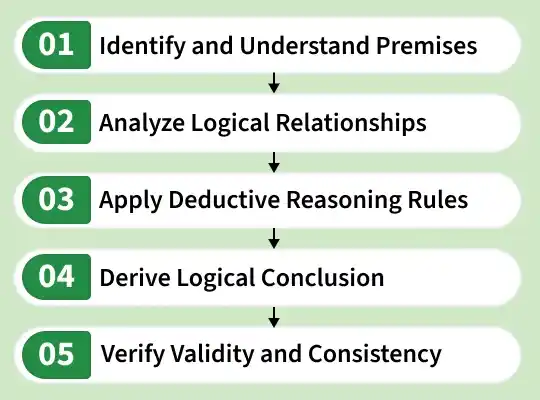
Working of Deductive Reasoning
- Identify and understand the given premises or statements.
- Analyze the logical relationship between the premises.
- Apply deductive reasoning rules such as syllogism, modus ponens, or modus tollens.
- Derive a conclusion that logically follows from the premises.
- Verify whether the conclusion is valid and consistent with the given information.
Applications
- Used in AI expert systems to apply predefined rules and provide logical decisions or recommendations.
- Helps in solving mathematical proofs and validating logical arguments step by step.
- Used to identify diseases based on symptoms and medical rules.
- Allows AI systems to derive conclusions from known facts and make accurate decisions.
Advantages
- Produces logically certain conclusions when premises are true.
- Helps in systematic and structured problem-solving.
- Widely used in mathematics, logic, and rule-based systems.
- Reduces chances of errors in decision-making.
Limitations
- Conclusions depend completely on the correctness of premises.
- Cannot generate new knowledge beyond given information.
- Less effective when information is incomplete or uncertain.
- Requires clearly defined rules and assumptions.