Derivatives of Inverse Functions (original) (raw)
Last Updated : 20 Jan, 2026
A function _f is the inverse of a function _g if each undoes the action of the other. If g(x) = y, then f(y) = x. In this case, both functions satisfy:
f(g(x)) = g(f(x)) = x
A function has an inverse only if it is one-to-one and onto (bijective). The inverse of _f is denoted by f−1.
Let y = f(x) and x = f−1. Differentiating both sides gives the relationship:
\left(f^{-1}\right)'(x) = \frac{1}{f'\big(f^{-1}(x)\big)}
This formula allows us to find the derivative of an inverse function using the derivative of the original function, even when the inverse is difficult to compute explicitly.
**Procedure of Finding Inverse of **f
- Check for one-one and onto function.
- If invertible then, interchange x and y in definition of f(x).
- Find y in terms of x.
- Obtained y is inverse of f defined from B ⇢ A.
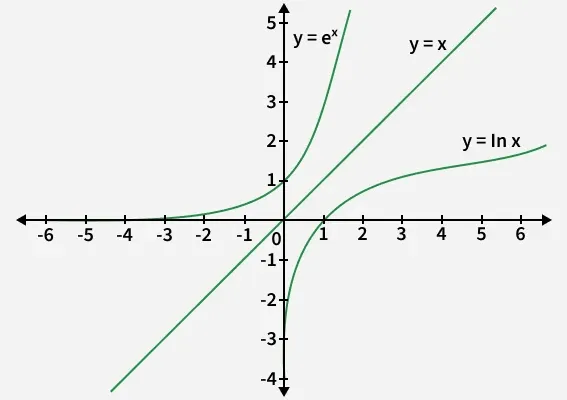
**Example: f(x) = ex
y = ex
Inverse of f(x) will be obtained by y ↔ x
- x = ey
- y = ln x
Now, ex and ln x are inverse function of each other.
Relation between Derivatives of Inverse Functions
If a function f(x) is a continuous one-one function and onto or bijective function defined on an interval lets say (I), then its inverse is also continuous and if the function f(x) is a differentiable function, then its inverse is also a differentiable function.
[f^{-1} (x)] = \frac{1}{f'(f^{-1}(x))}
g'(x) =\mathbf{\frac{1}{f'(g(x))}}
Here, f and g are inverse function. It is known as inverse function theorem.
**Proof:
Let us considered f and g be the inverse functions and x is present in the g domain, then
f(g(x)) = x
Differentiate both side with respect to x
\frac{d f(g(x))}{x} = \frac{d(x)}{dx}
Now solve the LHS using chain rule we get
f'(g(x))g'(x) = 1
Now solve for g'(x):
g'(x) = {\frac{1}{f'(g(x))}}
Hence, the derivative on inverse function is solved.
**Example 1: f(x) = e x , check whether condition holds true.
As, f(x) = ex
y = ex
x = ln y
g(x) = f-1(x) = ln x
Now,
f'(x) = \frac{d}{dx} (ex) = ex
g'(x) = \frac{d}{dx} (ln x) = \frac{1}{x}
g'(f(x)) = \frac{1}{e^x}
\frac{1}{g'(f(x))} = \frac{1}{(\frac{1}{e^x})} = ex
Hence,
f'(x) = \frac{1}{g'(f(x))}, holds true.
**Example 2: Let f(x) = \frac{1}{2} **x 3 + 3x - 4, and let g be the inverse function of f where f(-2) = -14. Find g'(-14)
f'(x) = \frac{1}{2} (3x2) + 3
According to eq (1).
g'(x) = \mathbf{\frac{1}{f'(g(x))}}
As, f(x) = g-1(x) and f(-2) = -14
then g(-14) = -2
x = -14
g'(-14) = \frac{1}{f'(g(-14))}
g'(-14) = \frac{1}{f'(-2)}
f'(-2) = \frac{1}{2} (3(-2)2) + 3
f'(-2) = \frac{12}{2} + 3
f'(-2) = 9
then, g'(-14) = \frac{1}{9}
**Find Derivatives of Inverse Functions from the Table
Let us discuss this concept with the help of an example. So let us assume g and f be the inverse function and the following table lists a few values of f, g and f'.
| x | f(x) | g(x) | f'(x) |
|---|---|---|---|
| 2 | 4 | 8 | \frac{-1}{6} |
| 8 | 3 | 2 | \frac{1}{2} |
We have to find g'(2). As it said from the question, that f and g be inverse functions. This means if we have two sets, now let us assume that the first set is the domain of f. So in this set, if we start from some x value then f is going to map that x to another value which is known as f(x)(this is the use of function f). Now as we know that g is the inverse of f, so this g gets us back to the first set(this is the use of function g).
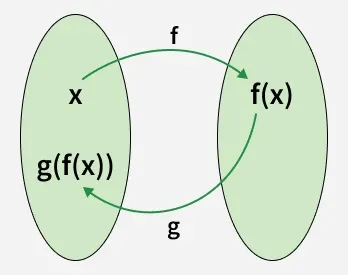
Hence we get
g(f(x)) = x ...(i)
f(g(x)) = x ...(ii)
Where, both are valid.
From eq(ii), we have
f(g(x)) = x
Now differentiate both side with respect to x. we get
\frac{d(f(g(x)))}{dx} = \frac{d(x)}{dx}
Now on the LHS we apply chain rule, now we get
f'(g(x))g'(x) = 1
**g'(x) = \mathbf{\frac{1}{f'(g(x))}}
Now we are going to find the value of g'(2)
g'(2) = \frac{1}{f'(g(2))}
From the table we get the value of g(2)
g'(2) = \frac{1}{f'(8)}
From the table we get the value of f'(8)
g'(2) = \frac{1}{\frac{1}{2}}
g'(2) = 2
Hence, the value of g'(2) = 2.
Applications of Derivatives of Inverse Functions
- Implicit differentiation
- Solving equations where the inverse is not explicit
- Integration techniques
- Inverse trig and inverse exponential derivatives
- Applied modeling problems
**Also Check:
**Solved Example on Derivative of Inverse Function
**Example 1. Find the derivative of y = tan **-1 (x 2 ).
Differentiating both side, we get
\frac{dy}{dx} = \frac{d(tan^{-1} (x^2))}{dx}
Using the inverse derivative of **tan -1 θ
= \frac{1}{1+(x^2)^2} \frac{d (x^2)}{dx}
= \frac{2x}{1+x^4}
**Example 2. Find the derivative of y = sin **-1 (3x-2).
Differentiating both side, we get
\frac{dy}{dx} = \frac{d (sin^{ -1} (3x-2))}{dx}
Using the inverse derivative of **sin -1 θ
= \frac{1}{\sqrt{1-(3x-2)^2}} \frac{d(3x-2)}{dx}
= \frac{1}{\sqrt{1-(9x^2-18x+4)}} (3)
= \frac{3}{\sqrt{(18x-9x^2-4)}}
**Example 3. Find the derivative of y = cos **-1 (1 - x 2 ).
Differentiating both side, we get
\frac{dy}{dx} = \frac{d(cos^{ -1} (1 - x^2))}{dx}
Using the inverse derivative of cos-1 θ
= \frac{-1}{\sqrt{1-(1-x^2)^2}} \frac{d(1-x^2)}{dx}
= \frac{-1}{\sqrt{1-(1-2x^2+x^4)}} (-2x)
= \frac{2x}{\sqrt{(2x^2-x^4)}}
= \frac{2}{\sqrt{(2-x^2)}}
Practice Problems - Derivatives of Inverse Functions
1: Find the inverse function: f(x) = 3x−5
2: Find the inverse function: f(x)=\frac{2x + 1}{3}
3: Find the derivative of the inverse function at y = 4 if: f(x) = x2+1
4: Find the inverse function:f(x)= \frac{1}{x}
5: Find the derivative of the inverse function at y = 2 if: f(x)=ln(x)
6: Find the inverse function: f(x) = x3+2
7: Find the derivative of the inverse function at y = 5 if: f(x) = ex
8: Find the inverse function: f(x) = \sqrt{x - 1}