Divisibility Rule of 13 with Examples (original) (raw)
Last Updated : 23 Jul, 2025
The **divisibility rule of 13 helps us know the given number that should be divisible by 13. Let's learn about those rules and how to apply them.
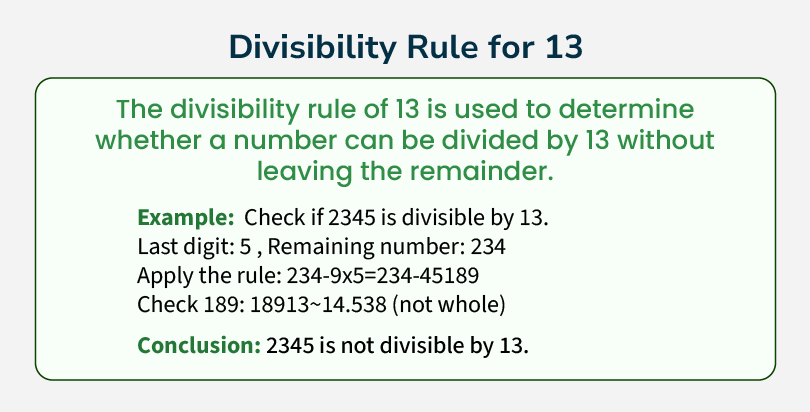
The Divisibility rule of 13 is explained in detail in the image below.

**For Example: Let’s take the number 273.
Last digit = 3
Remove the last digit from the number, Remaining number = 27Apply the rule: 27 - 9 × 3 = 27 - 27 = 0
Since 0 is divisible by 13, the number 273 is divisible by 13.
Divisibility Rule of 13
The divisibility rule of 13 is used to determine whether a number can be divided by 13 without leaving the remainder.
Mathematical division rules make it simple to determine if a given number is divisible by another integer without the need for division operations. The numbers 2 through 13 are the most widely utilized in divisibility rules.
Some of the points, you must go through:
- Take the last digit of the value.
- Make it double.
- After that subtract the double digit you get from the remaining part.
- Lastly, Check whether the number is divisible by 13, or not.
Divisibility Rules for 13 Examples
These are some of the important rules of divisibility for 13:
- Last Three Digits Rule
- Rule of Alternating Sum of Triplets
- Multiplying by 4 Rule
- Subtracting Twice the Last Digit Rule
Let's discuss these rules in detail.
Rule 1: Last Three Digits Rule
- If the last three digits of a number form a multiple of 13, then the entire number is divisible by 13.
**For Example: **Is 1,169 divisible by 13?
**Solution:
The last three digits of the given value is 169.
Dividing 169 by 13 is 13 or it can be a multiple of 13 also.
Therefore, 1,169 is also divisible by 13.
Rule 2: Rule of Alternating Sum of Triplets
- Starting from the right, take groups of three digits from the given value.
- Then, find out the alternating sum.
- At last, If the resulting sum is divisible by 13, then the given value is also divisible by 13.
**For Example: Is 7,884 divisible by 13?
**Solution:
Starting from the right, three digits from the value is 884.
Subtract from the last digit, [884-7 = 877]
Dividing 877 by 13 is 67, It's divisible by 13.
Therefore, 7,884 divisible by 13.
Rule 3: Multiplying by 4 Rule
- Take the last digit of the value.
- Make it double.
- After that add the double digit you get from the remaining part of the value.
- Lastly, Check whether the number is divisible by 13, or not.
**For Example: **Is 736 divisible by 13?
**Solution:
In this term, the Last digit is 6, and the double of 1 is [2×6 = 12]
Addition of 12 from the remaining number in value is 73 + 12= 85
After dividing 85 by 13 is 6.538, and so on, it's not divisible by 13.
Therefore 736, is not divisible by 13.
Rule 4: Subtracting Twice the Last Digit Rule
- Take the last digit from the value.
- After that, Subtract twice the last digit of the number from the remaining part.
- At last, the value is divisible by 13, then the original number is divisible by 13.
**For Example: **Is 2,723 divisible by 13?
**Solution:
In this term, the Last digit is 3, and the double of 3 is [2 × 3 = 6]
The subtraction of 6 from the remaining part is 272 - 6 = 266.
After dividing 266 by 13, it is 20.4 so on, it is divisible by 13.
Therefore 2,723, is divisible by 13.
Divisibility Rule of 13 for Large Numbers
- **Context: Simplifying the process of checking divisibility by 13 for large numbers, such as five-digit integers.
- **Method:
- **Create Triplets: Start with the rightmost digit and group the digits into triplets.
- **Calculate Alternating Sum: Find the alternating sum of these triplets.
- **Check Divisibility: Determine if the alternating sum is divisible by 13.
- **Example:
- **Number: 43,925.
- **Step 1: Group into triplets: 925 and 43.
- **Step 2: Calculate alternating sum: 925 - 43 = 882.
- **Step 3: Check divisibility: See if 882 is divisible by 13.
- **Conclusion: If 882 is divisible by 13, then 43,925 is also divisible by 13.
Divisibility Rule of 13 and 14
Divisibility Rule of 13:
**Application: For large integers, subtract and add groups of three digits alternately, starting from the rightmost digit.
**Rule: If the resultant sum is divisible by 13, then the original number is also divisible by 13.
**Divisibility Rule of 14:
This rule is more complicated, often involving checks for divisibility by both 2 and 7.
**Example:
Number: 3,842.
**Process: The last digit is 2. Calculate 842 - 3 = 839.
**Check: 839 is not divisible by 7.
**Conclusion: Therefore, 3,842 is not divisible by 14.
Divisibility Test of 13 and 17
- Method: Involves alternating subtraction and addition of groups of three digits.
- **Rule for 13: If the resultant sum is divisible by 13, then the original number is also divisible by 13.
- **Rule for 17: More complex than the rule for 13. Requires practice and understanding of divisibility rules for smaller numbers.
Example for 17:
- **Number: 3,456.
- **Process: Subtract the last three digits from the remaining part: 456 - 3 = 453.
- **Check: 453 is not divisible by 17.
- **Conclusion: Therefore, 3,456 is not divisible by 17.
**Related Articles:
Solved Examples on 13 Divisibility Rule
Let's solve some questions on the rules of divisibility for the number 13.
**1. Check the divisibility of 785423592 by 13.
**Solution:
To check the divisibility of 785423592 by 13 using the "Multiplying by 4 Rule":
Double the last digit: 2×2=4.
Add it to the remaining part of the number: 78542359 + 4 = 78542359The sum is not divisible by 13, as 78542363 is not divisible by 13. Therefore, according to the "Multiplying by 4 Rule," 785423592 is not divisible by 13.
**2. Check the divisibility 2754296835 by 13.
**Solution:
To check the divisibility of 2754296835 by 13 using the **Alternating Sum of Triplets Rule:
Starting from the right, take groups of three digits: 835,683,496,742, 572.
Find the alternating sum: 835−683+496−742+572 = 478.
Check if the resulting sum (478) is divisible by 13.Therefore, 478 is not divisible by 13, the Alternating Sum of Triplets Rule suggests that 2754296835 is not divisible by 13.
**3. Is 298 divisible by 13?
**Solution:
To check the divisibility of 298 by 13 using the "Multiplying by 4 Rule":
Double the last digit: 2 × 8 = 16.
Add it to the remaining part of the number: 29+16=45.Therefore, 45 is not divisible by 13, according to the "Multiplying by 4 Rule," 298 is not divisible by 13.
Example 4: Is 1,139 divisible by 13?
To check the divisibility of 1,139 by 13 using the Last Three Digits Rule:
The last three digits are 139.
Check if 139 is divisible by 13.Therefore, 139 is not divisible by 13, the Last Three Digits Rule suggests that 1,139 is not divisible by 13.
Divisibility Rule of 13 Worksheet
**Q1: Check the divisibility of 936 by 13 using the "Multiplying by 4 Rule."
**Q2: Is 5,726 divisible by 13?
**Q3: Is 7,14,369 divisible by 13?
**Q4: Use the "Last Three Digits Rule" to check if 9,874,123 is divisible by 13.
**Q5: Check that 1,635 is divisible by 13 using the "Alternating Sum of Triplets Rule."