Dot and Cross Products on Vectors (original) (raw)
Last Updated : 10 Dec, 2025
A quantity that has both magnitude and direction is known as a vector. Various operations can be performed on such quantities, such as addition, subtraction, and multiplication (products), etc. Some examples of vector quantities are: velocity, force, acceleration, and momentum etc.
Vectors can be multiplied in two ways:
- **Scalar Product (Dot Product)
- **Vector Product (Cross Product)
**Scalar Product/Dot Product of Vectors
The result of the scalar product/dot product of two vectors is always a scalar quantity. Consider two vectors **a and **b. The scalar product is calculated as the product of the magnitudes of a, b and the cosine of the angle between these vectors.
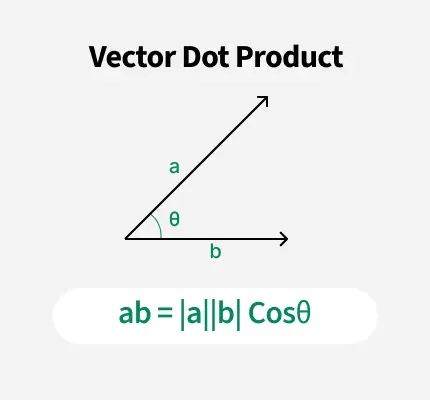
Dot Product of a and b
Scalar Product = |a||b| cos α
Here,
- |a| = magnitude of vector a,
- |b| = magnitude of vector b, and
- α = angle between the vectors.
**Properties of the Scalar Product
- The scalar product of two vectors is always a real number (scalar).
- It is commutative, i.e., a · b = b · a.
- The scalar product is also distributive over addition, i.e., a · (b + c) = a · b + a · c.
- If α = 90°, then the scalar product is zero, as cos(90°) = 0. So, the scalar product of unit vectors in the x and y directions is 0.
- If α = 0°, then the scalar product is simply the product of the magnitudes: |a||b|.
- The scalar product of a unit vector with itself is 1.
- The scalar product of a vector a with itself is |a| |².
- If α = 180°, the scalar product of vectors a and b is −|a||b|.
- For any scalar l and m, then, (la) ⋅ (mb) = lm (a ⋅ b)
**Other Properties
**1) If the component form of the vectors is given as:
- a = a1x + a2y + a3z
- b = b1x + b2y + b3z
Then the scalar product is given as:
a.b = a1b1 + a2b2 + a3b3
**2) The scalar product is zero in the following cases:
- The magnitude of vector a is zero
- The magnitude of vector b is zero
- Vectors a and b are perpendicular to each other
**Inequalities Based on Dot Product
There are various inequalities based on the dot product of vectors, such as:
- Cauchy-Schwarz inequality
- Triangle Inequality
**Cauchy-Schwarz inequality
According to this principle, for any two vectors a and b, the magnitude of the dot product is always less than or equal to the product of the magnitudes of vector a and vector b: |a.b| ≤ |a| |b|
**Proof:
Since, a.b = |a| |b| cos α
We know that 0 < cos α < 1
So, we conclude that |a.b| ≤ |a| |b|
**Triangle Inequality
For any two vectors **a and **b, we always have: |a+ b| ≤ |a| + | b|.
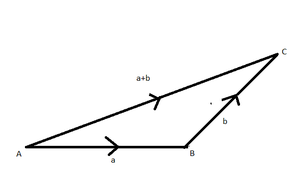
Triangle inequality
**Proof:
|a + b|2 = |a + b||a + b|
= a.a + a.b + b.a + b.b
= |a|2 + 2a.b + |b|2 (dot product is commutative)
≤ |a|2 + 2|a||b| + |b|2
≤ (|a| + |b|)2This proves that |a + b| ≤ |a| + |b|
**Solved Examples of Dot Products
**Example 1. Consider two vectors such that |a|=6 and |b|=3 and α = 60°. Find their dot product.
**Solution:
a.b = |a| |b| cos α
So, a.b = 6.3.cos(60°)
=18(1/2)a.b = 9
**Example 2. Prove that the vectors a = 3i+j-4k and b = 8i-8j+4k are perpendicular.
**Solution:
We know that the vectors are perpendicular if their dot product is zero
a.b = (3i + j - 4k)( 8i - 8j + 4k)
= (3)(8) + (1)(-8) + (-4)(4)
= 24 - 8- 16 = 0Since, the scalar product is zero, we can conclude that the vectors are perpendicular to each other.
**Cross Product/Vector Product of Vectors
The cross product or vector product gives another vector as an output that is always perpendicular to both a and b. The magnitude of the cross product is equal to the area of the parallelogram.
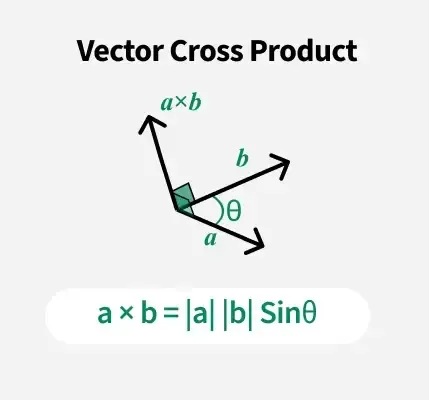
Cross Product of a and b
The vector product or cross productof two vectors **a and **b with an angle α between them is mathematically calculated as:
a × b = |a| |b| sin α
It is to be noted that the cross-product is a vector with a specified direction.
Also, if given two vectors, a = (a1, a2, a3) cross, b = (b1, b2, b3) their cross product, denoted by a × b, wich is calculated as:
\mathbf{a} \times \mathbf{b} = (a_2b_3 - a_3b_2, a_3b_1 - a_1b_3, a_1b_2 - a_2b_1)
In case a and b are parallel vectors, the resultant shall be zero as sin(0) = 0
**Properties of Cross-Product
- Cross Product generates a vector quantity. The resultant is always perpendicular to both a and b.
- Cross Product of parallel vectors/collinear vectors is zero as sin(0) = 0. Therefore, i × i = j × j = k × k = 0.
- The cross product of two mutually perpendicular vectors, each with unit magnitude, is unity. (Since sin(90°) = 1).
- The cross product is not commutative: a × b is not equal to b × a.
- The cross-product is distributive over addition: a × (b + c) = a × b + a × c.
- If k is a scalar, then: k(a × b) = k(a) × b = a × k(b)
- On moving in a clockwise direction and taking the cross product of any two pairs of the unit vectors, we get the third one, and in an anticlockwise direction, we get the negative resultant.
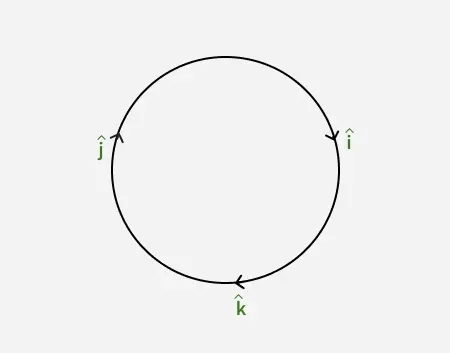
Clockwise direction and taking the cross product
The following results can be established:
| i × j = k | j × k = i | k × i = j |
|---|---|---|
| j × i = -k | i × k= -j | k × j = -i |
**Cross-product in Determinant Form
If the vector a is represented as a = a1x + a2y + a3z and vector b is represented as b = b1x + b2y + b3z
The cross product a × b can be computed using the determinant form
\begin{array}{ccc} x & y & z \\ a 1 & a 2 & a 3 \\ b 1 & b 2 & b 3 \end{array}
Then, a × b = x(a2b3 - b2a3) + y(a3b1 - a1b3) + z(a1b2 - a2b1)
If a and b are the adjacent sides of the parallelogram OXYZ, and α is the angle between the vectors a and b.
Then the area of the parallelogram is given by |a × b| = |a| |b|sin α.
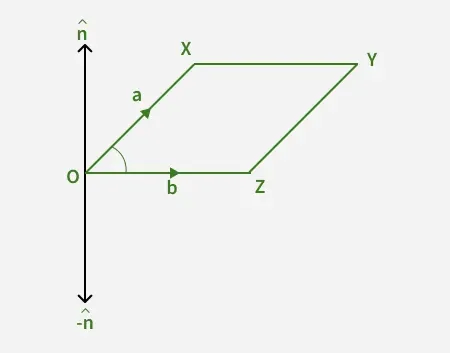
Cross product in determinant form
Solved Examples of Cross Products
**Example 1: Find the cross product of two vectors a and b if their magnitudes are 5 and 10, respectively. Given that the angle between them is 30°.
**Solution:
a × b = a.b.sin (30)
= (5) (10) (1/2)
= 25 perpendicular to a and **b
**Example 2: Find the area of a parallelogram whose adjacent sides are
- a = 4i+2j -3k
- b 2 i +j-4k
**Solution:
The area is calculated by finding the cross product of adjacent sides
a × b = x(a2b3 - b2a3) + y(a3b1 - a1b3) + z(a1b2 - a2b1)
= i(-8+3) + j(-6+16) + k(4-4)
= -5i +10jTherefore, the magnitude of area is \sqrt{(5^2 +10^2)}
= \sqrt{(25+100)}
= \sqrt{(125)}=5\sqrt{5}
Related Articles
Dot vs Cross-Product
Some of the common differences between the dot and cross products of vectors are:
| **Property | Dot Product | Cross Product | ||
|---|---|---|---|---|
| **Definition | a⋅b = |a | b | cos _θ, where _θ is the angle between the vectors. | |
| **Result | Scalar | Vector | ||
| **Commutativity | Holds [a⋅b = b⋅a] | Doesn't hold [a×b = −(b×a)] | ||
| **Direction | Scalar value, no direction | Perpendicular to the plane containing **a and **b | ||
| **Orthogonality | Two vectors are orthogonal if their dot product is zero. | The cross product of two non-zero vectors is orthogonal to both of them. | ||
| **Applications | Finding the angle between vectors, the projection of one vector onto another | Finding torque in physics, determining normal vectors to surfaces |
Practice Problem Based on Dot and Cross Products on Vectors
**Question 1. Given two vectors{a} = 4\hat{i} + 3\hat{j} + 2\hat{k}, calculate{b} = 2\hat{i} - \hat{j} + 4\hat{k} the dot product.
**Question 2. Find the angle θ between the two vectors{a} = 5\hat{i} - 2\hat{j} + 3\hat{k}.{b} = 3\hat{i} + 4\hat{j} - \hat{k} Use the formula for the dot product to find the angle between the vectors.
**Question 3. Given two vectors{a} = 7\hat{i} + 2\hat{j} - 5\hat{k}, prove{b} = 3\hat{i} - 1\hat{j} + 2\hat{k} whether the vectors {a}a{b}re perpendicular.
**Question 4. Given two vectors{a} = 2\hat{i} + 4\hat{j} - \hat{k}, find{b} = -\hat{i} + 2\hat{j} + 3\hat{k} the cross product {a} \times \mathbf{b}in component form.
**Question 5. Find the area of a parallelogram whose adjacent sides are represented by the vectors. {a} = 6\hat{i} + \hat{j} - 4\hat{k} {b} = 3\hat{i} - 5\hat{j} + 2\hat{k}Use the cross product formula to calculate the area.
**Question 6. Given the vectors, find{a} = 3\hat{i} - \hat{j} + 4\hat{k}, {b} = 2\hat{i} + 3\hat{j} + \hat{k} **the direction of the cross product using the right-hand rule. Additionally, calculate the magnitude of the cross product.
**Answer:-
1. 13
2. \theta = \cos^{-1}(0.127) \approx 82.73^\circ
3. a.b ≠0
4. 14\hat{i} - 5\hat{j} + 8\hat{k}
5. 44.7 Square units
6. {a} \times \mathbf{b} = -13\hat{i} + 5\hat{j} + 11\hat{k} , |\mathbf{a} \times \mathbf{b}|=\sqrt{315}