Exponential Series (original) (raw)
Last Updated : 24 Jul, 2024
**Exponential series is one among simple mathematical concepts that can be employed in the different branches of sciences and engineering disciplines. Exponential series is a mathematical series used to represent the exponential function ex in the form of an infinite sum.
In this article, we have covered "What is Exponential Series", the exponential series formula, its definition, its properties, derivation, and its usage and application.
What is an Exponential Series?
Exponential Series Definition
An exponential series is an infinite series representation of the exponential function, often used to express the function in a form that is easier to manipulate mathematically. It expands the exponential function into an infinite sum of terms involving powers of the variable. This series is significant because it converges for all real and complex numbers, providing a universal way to approximate exponential functions.
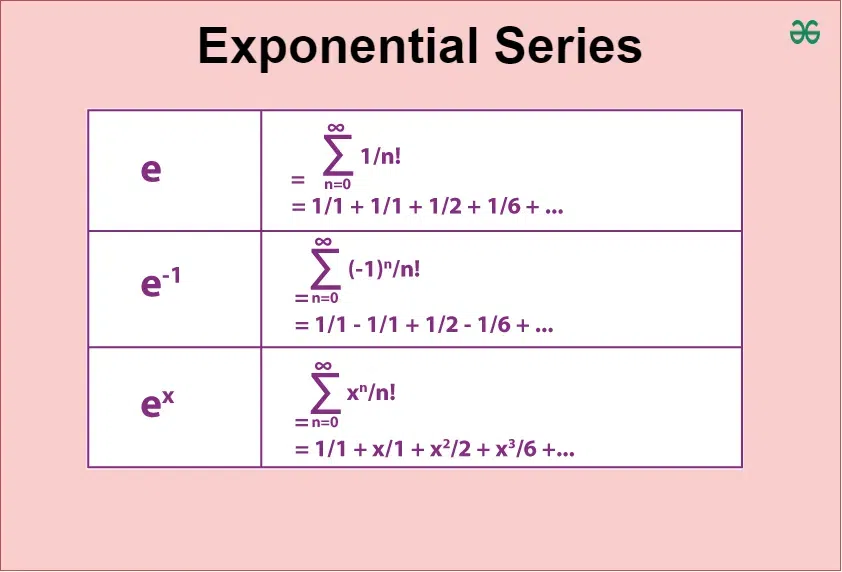
Exponential Series
It is also the basis for various mathematical courses like calculus and differential equations because of its unusual properties such as the fact that it is its own derivative. It also plays an important role in theoretical and applied branches of knowledge such as physics, engineering, and finance.
**For example, evaluate e2 using the first four terms of the series:
e2 ≈ 1 + 2 + 22/2! + 23/3!
= 1 + 2 + 2 + 8/6
≈ 7.33
Importance of Exponential Series
The importance of the Exponential Series is as follows:
- **Calculus: Integral to solving differential equations.
- **Engineering: Used in modeling and solving problems in electrical engineering.
- **Physics: Essential in quantum mechanics and statistical mechanics.
- **Finance: Helps in the modeling of compound interest and options pricing.
- **Computer Science: Important in algorithms involving growth rates and big-O notation.
Exponential Series Formula
The general formula for the exponential series is:
e^x~=~\sum_{n=0}^{\infty} \frac{x^n}{n!}
where:
- **e is Euler's Number
- **x is Exponent
- **n is Index, starting from 0
- **n! is Factorial of n, {Defined as n! = n⋅(n−1)⋅…⋅1, with 0! = 1}
Each term in the series is calculated as x^n/n!, with the terms becoming increasingly smaller as n increases, leading to convergence of the series.
Exponential Function Derivative
For the exponential function f(x) = ex its derivative is, ex this is explained as:
If **f(x) = e x
**f'(x) = d/dx(e x ) = e x
That is the derivative of the exponential function is the function itself.
Exponential Function Integration
For the exponential function f(x) = ex its integration is, ex this is explained as:
If **f(x) = e x
**∫f(x) = ∫(e x ) dx = e x + C
That is the integration of then expontetial function is the function itself.
Properties of Exponential Series
The properties of Exponential Series are as follows:
- **Convergence: The series converges for all x ∈ R
- **Self-Derivative: d/dx {ex} = ex
- **Sum of Series: Sum of the series from −∞ to ∞ equals ex
- **Symmetry: e−x = 1/ex
- **Addition Formula: ex+y = ex⋅ey
The graph of exponential function is added below:

Exponential Function Graph
Derivations and Proofs
To prove that ex is its own derivative
\frac{d}{dx} \left( \sum_{n=0}^{\infty} \frac{x^n}{n!} \right) = \sum_{n=1}^{\infty} \frac{nx^{n-1}}{n!} = \sum_{n=1}^{\infty} \frac{x^{n-1}}{(n-1)!} = e^x
Use Ratio Test
\lim_{n \to \infty} \left| \frac{\frac{x^{n+1}}{(n+1)!}}{\frac{x^n}{n!}} \right| = \lim_{n \to \infty} \left| \frac{x}{n+1} \right| = 0
Applications of Exponential Series
Various application of Exponential Series are as follows:
- **Solving Differential Equations: Used extensively in solutions to differential equations.
- **Compound Interest: Models growth of investments over time.
- **Signal Processing: Applies in the analysis and transformation of signals.
- **Probability Theory: Integral in defining exponential distributions.
- **Network Theory: Models growth processes in network structures.
Conclusion
Exponential series can be considered a primary element of the fundamental branch of mathematics known as mathematical analysis with numerous practical implications in numerous sciences. That is why it is actively used in theoretical and practical calculations: it has properties such as self-derivation and universal convergence.
Understanding the exponential series equips students with critical insights and techniques for tackling complex problems in numerous fields.
Solved Examples on Exponential Series
**Example 1: Approximate e 1 using the first five terms of the exponential series.
**Solution:
To approximate e1 using the first five terms of the exponential series:
e^1 \approx 1 + \frac{1^1}{1!} + \frac{1^2}{2!} + \frac{1^3}{3!} + \frac{1^4}{4!}
Individual terms calculation:
1^0/0! = 1/1 = 1
1^1/1! = 1/1 = 1
1^2/2! = 1/2 = 0.5
1^3/3! = 1/6 \approx 0.1667
1^4/4! = 1/24 \approx 0.0417
Summing the terms:
e1 = 1 + 1 + 0.5 + 0.1667 + 0.0417 = 2.7084
**Example 2: Approximate e 3 using terms up to n=4 in the exponential series.
**Solution:
To approximate e3 using terms up to n=4:
e^3 \approx 1 + \frac{3^1}{1!} + \frac{3^2}{2!} + \frac{3^3}{3!} + \frac{3^4}{4!}
Individual terms calculation:
3^0/0! = 1/1 = 1
3^1/1! = 3/1 = 3
3^2/2! = 9/2 = 4.5
3^3/3! = 27/6 = 4.5
3^4/4! = 81/24 = 3.375
Summing the terms:
e3 = 1 + 3 + 4.5 + 4.5 + 3.375 = 16.375
Practice Problems on Exponential Series
**P1. Approximate e 4 using the first three terms of the exponential series.
**P2. Approximate e −3 using the exponential series up to the term where n = 3.
**P3. Calculate e 1.5 using the exponential series up to the term where n = 5.