Exponents (original) (raw)
Last Updated : 27 Apr, 2026
An exponent tells you how many times a number (called the _base) is multiplied by itself. Exponents are a way to show repeated multiplication of the same number.
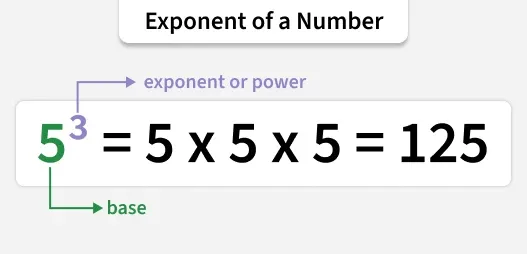
Exponents act like a shortcut for repeated multiplication.
For example: 23 means 2 is multiplied by itself three times = 2×2×2 = 8
**Exponents Examples
Exponents are mathematical symbols used to represent the multiplication of the same number multiple times. They help us express large values in a simpler form by indicating how many times a number is multiplied by itself.
**Some examples are given below:
**Example 1: If a file initially has a size of 50 MB and its size is halved in each step, what will be the size after 5 steps?

**Solution:
The file size after 5 steps can be calculated using the formula:
Final Size = 50 x (1/2)5
After solving this, the final size will be approximately 1.5625
**Example 2: Suppose we have a number 5 which is multiplied by itself 5 times, then this is expressed as, **5×5×5×5×5
As we can see,this is a very tedious way of representing the number in exponent; this is represented as,
**5×5×5×5×5 = 5 5 **= 3125
Thus, the exponent is a very short way of representing large numbers.
Negative Exponents
Negative Exponent is nothing but the exponents of the reciprocal numbers; thus, negative exponents are easily solved by taking the reciprocal and then easily solving the exponent using the normal rules. This is represented as,
**x -n = (1/x) n
Suppose we have to solve for the negative exponent (2)-3 then,
(2)-3 = (1/2)3 = 1/8
Thus, exponent rules can be applied directly to simplify expressions involving exponents, including negative exponents.
Exponents with Fractions
The exponents with the fraction are also called the radicals. These are the exponents that have a fraction of their power. The square root, cube root, nth root, and others are all called exponents with fractions.
We represent the fraction exponents as,
- Square Root = √()
- Cube Root = 3√()
- nth Root = n√()
Now the fraction exponent is solved in two parts. In the first part, we solve the denominator and then solve the numerator, which is represented as,
**x n/m = {(x) 1/m } n
Here, we first solve (x)1/m and then take its nth power to get the final answer. This can be understood by the example added below,
**Example: Simplify 4 3/2
**Solution:
= 43/2
= (41/2)3
= 23 = 8
Decimal Exponents
Decimal Exponents are nothing but another way of representing the fraction exponents. If any exponent is given in the decimal form then we first change it into fraction form and then easily solve for the fraction form.
This can be understood by the example added below,
**Example: Simplify 4 1.5
**Solution:
= 41.5 (As, 1.5 = 3/2)
= 43/2
= (41/2)3
= 23 = 8
Exponent Table
| **Type of Exponent | **Expression | **Expansion | **Simplified value |
|---|---|---|---|
| Zero exponent | 60 | 1 | 1 |
| One exponent | 41 | 4 | 4 |
| Exponent and power | 23 | 2 × 2 × 2 | 8 |
| Negative exponent | 5-3 | 1/53 = 1/(5 × 5 × 5) | 1/125 |
| Rational exponent | 91/2 | √9 | 3 |
| Multiplication | 32 × 33 | 3(2 + 3) = 35 | 273 |
| Quotient | 75/ 73 | 7(5 – 3) = 72 | 49 |
| Power of Product | 32 × 42 | ( 3 x 4) 2 = 122 | 144 |
| Power of an exponent | (82)2 | 8(2 × 2) = 84 | 4096 |
Laws of Exponents
There are seven laws of exponents that we study under this heading.
**1) Multiplication Law: This rule states that two numbers in exponential form having the same base are multiplied, then their product contains the same base and their powers get added.
For Example 23 ⨯ 24 = 23+4 = 27
**2) Division Law: The Quotient rule states that two numbers in exponential form are divided, then the quotient has the same base and their powers get subtracted. For Example: 35/32 = 35-2 = 33
**3) Power of Power Rule: If a number in exponential form is raised to some power, then its powers get multiplied. For Example, (43)2 = 43⨯2 = 46
**4) Power of a Product Rule: If two numbers in the exponential form that have different bases but the same exponents are multiplied, then the product has the base equal to the product of the two bases, and the power remains the same. For Example, 32⨯42 = (3x4)2 = 122 = 144
**5) Power of Quotient Rule: If two numbers in the exponential form that have a different base but the same exponents are divided, then the quotient has the base equal to the quotient of the two bases, and the power remains the same. For Example, 63/33 = 23 = 8
**6) Zero Exponent Rule: Any number raised to the power of zero gives 1. For Example, (101)0 = 1
**7) Negative Exponent Rule: If any number is raised to a negative power, then to make the power positive, the base is converted to its reciprocal. For Example, 2-3 = (1/2)3 = 1/23 = 1/8
Scientific Notation with Exponents
Scientific Notation is a way of writing very large numbers as very small numbers. In scientific notation, the numbers are represented in the multiple of 10. The number is first converted into its unit form and then the number is multiplied with the power of 10 to get the number in scientific notation.
These numbers are useful in writing very large and very small numbers. Suppose we have to write 15670000, then in scientific notation it is represented as **1.567×10 7
Any number can be easily represented in the scientific notation by following the steps added below.
- **Step 1: If the number is greater than onemark the decimal digit after the first digit from the starting of the number.
- **Step 2: Then multiply the number with the 10 raise to the power as their are digits after the decimal or point (include zero in the counting)
- **Step 3: If the number is smaller than one shift the decimal to the first digit counting from the left of the number excluding zeros.
- **Step 4: Then multiply the number with the 10 raise to the negative power as their are digits from which the decimal is shift.
**Example 1: Convert 134500000000 into scientific notation.
**Solution:
= 134500000000
= 1.345 × 10⁸
**Example 2: Convert 0.0000001345 into scientific notation.
**Solution:
= 0.0000001345
= 1.345 × 10⁻⁷
**Exponents Formulas
The formulas that are widely used for solving the exponents are added in the table below,
| Exponents Formulas | |
|---|---|
| n times product exponent formula | **x.x.x.x ... n times = x n |
| Multiplication Rule | **x m ****. x** n = x (m + n) |
| Division Rule | **x m /x n = x (m - n) |
| Power of the product rule | ****(xy)** n = x n . y n |
| Power of a fraction rule | ****(x/y)** n = x n /y n |
| Power of the power rule | **[(x) m ] n = x mn |
| Zero Exponent | ****(x)** 0 **= 1, if x ≠ 0 |
| One Exponent | ****(x)** 1 = x |
| Negative Exponent | **x -n = 1/x n |
| Fractional Exponent | **x m/n = **n √(x) m |
**Note: If an equation base is the same we can equate the exponents.
**Exponents Solved Examples
**Example 1: Solve the following:
- 2.2.2.2
- 32.33
- (4.5)2
- (5)0
- 2-2
- 25/23
- [(3)1]2
- 43/2
- (4/3)2
**Solution:
- 2.2.2.2 = 24 =16
- 32.33 = 3(2 + 3) = 35 = 243
- (4.5)2 = 42.52 = (16).(25) = 400
- (5)0 = 1
- 2-2 = 1/22 = 1/4
- 25/23 = 2(5-3) = 22 = 4
- [(3)1]2 = 3(1.2) = 32 = 9
- 43/2 = √(4)3 = √64 = 8
- (4/3)2 = 42/32 = 16/9
**Example 2: Simplify:
- (23 ÷ 24)-2.23
- 3(-2)÷ 42
- 33.42/64
- (3-1 + 2-2 + 4-1)
**Solution:
****(1)**
(23 ÷ 24)-2.23
= (23/24)-2.23
= [2(3 - 4)]-2.23
= [2-1]-2.23
= 2(-1).(-2).23
= 22.23
= 25 = 32****(2)**
3(-2) ÷ 42
= 1/(3)2(4)2
= 1/9.16 = 1/144****(3)**
33.42/64
= 33.42/(2.3)4
= 33.24/24.34
= 1/3****(4)**
(3-1 + 2-2 + 4-1)
= (1/3 + 1/22 +1/4)
= (1/3 + 1/4 + 1/4)
= 5/6
**Example 3: Find the value of x if (4)x + 12 = (4)2x + 6.(2)6
**Solution:
(4)x+12 = (4)2x+6.(22)3
(4)x+12 = (4)2x+6.(4)3
(4)x+12 = (4)2x+6+3
(4)x+12 = (4)2x+9Since, bases are equal powers gets equated
x +12 = 2x + 9
2x - x = 12 - 9
**x = 3
**Example 4: Find the value of {3434/3}1/4
**Solution:
{3434/3}1/4= {(73)4/3}1/4
= {7}3.(4/3).(1/4) = 7
**Example 5: Find the value of x + y if:
(81)y = 27/(3)x, 4y= 256
**Solution:
(34)y = (33)/(3)x
(3)4y = (3)3-xSince, bases are equal then powers get equated
4y = 3-x ⇢ Equation (1)
4y = 256
4y = (4)4
y = 4Putting the value of y in Equation 1,
4.4 = 3-x
16 = 3-x
x = -13Now, we have to find value of x + y
**x + y = -13+4 = -9
**Example 6: If (-9)2x+7 = (-9)x. 81, then find the value of (x2 + 1)/(x2 - 12).
**Solution:
(-9)2x+7 = (-9)x . 81
(-9)2x+7 = (-9)x . (-9)2
(-9)2x+7 = (-9)x+2Since, bases are equal then powers get equated
2x + 7 = x + 2
2x - x = 2 - 7
x = -5Now, we have to find value of (x2 + 1)/(x2 - 12)
(x2 + 1)/(x2 - 12) = [(-5)2 + 1]/[(-5)2 - 12]
= [25 + 1]/[25 - 12]
= 26/13****(x** 2 + 1)/(x 2 - 12) = 2
Practice Questions on Exponents
**Question 1: Solve (32)1/5 +(-9)0 + (64)1/3
**Question 2: Simplify (64/81)-3/4 ⨯ (25/9)-3/2
**Question 3: Find x when 3x+2/35 = 27
**Question 4: Find x when (64)x = 16/4x
**Question 5: Find multiplicative inverse of [(-13)-1]2 ÷ (91)-1