Fourier Transform (original) (raw)
Last Updated : 17 Feb, 2026
Fourier transform is a mathematical model that decomposes a function or signal into its constituent frequencies. It helps to transform the signals between two different domains, like transforming the frequency domain to the time domain.
The Fourier Transform decomposes a complex signal into simpler sine and cosine waves of different frequencies and amplitudes, which can be combined again to reconstruct the original signal.
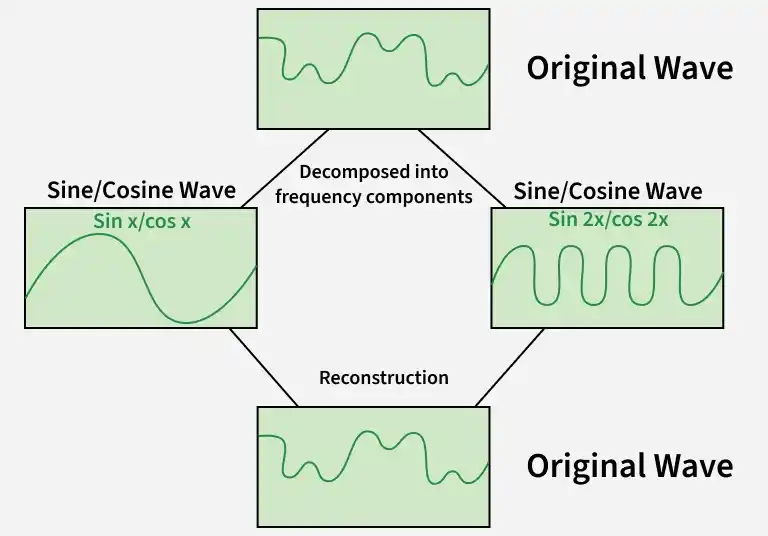
Decomposing a signal into sine and cosine waves using Fourier Transform.
- The generalized form of the complex Fourier series is referred to as the Fourier transform.
- It is a powerful tool used in many fields, such as signal processing, physics, and engineering, to analyze the frequency content of signals or functions that vary over time or space.
- It is used to represent the mathematical functions and the frequency domain.
- It helps to expand the non-periodic functions and convert them into easy sinusoidal functions.
Continuous Fourier Transform (CFT)
For a continuous-time function f(t), the Fourier transform F(ω) is defined as:
**F(ω) = \bold{\int\limits_{-\infty}^\infty} f(t)e iωt **dt
where:
- **F(ω) is the Fourier transform of f(t)
- **ω is the Angular Frequency
- **i is the Imaginary Number (**i 2 = -1)
- **t is Time
Fourier Transform Formulas
The formula for the Fourier transforms of a function f(x) is given by:
**f(x) = \bold{\int\limits_{-\infty}^\infty}**F(k)e 2πikx **dk
**F(k) = \bold{\int\limits_{-\infty}^\infty}**f(x)e -2πikx **dx
There are two types of Fourier transform i.e., forward Fourier transform and inverse Fourier transform.
Forward Fourier Transform
The forward Fourier transform is a mathematical technique used to transform a time-domain signal into its frequency-domain representation. This transformation is fundamental in various fields, including signal processing, image processing, and communications. Forward Fourier Transform is represented by F(k). The symbol for forward Fourier transform is \hat {f}(k) and is defined as:
**F(k) = \bold{\int\limits_{-\infty}^\infty}**f(x)e -2πikx **dx
Inverse Fourier Transform
The inverse Fourier transform is the process of converting a frequency-domain representation of a signal back into its time-domain form. This is the reverse process of the forward Fourier transform. Inverse Fourier Transform is represented by f(x). Symbol for Inverse Fourier transform is \widecheck {f}(x) and is defined as:
f(x) = F^{-1}_k[F(k)] (x) = \bold{\int\limits_{-\infty}^\infty}**F(k)e 2πikx **dk
Properties of Fourier Transform
- If a(t) has a Fourier transform A(f), then Fourier transform of A(t) is a(-f). It is called the duality property.
- Fourier transform is a linear transform. It is called linear transform.
- Modulation property is the property in which the function is modulated by other function.
- A shift in the time domain corresponds to a phase shift in the frequency domain in Fourier Transform
- Multiplying a time-domain signal by a complex exponential corresponds to a shift in the frequency domain in Fourier Transform
- In Fourier Transform taking the complex conjugate of the time-domain signal corresponds to taking the complex conjugate of the frequency-domain signal and reversing the frequency.
Fourier Transform Table
The table below shows the Fourier transform of various functions.
| Functions | f(x) | F(k) = Fx[f(x)] |
|---|---|---|
| 1 | 1 | δ(k) |
| Sine Function | sin(2πk0x) | (1/2) × i × [δ(k + k0) - δ(k -k0)] |
| Cosine Function | cos(2πk0x) | (1/2) × [δ(k + k0) + δ(k -k0)] |
| Inverse Function | -PV(1/πx) | i[1 - 2H(-k)] |
| Exponential Function | e-2πk0|x | |
| Gaussian Function | e^{-ax^2} | \sqrt{\frac{\pi}{a}}e^{-\pi^2k^2/a} |
Applications of Fourier Transform
- Fourier transforms are used in signal processing, telecommunications, audio processing, and image processing.
- Fourier transforms are used to reduce noise, compression, etc.
- It is also used to represent the wave propagation, analysis of electrical signals and many more.
- The special form of Fourier transforms is used to represent periodic functions and infinite series in mathematics.
**Related Articles:
Solved Examples on Fourier Transform
**Example 1: What is the Fourier transform of sin 4x.
**Solution:
To find the Fourier transform of sine function we use formula:
Fourier transform of sin(2πk0x) = (1/2) × i × [δ(k + k0) - δ(k -k0)]
We have to find Fourier transform for sin 4x
Comparing
2πk0 = 4
k0 = 4/2π
k0 = 2/π
Putting in formula
F(k) = (1/2) × i × [δ(k + 2/π) - δ(k - 2/π)]
**Example 2: What is Fourier transform of cos 2πx.
**Solution:
To find the Fourier transform of cosine function we use formula:
Fourier transform of cos(2πk0x) = (1/2) × [δ(k + k0) + δ(k -k0)]
We have to find Fourier transform for sin 4x
Comparing
2πk0 = 2π
k0 = 1
Putting in formula
F(k) = (1/2) × [δ(k + 1) + δ(k - 1)]
**Example 3: Find the Fourier transform of e^{-(\pi/4)x^2}
**Solution:
To find Fourier transform of e^{-ax^2} is \sqrt{\frac{\pi}{a}}e^{-\pi^2k^2/a}
We have to find the Fourier transform for e^{-(\pi/4)x^2}
Comparing
a = π / 4
Putting in the formula
F(k) = 2 e^{-4\pi k^2}