Geometrical meaning of the Zeroes of a Polynomial (original) (raw)
Last Updated : 2 Jun, 2026
The zero of a polynomial is the value of x for which the value of the polynomial becomes 0. In other words, if p(x) = 0, then that value of x is called a zero (or root) of the polynomial.
Geometrical Meaning
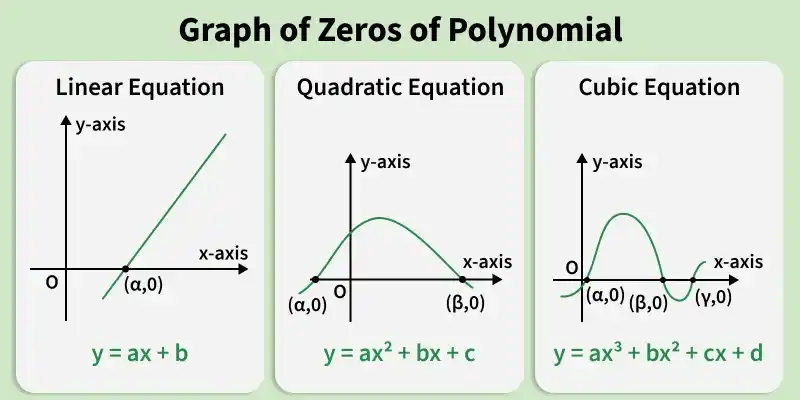
When a polynomial is represented graphically, its zeroes have a clear geometrical meaning. The zero of a polynomial is the x-coordinate of the point where its graph intersects or touches the x-axis, because at that point the value of the polynomial becomes zero.
Linear Polynomial
A linear polynomial is a polynomial of degree 1 and is written as p(x) = ax + b, where a ≠ 0 and a, b are real numbers. The graph of y = ax + b is a straight line. Since a straight line intersects the x-axis at one point, a linear polynomial has exactly one zero.
**Example: Consider the linear polynomial:
y = 2x + 3
Some points that lie on this line are: (-2, -1), (0, 3), (2, 7).
Plotting these points and joining them forms a straight line.
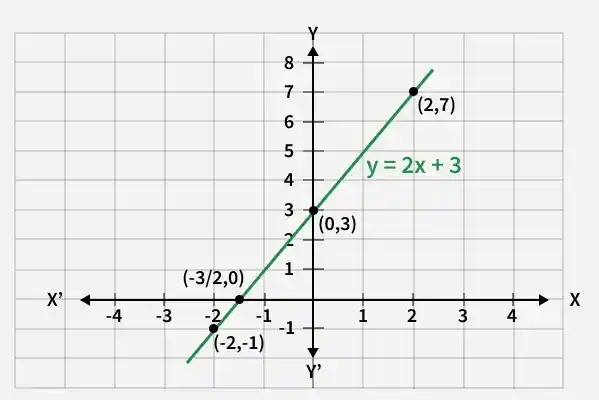
From the graph, we observe that the line intersects the x-axis between x = -1 and x = -2.
To find the exact zero, we solve: 2x + 3 = 0
x = -3/2
So, the graph intersects the x-axis at the point: (-3/2, 0)
Therefore, -3/2 is the zero of the polynomial y = 2x + 3.
**Quadratic Polynomial
A quadratic polynomial is a polynomial of degree 2 and is written in the form: p(x) = ax² + bx + c, where a ≠ 0 and a, b, and c are real numbers.
- A quadratic polynomial y = ax² + bx + c forms a parabola, and its zeroes are the x-values where the graph intersects the x-axis.
**Example: Consider the quadratic polynomial:
y = x² − 3x − 4
If we plot the points obtained from different values of x, we get a parabolic curve.
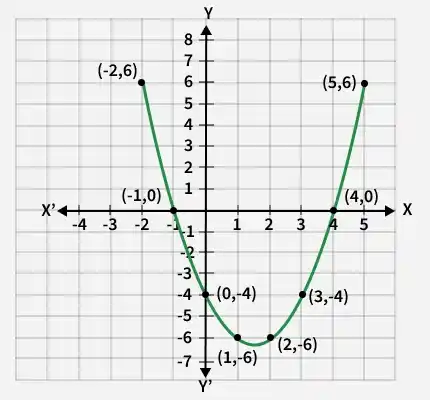
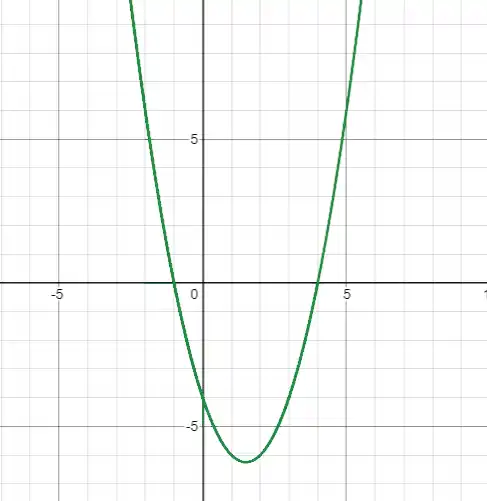
From the graph, the curve intersects the x-axis at (-1, 0) and (4, 0), so the zeroes of the polynomial are −1 and 4.
Cases of Zeros of a Quadratic Polynomial
A quadratic polynomial can have at most two zeroes, depending on how its graph intersects the x-axis.
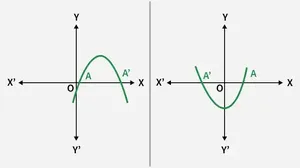
**Case 1: Two Zeroes
The parabola cuts the x-axis at two distinct points, so the quadratic polynomial has two real zeroes.
**Case 2: One Zero
The parabola touches the x-axis at exactly one point, so the quadratic polynomial has one real zero.
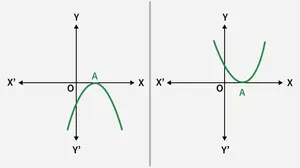
**Case 3: No Real Zero
The parabola does not intersect the x-axis, so the quadratic polynomial has no real zeroes.
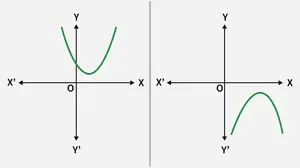
**Cubic Polynomial
A cubic polynomial is a polynomial of degree 3 and is generally written as: p(x) = ax³ + bx² + cx + d, where a ≠ 0.
The zeroes of the polynomial are the x-coordinates of the points where the graph intersects the x-axis.
Cases of Zeros of a Cubic Polynomial
A cubic polynomial can have at most three zeroes, depending on how the curve intersects the x-axis.
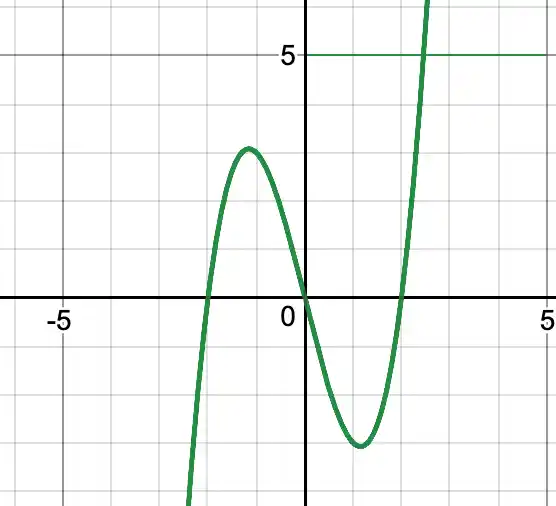
**Case 1: Three Zeroes
If the curve cuts the x-axis at three different points, then the polynomial has three real zeroes.
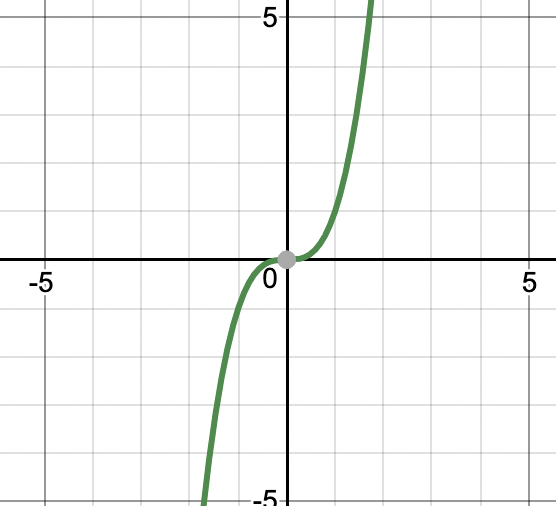
**Case 2: One Zero
If the curve intersects the x-axis at only one point, then the polynomial has one real zero.
**Case 3: Two Zeroes
Sometimes the curve intersects the x-axis at two points only, so the polynomial has two real zeroes.
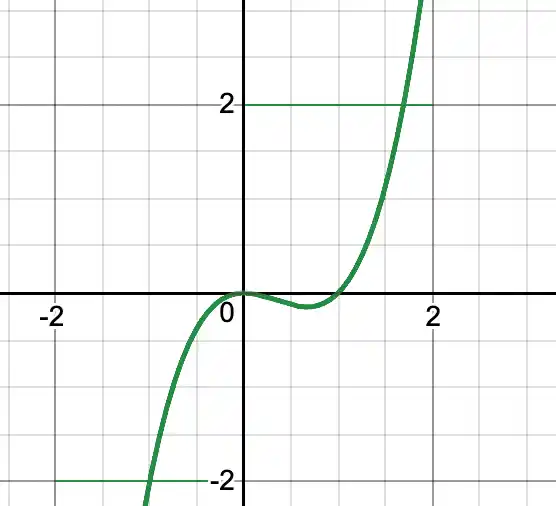
**Note: In general a polynomial of degree "N" can have at most N zeros.
Solved Examples
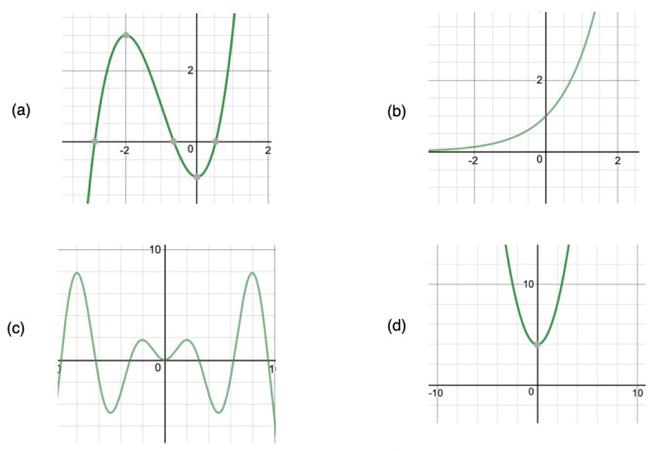
**Question 1: Which of the following graphs represents a cubic polynomial?
**Answer:
(A) is the graph of a cubic polynomial because it cuts the x-axis only three times.
(B) does not cut the x-axis at all and is continuously increasing, So it cannot be.
(C) It cuts the x-axis at more than 5 points. So it cannot be three degree polynomial
(D) It is a graph of a parabola, we studied earlier. So it is not a cubic polynomial.
**Question 2: Show the zeros of the Quadratic equation on the graph, x2 - 3x - 4 = 0
**Solution:
From the equation, we can tell that there are 2 values of x.
Factorizing the quadratic equation to find out the values of x,
x2-4x+x-4= 0
x(x-4) +1(x-4)= 0
x = (-1), x = 4
Hence, the graph will be an upward parabola intersecting at (-1,0) and (4,0)
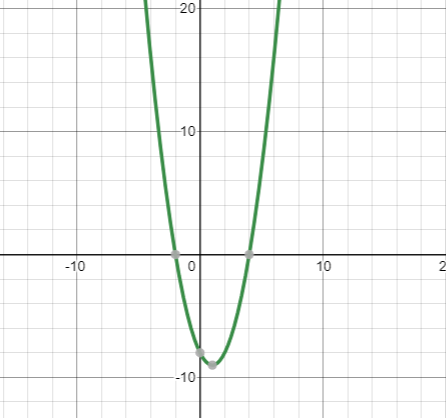
**Question 3: Find the point where the graph intersects the x-axis for the quadratic equation, x2 - 2x - 8 = 0.
**Solution:
Factorize the quadratic equation to find the points,
x2-4x+2x-8 = 0
x(x-4) +2(x-4)= 0
(x-4)(x+2)= 0
x = 4, x = (-2)
Therefore, the equation will cut the graph on x-axis at (4,0) and (-2,0)
Practice Problems
**Problems 1. Given the polynomial P(x) = x2 - 4x + 4
- Find the zeroes of the polynomial
- Plot the graph of the polynomial and indicate the zeroes on the graph.
- Describe the geometric significance of the zeroes on the graph.
**Problems 2. Consider the polynomial P(x) = x2 - 5x + 6
- Determine the zeroes of the polynomial.
- Sketch the graph of the polynomial and mark the zeroes.
- Explain the geometric interpretation of the zeroes.
**Problems 3. For the polynomial P(x) = x3 - 3x2 + 2x
- Find the zeroes of the polynomial.
- Draw the graph of the polynomial and label the zeroes.
- Describe the geometric meaning of each zero.
**Problems 4. Given the polynomial P(x) = x2 + x - 6
- Calculate the zeroes of the polynomial.
- Graph the polynomial and mark the zeroes.
- Explain the significance of the zeroes on the graph.