Graph a Rational Function with Holes (original) (raw)
Last Updated : 25 Apr, 2026
A rational function is a function of the form f(x) = \frac{P(x)}{Q(x)} where P(x) and Q(x) are polynomials.
Holes in a rational function occur when both the numerator P(x) and the denominator Q(x) share a common factor that causes the function to be undefined at specific points.
These points are known as the holes in the function. Graphically, holes are represented as open circles on the function's curve, indicating that the function is not defined at that particular x-value.
Steps to Graph
To graph a rational function with holes, we can use the following steps:
**Step 1: Identify the Rational Function
A rational function is typically in the form f(x) = P(x)/Q(x), where P(x) and Q(x) are polynomials.
**Step 2: Simplify the Function
Simplify the rational function by factoring both the numerator P(x) and the denominator Q(x). If any factors cancel out, this indicates the presence of a hole in the graph.
For example, consider the function f(x) = [(x−2)(x+3)]/[(x−2)(x+1)]. After canceling the common factor (x−2), the simplified function is f(x) = x+3/x+1. The factor (x−2) that was canceled indicates a hole at x = 2.
**Step 3: Determine the Hole's Location
To find the exact location of the hole, Set the canceled factor equal to zero to find the x-coordinate of the hole. In the example, set x − 2 = 0, so x = 2.
Substitute this x-coordinate back into the simplified function to find the corresponding y-coordinate.
For f(x) = (x+3)/(x+1) at x = 2: f(2) = (2+3)/(2+1) = 5/3
So, the hole is at (2, 5/3).
**Step 4: Determine the Asymptotes and Intercepts
- **Vertical Asymptotes: These occur where the denominator Q(x) equals zero (after simplifying).
- **Horizontal Asymptotes: Compare the degrees of the polynomials in the numerator and denominator to determine if a horizontal asymptote exists.
- **Intercepts: Find the x-intercepts by setting the numerator equal to zero and the y-intercept by evaluating f(0).
**Step 5: Sketch the Graph
- **Plot the Hole: Mark the hole on the graph as an open circle at the point (2, 5/3).
- **Draw the Asymptotes: Draw the vertical and horizontal asymptotes as dashed lines.
- **Plot Intercepts: Mark the x-intercepts and y-intercept on the graph.
- **Sketch the Curve: Draw the graph of the simplified function, ensuring that it approaches the asymptotes appropriately. Remember, the curve should not pass through the hole but should instead show a gap at that point.
Solved Examples
**Example 1: Identify the holes in the function f(x) = \frac{x^2 - 9}{x^2 - 4x + 3}.
**Solution:
Factor: f(x) = \frac{(x-3)(x+3)}{(x-3)(x-1)}.
Hole: x = 3, \quad y = \frac{3-1}{3+3} = 3.
The function has a hole at (3, 3).
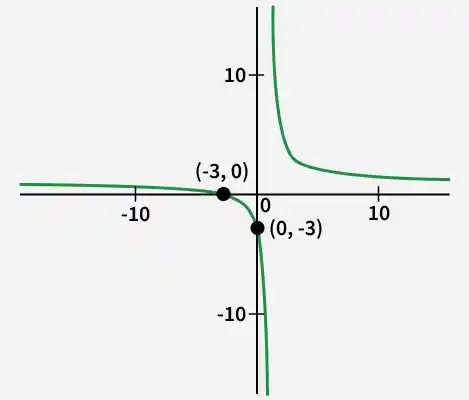
**Example 2: Graph the function f(x) = \frac{x^2 - 4}{x^2 - 1} and identify any holes.
**Solution:
Factor: f(x) = \frac{(x-2)(x+2)}{(x-1)(x+1)}. No common factors so no holes.
Vertical Asymptotes: x = 2 \quad \text{and} \quad x = -2.
Horizontal Asymptote: y = 1.
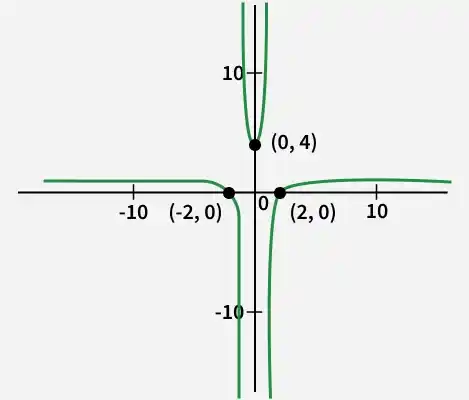
**Example 3: Determine the hole for f(x)f(x) = \frac{x^2 - 4}{x^2 - 2x}.
**Solution:
Factor: f(x) = \frac{(x-2)(x+2)}{x(x-2)}.
Hole: x = 2, \quad y = \frac{2+2}{2} = 2. Hole at (2, 2).
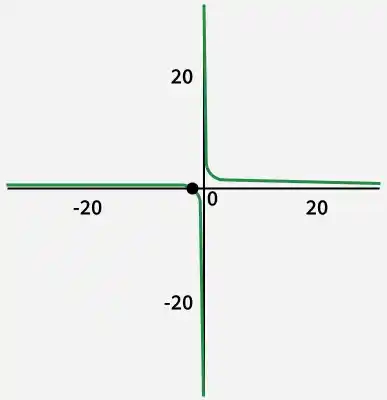
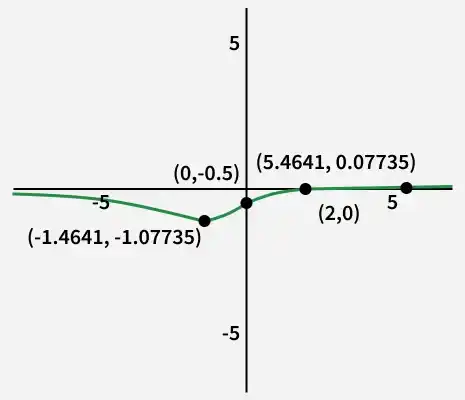
**Example 4: Find and graph the hole in f(x) = \frac{x^2 - 4x + 4}{x^3 - 8}
**Solution:
Factor: f(x) = \frac{(x-2)^2}{(x-2)(x^2 + 2x + 4)} = \frac{(x-2)}{(x^2 + 2x + 4)}.
As x2 + 2x + 4, can't be factorized further (complex roots), thus there is no hole in the graph of this rational function.
Practice Questions
1. Graph f(x) = \frac{x^2 - 4x + 4}{x^2 - 1} and identify any holes.
2. Determine the hole for f(x) = \frac{x^2 - 9}{x^2 - 6x + 9}.
3. Find and graph the hole in f(x) = \frac{x^3 - 27}{x^2 - 9} .
4. Identify the holes in f(x) = \frac{x^2 - 16}{x^2 - 4x + 4}.
5. Graph f(x) = \frac{x^2 - 1}{x^2 - 2x + 1} and identify any holes.
6. Determine the hole in f(x) = \frac{x^3 - 8}{x^3 - 8x + 4} .
7. Find the holes for f(x) = \frac{x^2 - 4}{x^2 - 2x - 8} .
8. Graph the function f(x) = \frac{x^2 - 9}{x^2 - 6x + 9} and identify holes.
9. Identify and graph the hole in f(x) = \frac{x^2 - 4x + 4}{x^2 - 1} .
10. Determine the holes for f(x) = \frac{x^3 - 27}{x^3 - 9x + 27}.
**Answer Key
- Hole at (1, 1)
- Hole at (3, 3)
- Hole at (3, 9)
- Hole at (2, 4)
- Hole at (1, 0)
- Hole at (2, 8)
- Hole at (2, 2)
- Hole at (3, 9)
- Hole at (1, 1)
- Hole at (3, 27)