Graphical Solution of Linear Inequalities in Two Variables (original) (raw)
Last Updated : 16 Apr, 2026
Linear inequalities in two variables are inequalities formed by algebraic expressions and related by the symbols (<), (>), (≤), or (≥).
A linear equation in two variables represents a line that divides the plane into two regions. We call each part a half-plane. Vertical line divides the plane into the left half-plane and the right half-plane, and the non-vertical line divides the plane into the upper left half-plane and the lower half-plane.
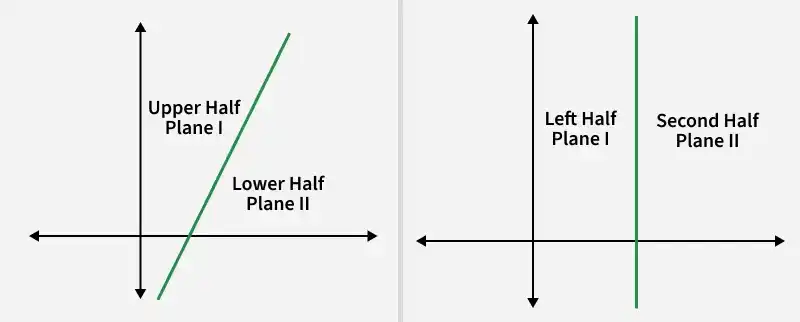
Every point in the Cartesian plane lies either on the line or in one of these two half-planes.
Let us consider the line.
ax + by = c
where a ≠ 0 and b ≠ 0.
For any point (x, y), there are three possible cases:
**Case (i): ax + by > c
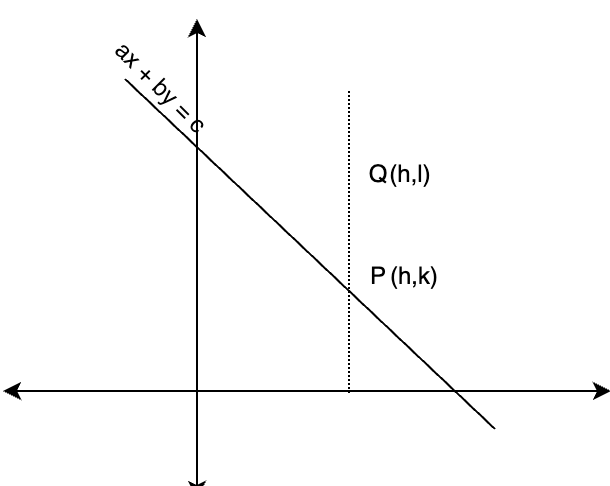
Let's say b > 0. Consider a point(h, k) that satisfies the line. Then,
ah + bk = c
Now take another arbitrary point (h,l)(h, l)(h,l). If l>kl > kl>k, then
l > k
bl > bk
ah + bl > ah +bk
ah + bl > c
Thus, point (h, l) satisfy the property ax + by > c. Thus, all the points lying in half-plane II satisfy this inequality. For b < 0 also, this can be proved similarly.
**Case (ii): ax + by = c
All the points satisfying the line, that is lying on the line satisfy this equation.
**Case (iii): ax + by < c
All the remaining points, that is the points lying in the half-plane I satisfy this inequality.
**Related Articles
Sample Problems
**Question 1: Solve the equation (5x + 3y > 6) graphically.
**Solution:
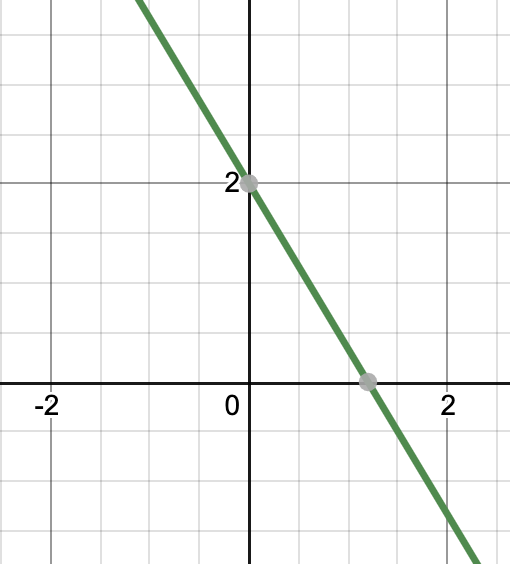
First we need to draw the graph for 5x + 3y = 6. It can be done by bringing the equation in slope intercept form or the intercept form.
Now select a point arbitrarily to check. Let's take (0,0).
Substituting this point (0,0) in the equation,
5(0) + 3(0) = 0 < 6.
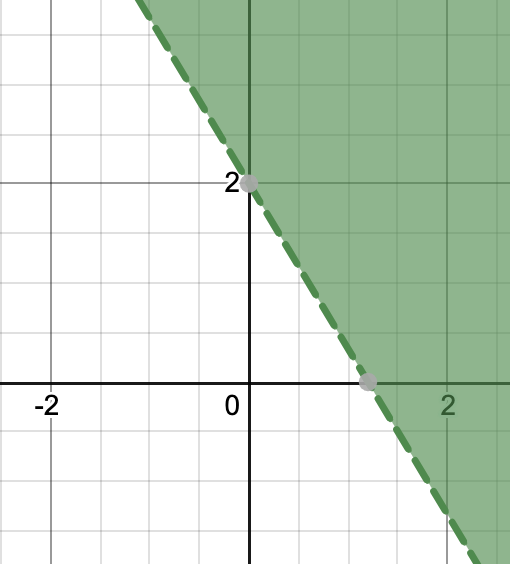
Thus points in the lower half will satisfy 5x + 3y < 6. Thus, all the points satisfying the given equation will lie on upper half plane.
**Question 2: Solve the equation (6x + 2y > 3) graphically.
**Solution:
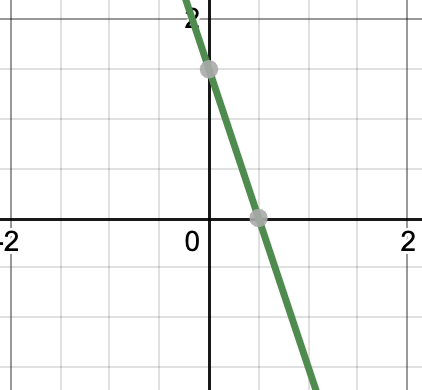
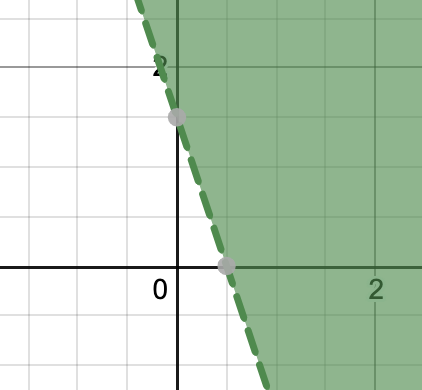
First we need to draw the graph for 6x + 2y = 3. It can be done by bringing the equation in slope intercept form or the intercept form.
Putting (0,0) in the equation,
6(0) + 2(0) = 0 < 3. Thus, the points in the upper half plane satisfy the given equation.
6x + 2y > 3
**Question 3: Solve the equation x + y < 2 graphically.
**Solution:
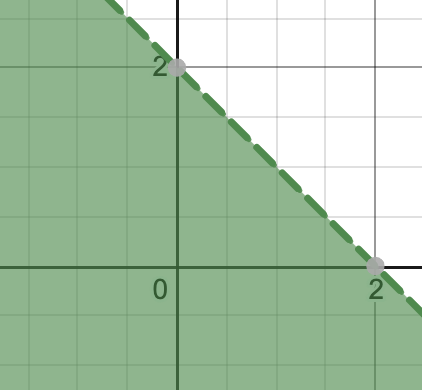
The equation given is, x + y < 2.
Putting the (0, 0) in the equation,
0 < 2.
This point satisfies the given equation. Thus, the graph will be,
**Question 4: Solve the equation 3x - 5y < 20 graphically.
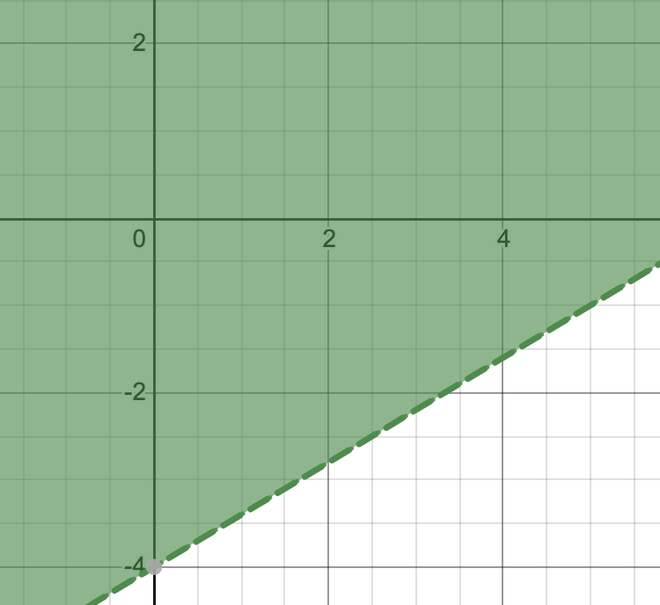
**Solution:
As usual, we will take (0, 0) as the point we want to test on.
3(0) - 5(0) < 20.
This point satisfies the given inequality. Thus, the upper left half plane satisfies the inequality.
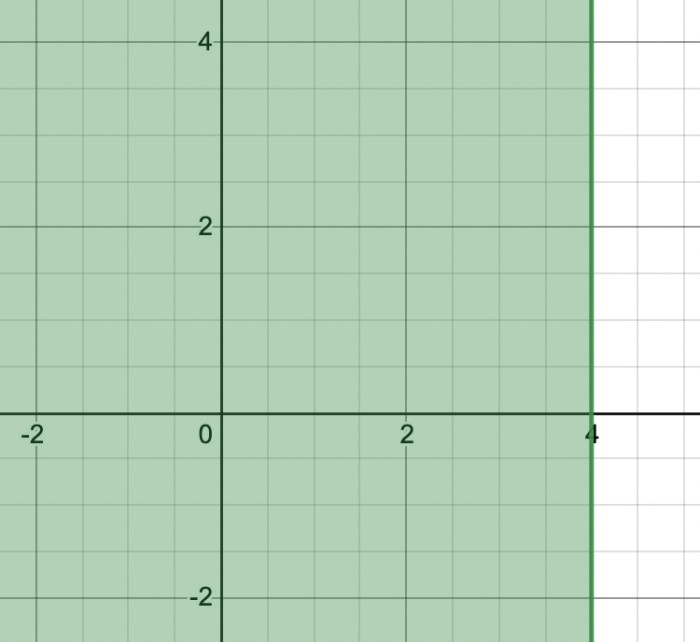
**Question 5: Form the inequality from the graph given below.
**Solution:
We can see this line is parallel to one of the axes. The equation of the line is,
x = 4
Now we want to form the linear inequality for the shaded region. (0,0) in the shaded region so we will check for that.
x = 0 < 4
Thus, the shaded region satisfies,
x < 4
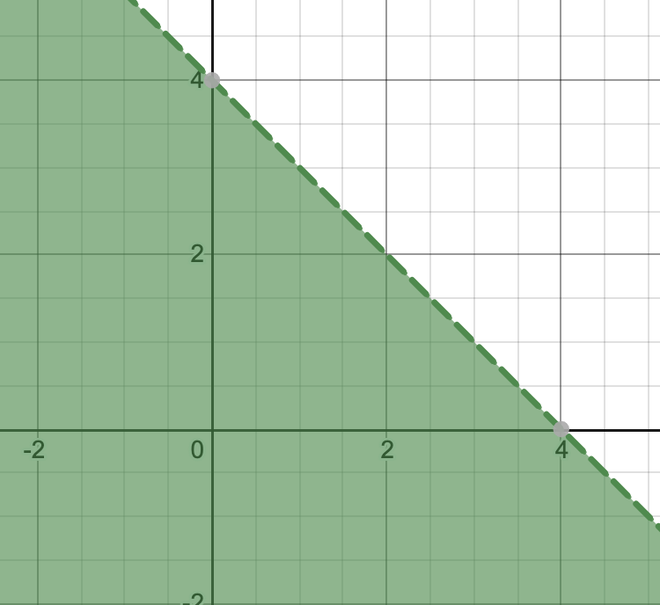
**Question 6: Form the inequality from the graph given below.
**Solution:
From the graph, first let's deduce the equation of the line. We can see the that x and y-axis intercepts are of length 4.
\frac{x}{4} + \frac{y}{4} = 1
Now we need to figure out which condition is satisfied by the lower half plane. Let's use (0,0) as it belongs to lower half plane. Substituting the value (0,0) in the equation,
\frac{x}{4} + \frac{y}{4} = 1 \\ = \frac{0}{4} + \frac{0}{4} < 1
So,
\frac{x}{4} + \frac{y}{4} < 1 \\ x + y < 4
Practice Problems
- Solve the inequality 2x − 4y < 20 graphically.
- Graph the solution for y ≤ 2x + 1.
- Solve the inequality y > -x/2 + 3 using a graph.
- Represent 2x − 3y ≤ 6 graphically and identify the solution set.
- Solve the inequality −x + 4y < 8 on a graph.