Graphs of Inverse Trigonometric Functions (original) (raw)
Last Updated : 15 Nov, 2025
Inverse trigonometric functions are the inverse functions of the trigonometric ratios, i.e., sin, cos, tan, cot, sec, cosec. These functions are widely used in fields like physics, mathematics, engineering, and other research fields.
There are two popular notations used for inverse trigonometric functions:
- Adding "arc" as a prefix.
**Example: arcsin(x), arccos(x), arctan(x), ...
- Adding "-1" as superscript.
**Example: sin-1(x), cos-1(x), tan-1(x), ...
Inverse Sine Function, (y = sin-1x)
sin-1(x) is the inverse function of sin(x). Its domain is [−1, 1] and its range is [- π/2, π/2]. It intersects the coordinate axis at (0,0). It is an odd function and is strictly increasing in (-1, 1).
Graph of Function
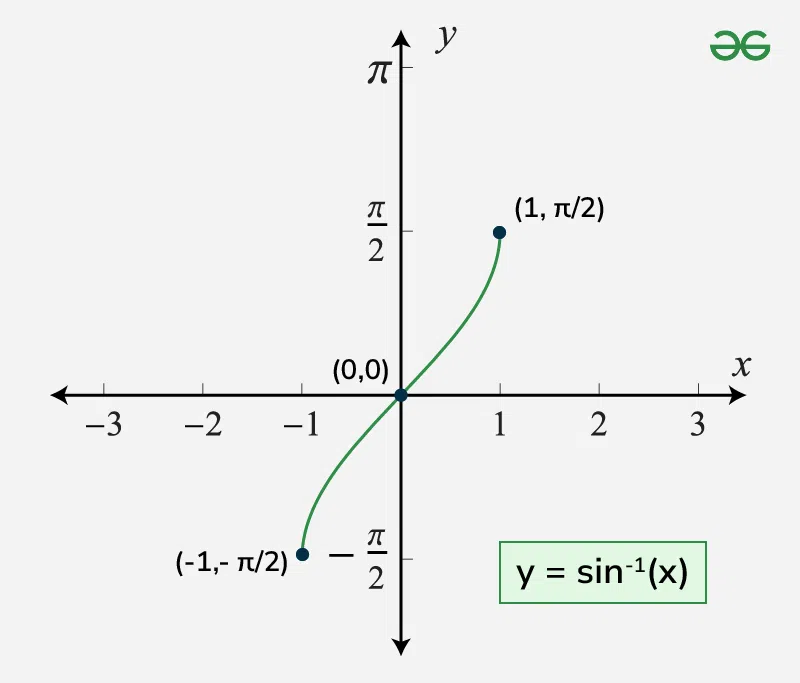
Graph of Sin-1(x)
**Function Analysis
| Domain | x ∈ [−1, 1] |
|---|---|
| Range | y ∈ \big[\frac{−\pi}{2}, \frac{\pi}{2}\big] |
| X - Intercept | x = 0 |
| Y - Intercept | y = 0 |
| Minima | \big(−1, \frac{−\pi}{2}\big) |
| Maxima | \big(1, \frac{\pi}{2}\big) |
| Inflection Points | (0, 0) |
| Parity | Odd Function |
| Monotonicity | In (-1, 1), strictly increasing |
Sample Problems on Inverse Sine Function
**Problem 1: Find the principal value of the given equation: y = sin-1(1/√2)
**Solution:
We are given that:
y = sin-1(1/√2)
So we can say that,
sin(y) = (1/√2)
We know that the range of the principal value branch of sin-1(x) is (−π/2, π/2) and sin(π/4) = 1/√2.
So, the principal value of sin-1(1/√2) = π/4.
**Problem 2: Find the principal value of the given equation: y = sin-1(1)
**Solution:
We are given that:
y = sin-1(1)
So we can say that,
sin(y) = 1
We know that the range of the principal value branch of sin-1(x) is (−π/2, π/2) and sin(π/2) = 1.
So, the principal value of sin-1(1) = π/2.
Inverse of Cosine Function, y = cos-1(x)
cos-1(x) is the inverse function of cos(x). Its domain is [−1, 1] and its range is [0, π]. It intersects the coordinate axis at (1, π/2). It is neither even nor an odd function and is strictly decreasing in (-1, 1).
**Graph of Function
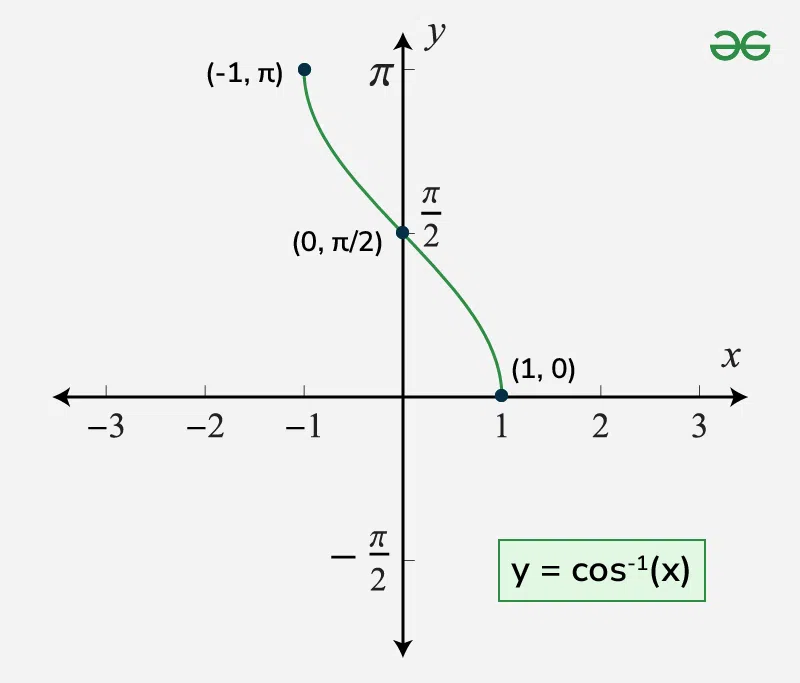
Graph of Cos-1(x)
**Function Analysis
| Domain | x ∈ [−1, 1] |
|---|---|
| Range | y ∈ [0, \pi] |
| X - Intercept | x = 1 |
| Y - Intercept | y = \frac{\pi}{2} |
| Minima | (1, 0) |
| Maxima | (-1, \pi) |
| Inflection Points | \big(0, \frac{\pi}{2}\big) |
| Parity | Neither Even Nor Odd |
| Monotonicity | In (-1, 1) strictly decreasing |
Sample Problems on Inverse Cosine Function
**Problem 1: Find the principal value of the given equation: y = cos-1(1/√2)
**Solution:
We are given that:
y = cos-1(1/√2)
So we can say that,
cos(y) = (1/√2)
We know that the range of the principal value branch of cos-1(x) is (0, π) and cos(π/4) = 1/√2.
So, the principal value of cos-1(1/√2) = π/4.
**Problem 2: Find the principal value of the given equation: y = cos-1(1)
**Solution:
We are given that:
y = cos-1(1)
So we can say that,
cos(y) = 1
We know that the range of the principal value branch of cos-1(x) is (0, π) and cos(0)=1.
So, the principal value of cos-1(1) = 0.
Inverse of Tangent Function, y = tan-1(x)
tan-1(x) is the inverse function of tan(x). Its domain is ℝ and its range is [-π/2, π/2]. It intersects the coordinate axis at (0, 0). It is an odd function which is strictly increasing in (-∞, ∞).
**Graph of Function
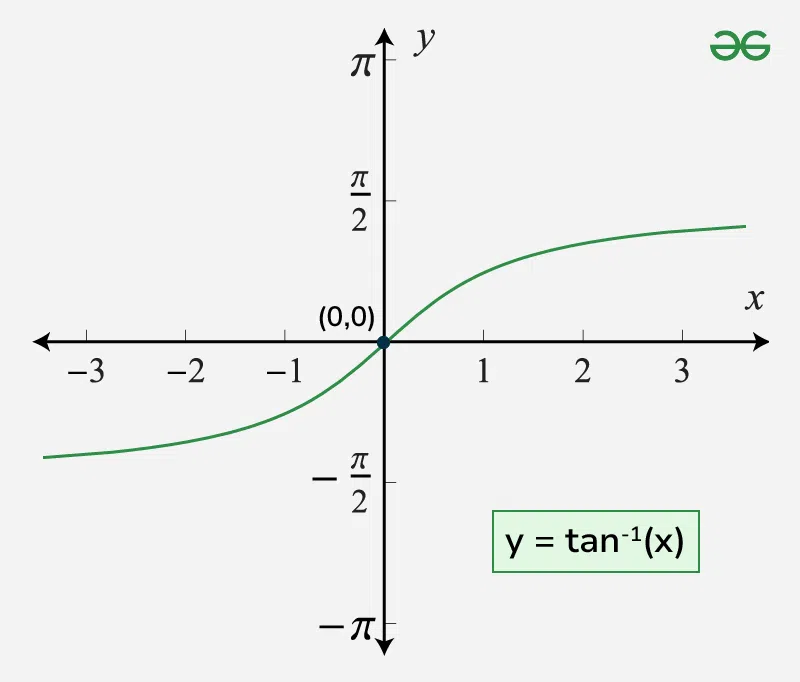
Graph of tan-1(x)
**Function Analysis
| Domain | x ∈ ℝ |
|---|---|
| Range | y ∈ \big(\frac{-\pi}{2}, \frac{\pi}{2}\big), |
| X - Intercept | x = 0 |
| Y - Intercept | y = 0 |
| Minima | The function does not have any minima points. |
| Maxima | The function does not have any maxima points. |
| Inflection Points | (0, 0) |
| Parity | Odd Function |
| Monotonicity | In (−∞, ∞) strictly Increasing |
| Asymptotes | y = \frac{\pi}{2}\space and\space y= \frac{-\pi}{2} |
Sample Problems on Inverse of Tangent Function
**Problem 1: Find the principal value of the given equation: y = tan-1(1)
**Solution:
We are given that:
y = tan-1(1)
So we can say that,
tan(y) = (1)
We know that the range of the principal value branch of tan-1(x) is (-π/2, π/2) and tan(π/4) = 1.
So, the principal value of tan-1(1) = π/4.
**Problem 2: Find the principal value of the given equation: y = tan-1(√3)
**Solution:
We are given that:
y = tan-1(√3)
So we can say that,
tan(y) = (√3)
We know that the range of the principal value branch of tan-1(x) is (-π/2, π/2) and tan(π/3) = √3.
So, the principal value of tan-1(√3) = π/3.
Inverse of Cosecant Function, y = cosec-1(x)
cosec-1(x) is the inverse function of cosec(x). Its domain is (-∞, -1] U [1, ∞) and its range is [-π/2, 0) U (0, π/2]. It doesn't intercept the coordinate axis. It is an odd function that is strictly decreasing in its domain.
**Graph of Function
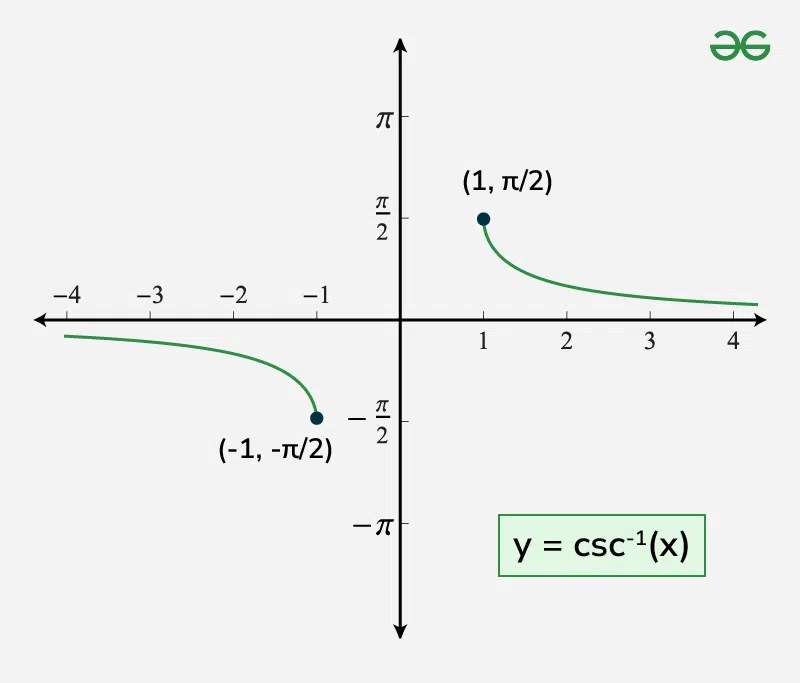
Graph of Csc-1(x)
**Function Analysis
| Domain | x ∈ (−\infin, −1] ∪ [1,\infin) |
|---|---|
| Range | y ∈ \big[\frac{-\pi}{2}, 0 \big) ∪ \big(0, \frac{\pi}{2}\big] |
| X - Intercept | \phi |
| Y - Intercept | \phi |
| Minima | \big(-1, \frac{-\pi}{2} \big) |
| Maxima | \big(1, \frac{\pi}{2} \big) |
| Inflection Points | The function does not have any inflection points. |
| Parity | Odd Function |
| Monotonicity | In (1, ∞) it is decreasing, and in (-∞, -1) it is decreasing |
| Asymptotes | y = 0 |
Sample Problems on Inverse Cosecant Function
**Problem 1: Find the principal value of the given equation: y = cosec-1(√2)
**Solution:
We are given that:
y = cosec-1(√2)
So we can say that,
cosec(y) = (√2)
We know that the range of the principal value branch of cosec-1(x) is [-π/2, π/2] - {0} and cosec(π/4) = √2.
So, the principal value of cosec-1(√2) = π/4.
**Problem 2: Find the principal value of the given equation: y = cosec-1(1)
**Solution:
We are given that:
y = cosec-1(1)
So we can say that,
cosec(y) = 1
We know that the range of the principal value branch of cosec-1(x) is [-π/2, π/2] - {0} and cosec(π/2) = 1.
So, the principal value of cosec-1(1) = π/2.
Inverse of Secant Function, y = sec-1(x)
sec-1(x) is the inverse function of sec(x). Its domain is (-∞, -1] U [1, ∞) and its range is [0, π/2) U (π/2, π]. It doesn't intercept the coordinate axis as it is a discontinuous function. It is neither an even nor an odd function and is strictly increasing in its domain.
**Graph of Function
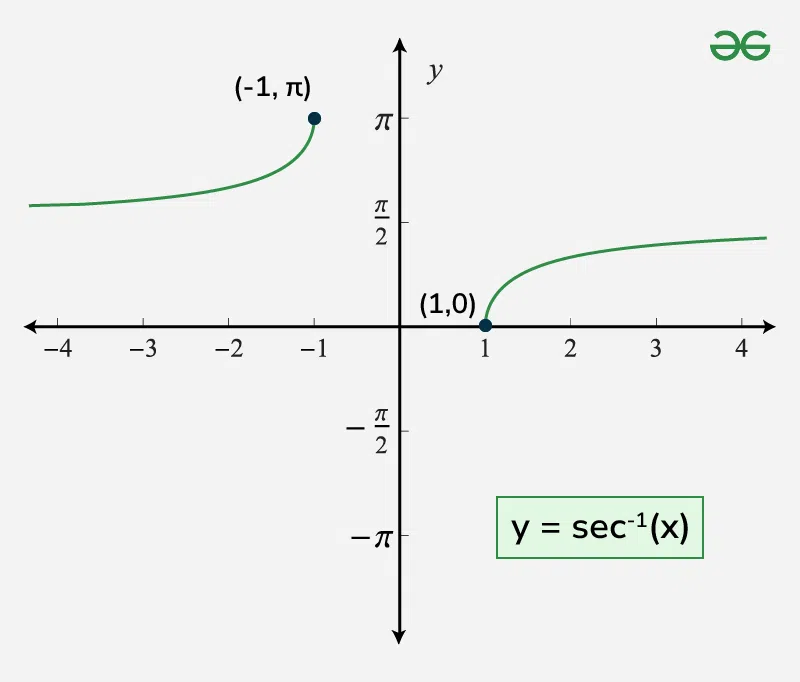
Graph of Sec-1(x)
**Function Analysis
| Domain | x ∈ (−\infin, −1] ∪ [1, \infin) |
|---|---|
| Range | y ∈ \big[0, \frac{\pi}{2}\big) ∪ \big(\frac{\pi}{2}, \pi\big] |
| X - Intercept | x=1 |
| Y - Intercept | \phi |
| Minima | (1,0) |
| Maxima | (-1, \pi) |
| Inflection Points | The function does not have any inflection points. |
| Parity | Neither Even Nor Odd |
| Monotonicity | In (1, ∞) it is increasing and in (-∞, -1) it is increasing |
| Asymptotes | y = \frac{\pi}{2} |
Sample Problems on the Inverse of the Secant Function
**Problem 1: Find the principal value of the given equation: y = sec-1(√2)
**Solution:
We are given that:
y = sec-1(√2)
So we can say that,
sec(y) = (√2)
We know that the range of the principal value branch of sec-1(x) is [0, π] - {π/2} and sec(π/4)=√2.
So, the principal value of sec-1(√2) = π/4.
**Problem 2: Find the principal value of the given equation: y = sec-1(1)
**Solution:
We are given that:
y = sec-1(1)
So we can say that,
sec(y) = 1
We know that the range of the principal value branch of sec-1(x) is [0, π] - {π/2} and sec(0) = 1.
So, the principal value of sec-1(1) = 0.
Inverse of Cotangent Function, y = cot-1(x)
cot-1(x) is the inverse function of cot(x). Its domain is ℝ and its range is (0, π). It intersects the coordinate axis at (0, π/2). It is neither an even nor an odd function and is strictly decreasing in its domain.
**Graph of Function

Graph of Cot-1(x)
**Function Analysis
| Domain | x ∈ ℝ |
|---|---|
| Range | y ∈ (0, \pi) |
| X - Intercept | x = \phi |
| Y - Intercept | y = \frac{\pi}{2} |
| Minima | The function does not have any minima points. |
| Maxima | The function does not have any maxima points. |
| Inflection Points | The function does not have any inflection points. |
| Parity | Neither Even Nor Odd |
| Monotonicity | In (-∞, ∞) strictly decreasing |
| Asymptotes | y = 0\space and\space y = \pi |
**Related Articles
Sample Problems on Inverse of Cotangent Function
**Problem 1: Find the principal value of the given equation: y = cot-1(1)
**Solution:
We are given that:
y = cot-1(1)
So we can say that,
cot(y) = 1
We know that the range of the principal value branch of cot-1(x) is (-π/2, π/2) and cot(π/4) = 1.
So, the principal value of cot-1(1) = π/4.
**Problem 2: Find the principal value of the given equation: y = cot-1(1/√3)
**Solution:
We are given that:
y = cot-1(1/√3)
So we can say that,
cot(y) = (1/√3)
We know that the range of the principal value branch of cot-1(x) is (-π/2, π/2) and cot(π/3)= 1/√3.
So, the principal value of cot-1(1/√3) = π/3.