Horizontal Asymptote (original) (raw)
Last Updated : 1 Jun, 2026
Horizontal asymptotes are horizontal lines (parallel to the x-axis) that a graph approaches as x \to +\infty\ \text{or}\ x \to -\infty, but typically never actually reaches.
- It describes the end behavior of a function, what happens to the function as the input becomes very large (positive or negative).
- This concept helps in analyzing the long-term behavior of the functions and is essential in various fields such as physics, engineering, and economics.
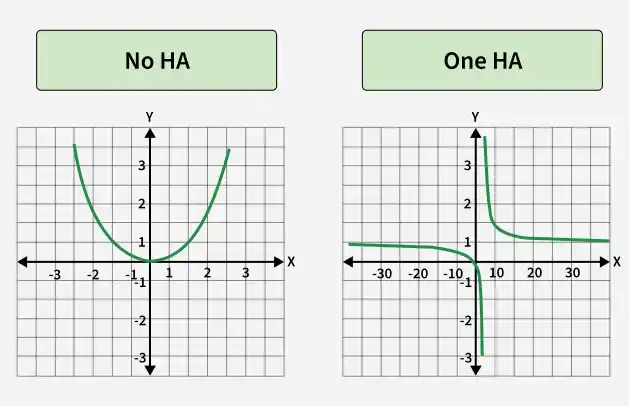
A line y = L is a horizontal asymptote of a function f(x) if
\lim\limits_{x \to \infty} f(x) = L \quad
or
\lim\limits_{x \to -\infty} f(x) = L
Methods to Find Horizontal Asymptotes
1. Horizontal Asymptotes From Graph
- Observe the graph as x \to \infty\ and \ x \to -\infty
- Identify the value that the curve approaches
2. Horizontal Asymptotes from the Equation
- Evaluate limits at infinity: \lim\limits_{x \to \infty} f(x),\ \lim\limits_{x \to -\infty} f(x)
**Example: f(x) = \frac{1}{x}
\lim\limits_{x \to \infty} \frac{1}{x} = 0
Horizontal asymptote: y=0
Horizontal Asymptote of Rational Functions
For rational functions of the form \frac{P(x)}{Q(x)} where P(x) and Q(x) are polynomials:
- If the degree of the P(x) is less than the degree of the Q(x), the horizontal asymptote is y = 0.
- If the degree of the P(x) is equal to the degree of the Q(x), the horizontal asymptote is y = \frac{a}{b} where a and b are the leading coefficients of P(x) and Q(x), respectively.
- If the degree of the P(x) is greater than the degree of the Q(x), there is no horizontal asymptote.
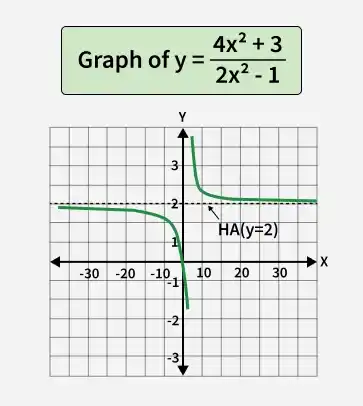
**Example: Find the horizontal asymptote of f(x) = \frac{4x^2 + 3}{2x^2 - 1}
Step 1: Identify degrees
- Degree of numerator = 2
- Degree of denominator = 2
Step 2: Apply rule (degrees equal)
\text{Horizontal asymptote(y)} = \frac{\text{leading coefficient of numerator}}{\text{leading coefficient of denominator}}
y=\frac{4}{2} = 2
Horizontal Asymptote of Exponential Functions
For functions of the form f(x) = a \cdot e^{bx}:
- If (b > 0) the horizontal asymptote is y = 0 as x to the -\infty.
- If (b < 0) the horizontal asymptote is y = 0 as x to the \infty.
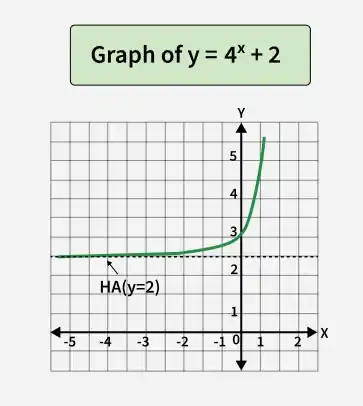
**Example: Find the horizontal asymptote of f(x) = 4e^x +2
Step 1: Analyze behavior as x \to -\infty
e^x \to 0
Step 2: Substitute limit f(x) = 4e^x + 2 \to 4(0) + 2 = 2
**Horizontal Asymptote of Logarithmic Functions
For functions like f(x) = \log_a(x) there is no horizontal asymptote as the x to the \infty or x to -\infty. However, the vertical asymptote is at x = 0.
Solved Examples
**Example 1: Find the horizontal asymptote of f(x) = \frac{2x^3 - 5x + 1}{x^3 + 4}.
Degree of Numerator: 3
Degree of Denominator: 3
Since the degrees are equal the horizontal asymptote is determined by the ratio of the leading coefficients:
y = \frac{2}{1} = 2
Thus, the horizontal asymptote is y = 2.
**Example 2: Determine the horizontal asymptote of the g(x) = 3e^{-2x}.
As x to \infty , e^{-2x} to 0 .
Therefore, g(x) to 3 \cdot 0 = 0.
Thus, the horizontal asymptote is y = 0.
Practical Questions: Horizontal Asymptote
**Questions 1. Find the horizontal asymptote of f(x) = \frac{4x^2 + 1}{2x^2 - 3}.
**Questions 2. Determine the horizontal asymptote of g(x) = \frac{7x^3 - 2}{3x^2 + 5x}.
**Questions 3. What is the horizontal asymptote of h(x) = \frac{1}{x} + 3?
**Questions 4. Find the horizontal asymptote of j(x) = 6 - \frac{5}{x^2}.
**Questions 5. Determine if the function k(x) = x + \frac{1}{x} has a horizontal asymptote.