How to find the length of diagonal of a rhombus? (original) (raw)
Last Updated : 18 Feb, 2024
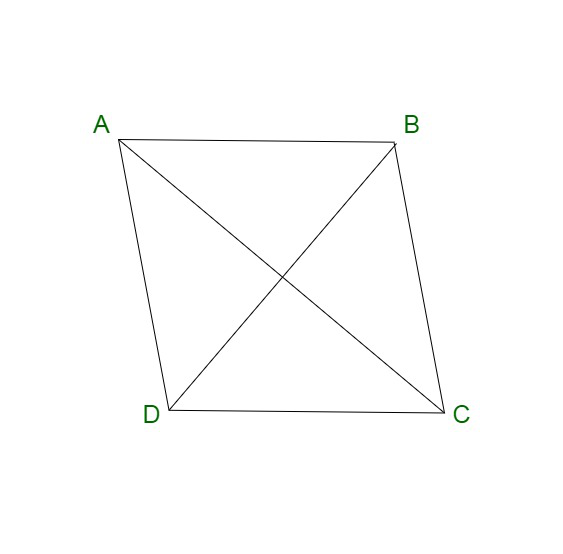
Rhombus is also known as a four-sided quadrilateral. It is considered to be a special case of a parallelogram. A rhombus contains parallel opposite sides and equal opposite angles. A rhombus is also known by the name diamond or rhombus diamond. A rhombus contains all the sides of a rhombus as equal in length. Also, the diagonals of a rhombus bisect each other at right angles.
**Properties of a Rhombus
A rhombus contains the following properties:
- A rhombus contains all equal sides.
- Diagonals of a rhombus bisect each other at right angles.
- The opposite sides of a rhombus are parallel in nature.
- The sum of two adjacent angles of a rhombus is equal to 180o.
- There is no inscribing circle within a rhombus.
- There is no circumscribing circle around a rhombus.
- The diagonals of a rhombus lead to the formation of four right-angled triangles.
- These triangles are congruent to each other.
- Opposite angles of a rhombus are equal.
- When you connect the midpoint of the sides of a rhombus, a rectangle is formed.
- When the midpoints of half the diagonal are connected, another rhombus is formed.
**Diagonal of a Rhombus
A rhombus has four edges joined by vertices. On connecting the opposite vertices of a rhombus, additional edges are formed, which result in the formation of diagonals of a rhombus. Therefore, a rhombus can have two diagonals each of which intersects at an angle of 90°.
**Properties of diagonal of a rhombus
The diagonals of a rhombus have the following properties:
- The diagonals bisect each other at right angles.
- The diagonals of a rhombus divide into four congruent right-angled triangles.
- The diagonals of a rhombus may or may not be equal in length.
**Computation of diagonal of rhombus
The length of the diagonals of the rhombus can be calculated by using the following methods:
**By Pythagoras Theorem
Let us assume d1 to be the diagonal of the rhombus.
Since, we know, all adjacent sides in a rhombus subtend an angle of 90 degrees.
Therefore,
In the triangle, BCD we have,
BC2 + CD2 = BD2
Now, we have,
In the case of a square rhombus with all sides equal,
**Square Diagonal: a√2
where a is the length of the side of the square
In the case of a rectangle rhombus, we have,
**Rectangle Diagonal: √[l 2 + b 2 ]
where,
- l is the length of the rectangle.
- b is the breadth of the rectangle.
**By using the area of rhombus
Let us consider, O to be the point of intersection of two diagonals, namely d1 and d2.
Now,
The area of the rhombus is equivalent to,
A = 4 × area of ∆AOB
= 4 × (½) × AO × OB sq. units
= 4 × (½) × (½) d1 × (½) d2 sq. units
= 4 × (1/8) d1 × d2 square units
= ½ × d1 × d2
Therefore, **Area of a Rhombus = A = ½ × d 1 × d 2
**Area of rhombus using diagonals
Consider a rhombus ABCD, having two diagonals, i.e. AC & BD.
- **Step 1: Compute the length of the line segment AC, by joining the points A and C. Let this be diagonal 1, i.e. **d 1.
The diagonals of a rhombus are perpendicular to each other subtending right triangles upon intersection with each other at the centre of the rhombus.
- **Step 2: Similarly, compute the length of diagonal 2, i.e. **d 2 which is the distance between points B and D.
- **Step 3: Multiply both the calculated diagonals, d1, and d2.
- **Step 4: The result is obtained by dividing the product by 2.
The resultant will give the area of a rhombus ABCD.
Sample Questions
**Question 1. One of the sides of a rhombus is equivalent to 5 cm. One of the diagonals of the rhombus is 8 cm, compute the length of the other diagonal.
**Solution:
Let us consider, ABCD to be a rhombus, where AC and BD are the diagonals.
We have,
Side of the rhombus is 5 cm
BD = 8 cm
Since, we know that the diagonals of rhombus perpendicularly bisect each other.
∴ BO = 4cm
By Pythagoras theorem, we have,
In right angled △AOB,
⇒ (AB)2 = (AO)2 + (BO)2
⇒ (5)2 = (AO)2 + (4)2
⇒ 25 = (AO)2 + 16
⇒ (AO)2 = 9
∴ AO = 3cm
⇒ AC = 2 × 3 = 6 cm
∴ The length of other diagonal of the rhombus is equivalent to 6 cm.
**Question 2. Calculate the area of a rhombus with diagonals equivalent to 6 cm and 8 cm respectively.
**Solution:
We know,
Diagonal 1, d1 = 6 cm
Diagonal 2, d2 = 8 cm
Area of a rhombus, A = (d1 × d2) / 2
Substituting the values,
= (6 × 8) / 2
= 48 / 2
= 24 cm2
Hence, the area of the rhombus is 24 cm2.
**Question 3. A rectangular park has 10m length and breadth is 8m. Compute the diagonal of park.
**Solution:
We have,
Length = 100m
Breadth = 8 mComputing diagonals, we obtain,
Rectangle Diagonal = √[l2 + b2]
= √[102 + 82 ]
= √[164]
= 12.80 m
**Question 4. A square rhombus has a side of 5 cm. Compute the length of diagonal.
**Solution:
We have,
Side of square, a = 5 units
Computing diagonals, we obtain,
Square Diagonal = a√2
= 5√2
= 7.07 cm
**Question 5. The area of rhombus is 315 cm² and its perimeter is 180 cm. Find the altitude of the rhombus.
**Solution:
We have,
Perimeter of rhombus = 180 cm
Calculating for the side of rhombus,
Side of rhombus,b = P/4 = 180/4 = 45 cm
Now,
Area of rhombus = b × h
Substituting the values,
⇒ 315 = 45 × h
⇒ h = 315/45
⇒ h =7 cm
Therefore, altitude of the rhombus is 7 cm.