Implicit Function (original) (raw)
Last Updated : 14 May, 2026
An implicit function is a function in which the dependent variable is not written directly in terms of the independent variable. Instead, the variables are connected in a single equation.
In general, an implicit function is written in the form: f(x, y) = 0 , where both x and y appear in the same equation, and y cannot be easily expressed as y = f(x).
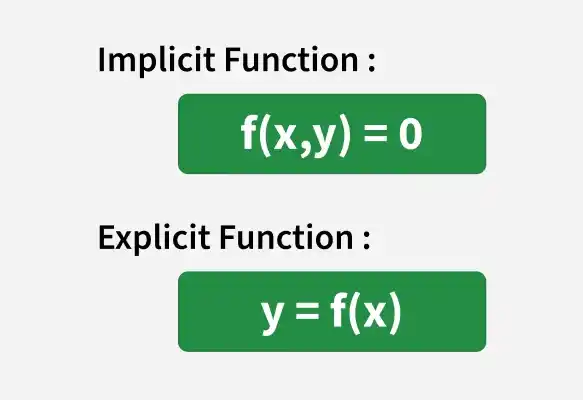
In contrast, a function written directly as y = f(x) is called an explicit function.
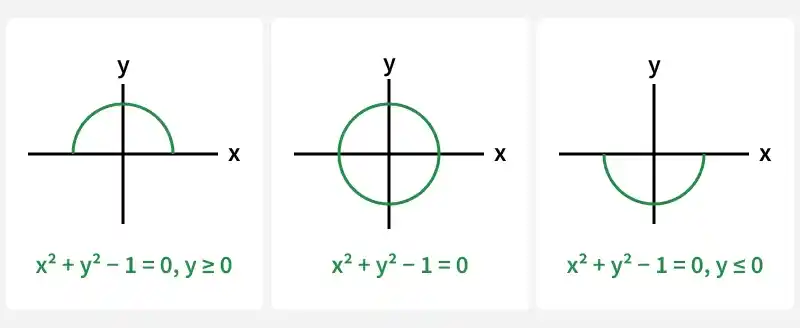
**Example: The unit circle can be represented by the implicit equation: x² + y² − 1 = 0
If the values of x are limited to the interval [−1, 1] and y is restricted to either only positive or only negative values, then the equation defines y as an implicit function of x. In this case, y can be treated as the value of a single-variable function, written as y = f(x).
If the implicit equation is rearranged for y, the two explicit forms of the function are: y = \pm \sqrt{1 - x^2}
Derivative of Implicit Functions
Implicit differentiation is used to differentiate equations in which x and y are written together in a single equation.
**How to Differentiate an Implicit Function
Since y cannot be isolated easily, both sides of the equation are differentiated with respect to x using the chain rule wherever y appears (since y depends on x). Then we rearrange the result to solve for dy/dx.
**Steps:
- Differentiate both sides of the equation f(x, y) = 0 with respect to x.
- Apply the chain rule to terms containing y, since y is treated as a function of x. Therefore, their derivatives include dy/dx.
- Move all terms containing dy/dx to one side of the equation.
- Solve algebraically to find dy/dx
**Example: Find dy/dx for x² + y² = 25
Differentiating both sides with respect to x:
2x + 2y(dy/dx) = 0
Solving for dy/dx:
dy/dx = −x/y
The result contains both x and y, which is normal for implicit differentiation.
Properties
- Not written directly in the form y = f(x).
- Usually represented as an equation involving two or more variables, such as f(x, y) = 0.
- Dependent and independent variables remain combined in the same equation.
- Commonly represent non-linear relationships between variables.
- A single value of x may correspond to more than one value of y.
- Useful for representing curves such as circles and ellipses.
- Their derivatives are found using implicit differentiation and the chain rule.
Real-Life Applications of Implicit Functions
Implicit functions have many important applications in mathematics and various real-world fields:
- Used in geometry to represent curves such as circles, ellipses, and other complex shapes.
- In physics and engineering, they help describe relationships between variables that cannot be expressed directly.
- In computer graphics, implicit equations are used to model curves and surfaces.
- In economics, implicit functions are used to study relationships between quantities such as cost, demand, and profit.
- Implicit differentiation is used to find rates of change and slopes in real-world mathematical models.
Solved Examples
**Example 1: Find the derivative of the implicit function x² + y² + 6xy + 3 = 0 with respect to x.
**Solution:
Differentiating both sides with respect to x:
d/dx(x²) + d/dx(y²) + d/dx(6xy) + d/dx(3) = 0
2x + 2y(dy/dx) + 6(x·dy/dx + y) + 0 = 0
2x + 2y·dy/dx + 6x·dy/dx + 6y = 0
2x + 6y + (2y + 6x)·dy/dx = 0
2(x + 3y) + 2(y + 3x)·dy/dx = 0
(x + 3y) + (3x + y)·dy/dx = 0
(3x + y)·dy/dx = −(x + 3y)
dy/dx = −(x + 3y) / (3x + y)
**Example 2: Find the derivative of the implicit function x + cos(xy) − y = 0 with respect to x.
**Solution:
Differentiating both sides with respect to x:
d/dx(x) + d/dx(cos xy) − d/dx(y) = 0
1 − sin(xy)·(d/dx of xy) − dy/dx = 0
1 − sin(xy)·(x·dy/dx + y) − dy/dx = 0
1 − x·sin(xy)·dy/dx − y·sin(xy) − dy/dx = 0
1 − y·sin(xy) + dy/dx(−x·sin(xy) − 1) = 0
dy/dx(−x·sin(xy) − 1) = −(1 − y·sin(xy))
dy/dx(x·sin(xy) + 1) = (1 − y·sin(xy))
dy/dx = (1 − y·sin(xy)) / (1 + x·sin(xy))