InclusionExclusion and its various Applications (original) (raw)
Inclusion-Exclusion and its various Applications
Last Updated : 1 Jun, 2026
The Inclusion-Exclusion Principle is a counting technique used to determine the number of elements in the union of two or more sets when some elements are common between the sets. It helps avoid double-counting by subtracting the overlapping elements.
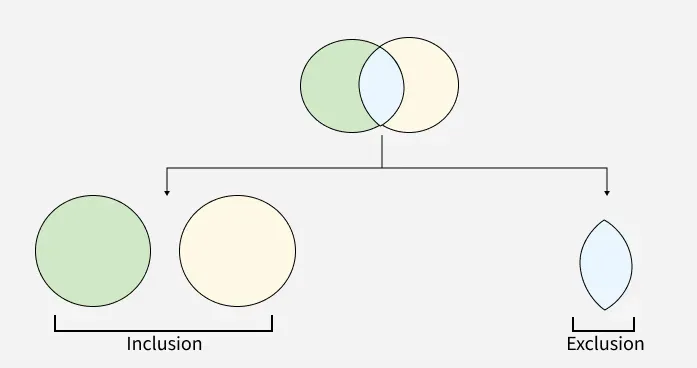
The principle is widely used in set theory, probability, combinatorics, surveys, and counting problems.
Inclusion-Exclusion Principle Formula
When the sizes of sets are added directly, the common elements are counted more than once.
- In the case of two sets, elements common to both sets are counted twice, so the intersection is subtracted once.
- In the case of three sets, pairwise intersections are subtracted, but elements common to all three sets are removed three times, so the triple intersection is added back once.
**For any two finite sets A and B:
n(A∪B) = n(A) + n(B) − n(A∩B)
**For three finite sets A, B, and C:
n(A∪B∪C) = n(A) + n(B) + n(C) − n(A∩B) − n(B∩C) − n(C∩A) + n(A∩B∩C)
**General Formula for n Sets
For finite sets A1,A2,A3,…,An, the Inclusion-Exclusion Principle is given by:
n\left(\bigcup_{i=1}^{n} A_i\right)=\sum n(A_i)-\sum n(A_i \cap A_j)+\sum n(A_i \cap A_j \cap A_k)-\cdots+(-1)^{n+1}n(A_1 \cap A_2 \cap \cdots \cap A_n)
where,
- Add the sizes of all individual sets
- Subtract all pairwise intersections
- Add all triple intersections
- Subtract all four-set intersections
- Continue alternately until the last intersection
**Disjoint Sets: If two sets have no common elements, then they are called disjoint sets.
For disjoint sets: n(A∩B)=0 , hence
n(A∪B) = n(A) + n(B)
**Derangements: The Inclusion-Exclusion Principle is used to find the number of derangements.
A derangement is a permutation in which no element remains in its original position. The number of derangements of n objects is denoted by !n and is given by:
!n = n!\left(1 - \frac{1}{1!} + \frac{1}{2!} - \frac{1}{3!} + \cdots + (-1)^n \frac{1}{n!}\right)
**Example: Find the number of derangements of 3 objects.
Using the formula: !3=3!\left(1-\frac{1}{1!}+\frac{1}{2!}-\frac{1}{3!}\right)=2
Therefore, there are 2 derangements of 3 objects.
**Set Theory: The principle is used to find the total number of elements belonging to one or more sets without counting common elements multiple times.For two sets A and B: n(A∪B) = n(A) + n(B) − n(A∩B)
**Probability: The Inclusion-Exclusion Principle is used to calculate the probability that at least one event occurs.For two events A and B: P(A∪B) = P(A) + P(B)−P(A∩B)
**Counting Problems: The principle is frequently used to count numbers satisfying at least one condition. E.g Find the number of integers from 1 to 100 divisible by 2 or 5.
**Surveys and Data Analysis: The principle is used in surveys to determine the number of people belonging to one or more categories.
**Computer Science: The Inclusion-Exclusion Principle is used in: Database query optimization , Boolean logic , Network analysis , Combinatorics.
Solved Examples
**Example 1: 3 finite sets A, B and C with their corresponding values are given. Compute A∪B∪C.
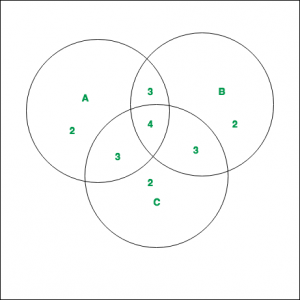
The values of the corresponding regions, as can be noted from the diagram are - ∣A∣=2, ∣B∣=2, ∣C∣=2, ∣A∩B∣=3, ∣B∩C∣=3, ∣A∩C∣=3, ∣A∩B∩C∣=4
Using the Inclusion-Exclusion Principle for three sets: ∣A∪B∪C∣ = ∣A∣ + ∣B∣ + ∣C∣ − ∣A∩B∣ − ∣B∩C∣ − ∣A∩C∣ + ∣A∩B∩C∣
Substituting the given values: ∣A∪B∪C∣ = 2 + 2 + 2 − 3 − 3 − 3 + 4 = 1
**Example 2: In a class, 45 students study Mathematics, 30 study Physics, and 12 study both subjects. Find the number of students studying at least one subject.
Let, A = students studying Mathematics , B = students studying Physics
Given:
- n(A)=45
- n(B)=30
- n(A∩B)=12
Using the Inclusion-Exclusion Principle: n(A∪B) = 45+30−12 = 63
Therefore, 63 students study at least one subject.