Integration in Maths (original) (raw)
Last Updated : 23 Jul, 2025
The process of determining the function from its derivative is called **Integration. In other words, the procedure of finding the anti-derivatives of the function is called the integration. The result obtained after the integration is called **integral. The integration can be done using multiple methods like integration by substitution, integration by parts, integration by partial fraction, etc.
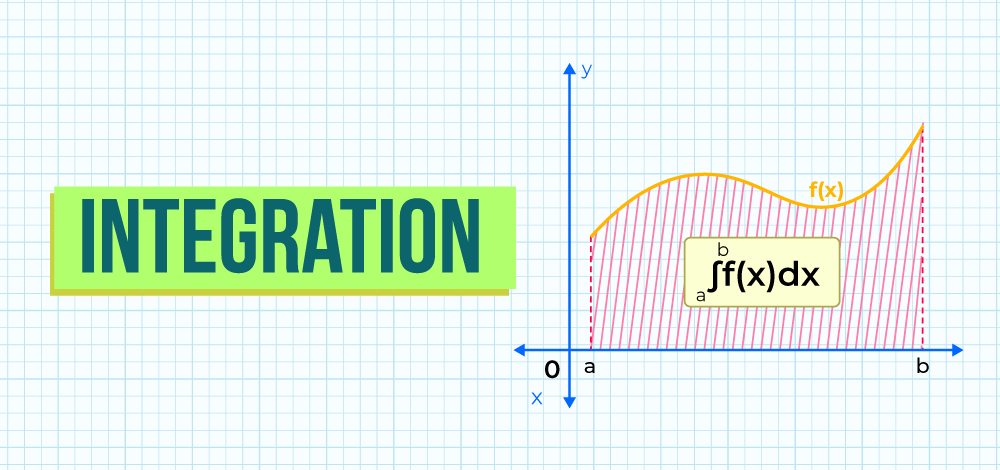
If f is the positive continuous function defined over an interval [a, b] then, the area between the function f graph and x-axis results in the integration of f w.r.t x. The area under the curve gives the definite integration of f.
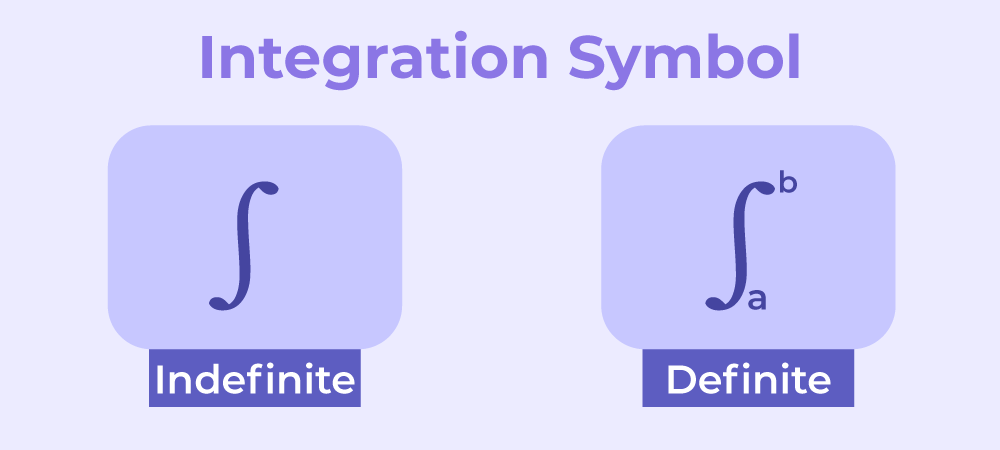
Integration Symbol
**The symbol of integration is ∫. For the definite integral we apply limits and use symbol ∫ab .
Antiderivative: Integration as Inverse Process of Differentiation
The process of finding the**antiderivative i.e., the inverse of the derivative is called integration. If Φ(x) is a function and the derivative of Φ(x) is f(x) then, integration of f(x) results in Φ(x).
****(d / dx) {Φ(x)} = f(x) ⇔ ∫f(x) dx = Φ(x) + C**
OR
**∫[d/dx]g(x) dx = g(x)
Rules for Integration
Some important rules of integration are:
- **Power Rule
The power rule of integration is stated as:
**∫x n dx = x n+1 / (n + 1)
- **Addition Rule
The addition rule of integration is stated as:
**∫{f(x) + g(x)} dx = ∫f(x) dx + ∫g(x) dx
- **Subtraction Rule
The subtraction rule of integration is stated as:
**∫{f(x) - g(x)} dx = ∫f(x) dx - ∫g(x) dx
- **Constant Multiple Rule
The multiplication of constant rule of integration can be stated as:
**∫k f(x) dx = k ∫f(x) dx,
Where k is constant.
Integration Formulas
The various integration formulas are:
- \frac{d}{dx}{Φ(x)} = f(x) ⇔ ∫f(x) dx = Φ(x) + C
- ∫xn dx = xn+1/ (n + 1) + C
- ∫(1 / x) dx = loge|x| + C
- ∫ex dx = ex + C
- ∫ax dx = [ax/ logea] + C
- ∫sin x dx = -cos x + C
- ∫cos x dx = sin x + C
- ∫sec2x dx = tan x + C
- ∫cosec2x dx = -cot x + C
- ∫sec x tan x dx = sec x + C
- ∫cosec x cot x dx = - cosec x + C
- ∫tan x dx = ln |sec x| + C = -ln |cos x| + C
- ∫cot x dx = ln |sin x| + C
- ∫sec x dx = ln |sec x + tan x| + C
- ∫cosec x dx = ln |cosec x - cot x| + C
- ∫\frac{1}{\sqrt{a^2 -x^2}}dx = sin-1(x/a) +C
- ∫- \frac{1}{\sqrt{a^2 -x^2}}dx = cos-1(x/a) + C
- ∫ \frac{1}{{a^2 + x^2}}dx = (1/a) tan-1 (x/a) + C
- ∫- \frac{1}{{a^2 + x^2}}dx = (1/a) cot-1(x/a) + C
- ∫\frac{1}{x\sqrt{x^2 -a^2}}dx = (1/a) sec-1(x/a) + C
- ∫- \frac{1}{x\sqrt{x^2 -a^2}}dx = (1/a)cosec-1(x/a) + C
Learn more about **Integration Formulas.
Integration Techniques
There are various methods to find the integration of a function. Some of these are listed below:
Read more about **Method of Integration.
Integration of Basic Functions
There are different integration formulas for different functions. Below we will discuss the integration of different functions in depth and get complete knowledge about the integration formulas.
Integration of Constant Function
**The integration of a constant function is given by:
**∫k dx = kx + C, where k is constant
Integration of Trigonometric Functions
**The integration of trigonometric functions is given by:
- ∫sin x dx = -cos x + C
- ∫cos x dx = sin x + C
- ∫sec2x dx = tan x + C
- ∫cosec2x dx = -cot x + C
- ∫sec x tan x dx = sec x + C
- ∫cosec x cot x dx = - cosec x + C
- ∫tan x dx = -log |cos x| + C
- ∫cot x dx = log |sin x| + C
- ∫sec x dx = log |sec x + tan x| + C
- ∫cosec x dx = log |cosec x - cot x| + C
Integration of Exponential and Logarithmic Functions
**The integration of exponential and logarithmic function is given by:
- ∫(1 / x) dx = loge|x| + C
- ∫ex dx = ex + C
- ∫ax dx = [ax/ logea] + C
Integration vs Differentiation
The basic difference between integration and differentiation is tabulated below:
| **Aspect | **Differentiation (Derivative) | **Integration (Integral) |
|---|---|---|
| **Definition | Finding the rate of change or slope of a function at a point. | Finding the continuous sum or the area under a curve. |
| **Operation | Derivative of a function f(x) is denoted as f'(x) or dy/dx. | Integral of a function f(x) is denoted as ∫f(x) dx. |
| **Notation | d/dx or ∂/∂x (Leibniz notation), f'(x) (Prime notation). | ∫ (Integral symbol), ∫f(x) dx (Indefinite integral), ∫[a, b]f(x) dx (Definite integral). |
| **Reverse Operation | The antiderivative of a function f'(x) is F(x) + C, where F(x) is an antiderivative of f(x) and C is the constant of integration. | Finding the derivative of a function F(x) yields f(x), but there may be a constant of integration (C) when ∫f(x) dx. |
| **Geometric Interpretation | Derivative represents the slope of the tangent line to the curve at a point. | Integral represents the area between the curve and the x-axis over a given interval. |
| **Applications | Used to analyze motion, optimization, and rates of change in various real-world problems. | Used for finding accumulated quantities such as area, volume, work, and other totals. |
| **Linearity | Follows the linearity property: d/dx [af(x) + bg(x)] = af'(x) + bg'(x) | Follows the linearity property: ∫[a__f(x) + b_g(x)] dx = a∫f(x) dx + b∫g(x) dx |
| **Product Rule | Utilizes the product rule for differentiation: (uv)' = u'v + uv' | Utilizes integration by parts for integration: ∫u dv = uv - ∫v du |
| **Chain Rule | Utilizes the chain rule for differentiation: (f(g(x)))' = f'(g(x)) * g'(x) | No direct analogue in integration, but there is a technique called substitution. |
| **Fundamental Theorem | Fundamental Theorem of Calculus relates differentiation and integration: ∫[a, b]f'(x) dx = f(b) - f(a). | Fundamental Theorem of Calculus states that ∫[a, b]f(x) dx can be evaluated by finding an antiderivative F(x) of f(x) and applying it at the limits: F(b) - F(a). |
Applications of Integration
There are various applications of integration. Some of them are listed below:
- Integration is used to find area under the curve.
- It is also used to find the volumes.
- Integration is used to find area between the two curves.
- It is used in multiple formulas in physics.
Integration in Physics and Engineering
**Integration is used widely in Physics and Engineering
- In **Physics integration is used in multiple formulas for example finding the velocity from acceleration and many more.
- In **Engineering integration is used in different fields and in many formulas of engineering mechanics etc.
Integration in Economics and Finance
Integration is also helpful in **Economics and Finance to calculate marginal and total revenue, costs, profits, consumer and producer surplus, capital accumulation over a specified time and in the Lorenz curve and Gini coefficient.
**Related Articles:
- **Calculus in Maths
- **Integral Calculus
- **Differentiation and Integration Formula
- **Integration Formulas
- **Methods of Integration
- **Application of Integration
Solved Examples on Integration
**Example 1: Solve: ∫x 6 dx
**Solution:
∫xn dx = xn+1/ (n + 1) + C
∫x6 dx = x6+1/ (6 + 1) + C
∫x6 dx = [x7/ 7] + C
**Example 2: Solve: ∫3 x+2 dx
**Solution:
∫3x+2dx = ∫3x+2dx
∫3x+2dx = ∫3x.32dx
∫3x+2dx = 9 ∫3xdx
∫3x+2dx = 9[3x / loge3] + C
**Example 3: Solve: ∫(x 3 + 4x 2 + 3x + 1)dx
**Solution:
∫(x3 + 4x2 + 3x + 1)dx = ∫x3 dx + ∫(4x2) dx + ∫(3x) dx + ∫(1) dx
∫(x3 + 4x2 + 3x + 1)dx = [x3+1 / (3 + 1)] + 4 [x2+1 / (2 + 1)] + 3[x1+1 / (1 + 1)] + x + C
∫(x3 + 4x2 + 3x + 1)dx = [x4 / 4] + 4 [x3 / 3] + 3[x2 / 2] + x + C
**Example 4: Solve: ∫(x + 3sinx)dx
**Solution:
∫(x + 3sinx) dx = ∫x dx + ∫ (3sinx) dx
∫(x + 3sinx) dx = [x1+1 / (1 +1)] + 3(-cos x) + C
∫(x + 3sinx) dx = (x2 / 2) - 3 cos x + C
**Example 5: Solve: ∫[1/ (x 2 **+ 25)] dx
**Solution:
∫[1/ (x2 + 25)] dx = ∫[1/ (x2 + 52)] dx
∫[1/ (x2 + 25)] dx = (1 / 5) tan-1 (x / 5) + C
**Example 6: Solve: ∫(2e x + x 3 ) dx
**Solution:
∫(2ex + x3) dx = ∫2ex dx + ∫x3 dx
∫(2ex + x3) dx = 2ex + [x3+1 /(3 +1)] + C
∫(2ex + x3) dx = 2ex + [x4 /4] + C
Practice Questions on Integration
**Question 1: Evaluate: ∫ (x 4 + e x + 3sinx) dx
**Question 2: Calculate: ∫sin x. cos x dx
**Question 3: Simplify: ∫1 / {8 √(x 2 - 64)} dx
**Question 4: Calculate: ∫(sin x - cos x) / (sin x + cos x) dx
**Question 5: Evaluate: ∫ tan 5x dx
**Question 6: Simplify: ∫ [1 / (x 2 + 2)] dx
**Question 7: Find: ∫ x e x dx
**Question 8: Evaluate: ∫ e 2x dx
**Question 9: Calculate: ∫ (1 + x 2 ) 1/2 dx
**Question 10: Simplify: ∫ (1 + cos 2x) dx