Introduction to Application of Derivatives (original) (raw)
Last Updated : 6 May, 2026
Derivative of a variable y with respect to x is defined as the ratio between the change in y and the change in x, depending upon the condition that changes in x should be very small, tending towards zero.
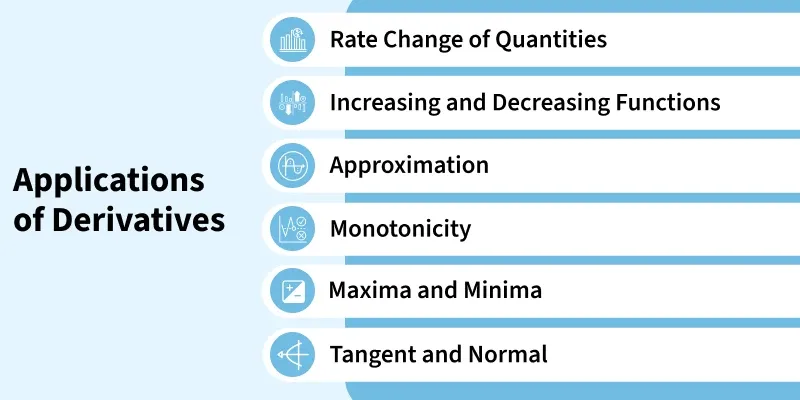
Derivatives are crucial in mathematics and have wide applications in fields like engineering, architecture, economics, and more. They help in understanding how physical quantities change, such as velocity (rate of change of displacement) and acceleration (rate of change of velocity).
Rate Change of Quantities
When two quantities are related by some function, then a change in one quantity with respect to another quantity is known as a rate change of quantities, and it is represented by the derivatives.
For a function y = f(x), the rate of change of y with respect to x is represented by
dy/dx = lim h⇢0[f(x + h) - f(x)]/h
- h is the rate change in the value of x,
- f(x + h) - f(x) is the change in the value of function i.e., y, and
- [f(x + h) - f(x)]/h is the rate of change of y with respect to x.
**Example: For y = 16 - x2. Find the rate of change of y at x = 8.
The rate of change of y at x = 8 is given by dy/dx at x = 8,
i.e., dy/dx = -2x [Putting x = 8]
⇒ dy/dx (at x = 8) = -16,
Hence, -16 is the required answer.
Increasing and Decreasing Function
A function is said to be an increasing function if for function f(x) if we consider two values in its domain x1 and x2 such that x1 > x2, then f(x1) > f(x2). In derivatives, we can define the increasing function as the function for which the slope of its graph is positive i.e., for a function f(x), f'(x) > 0, where f'(x) represents the derivative of the given function.
**Example: Check whether function f(x) = x2 is increasing or not for x > 0.
For f(x) = x2
f'(x) = 2xNow, for x > 0 f'(x) = 2x, is always positive.
Thus f(x) = x2, is an increasing function for x > 0.
A function is said to be a decreasing function if for function f(x) if we consider two values in its domain x1 and x2 such that x1>x2, then f(x1) < f(x2). In derivatives, we can define the decreasing function as the function for which the slope of its graph is negative i.e., for a function f(x), f'(x) < 0, where f'(x) represents the derivative of the given function.
**Example: Check whether function f(x) = x2 is decreasing or not for x< 0.
for f(x) = x2
⇒ f'(x) = 2xNow, for x < 0 f'(x) = 2x, is always negative.
Thus f(x) = x2, is an decreasing function for x < 0.
Approximation
As derivative is defined as f'(a) = [f(x) - f(a)]/(x-a)
Rearranging the above definition, we find the linear approximation formula for any function f(x).
f(x) ≈ f(a) + f'(a)(x - a)
**Example: Approximate the value of √0.037 using derivatives.
Let's consider a function f(x) = √x
On differentiating f(x) with respect to x, we get
f'(x) = (1/2) × x(-1/2)
As 0.037 can rewritten as 0.04 - 0.003,
Thus, h = 0.003
Now, f'(x) = (f(x + h) - f(x)) / h, where h is the change in x.
Thus, -0.003 × (1/2) × 0.04(-1/2) = f(00.4 - 0.003) - f(0.04)
⇒ f(0.037) ≈ 0.1925
⇒ √0.037 ≈ 0.1925Thus, approximation of √0.037 is 0.1925.
Monotonicity
Monotonicity refers to the behavior of a function, specifically how it changes as its input variable changes. A function is said to be monotonically increasing if its output values increase as its input values increase. Similarly, a function is monotonically decreasing if its output values decrease as its input values increase.
More formally, a function f(x) is said to be:
- Monotonically increasing on an interval I if for any x1, x2 ∈ I such that x1 < x2, we have f(x1) ≤ f(x2).
- Monotonically decreasing on an interval I if for any x1, x2 ∈ I such that x1 < x2, we have f(x1) ≥ f(x2).
Maxima and Minima
The tangent to a curve at the point of maxima or minima is a line parallel to the x-axis. The slope of a line parallel to the x-axis is zero. Hence the value of dy/dx at the point of maxima and minima is zero.
Now, the steps involved in finding the point of maxima or minima are as follows:
- Find the derivative of the function.
- Equate the derivative with zero to get the critical points.
- Now find the double derivative of the function.
If the value of the double derivative at a critical point is less than zero then that point is the point of maxima.
If the value of the double derivative at a critical point is greater than zero then the point is the point of minima.
**Example: Find the local maxima and local minima of the function 2x3 - 21x2 + 36x - 20.
Let y = 2x3 - 21x2 + 36x - 20.
⇒ dy/dx = 6x2 - 42x + 36
For Critical point, dy/dx = 0,
6x2 - 42x + 36 = 0
⇒ x2 - 7x + 6 = 0
⇒ x2 - (6 + 1)x + 6 = 0
⇒ x2 - 6x - x + 6 = 0
⇒ x = 6, 1.Thus, the critical points are 6 and 1.
Now, d2y/dx2 = 12x - 42
Putting x = 6.
d2y/dx2 = 12 × 6 - 42 = 30 > 0
Hence, 6 is a point of minima.
Minimum value is 2 × 216 - 21 × 36 + 36 × 6 - 20 = -128
Putting x=1.
d2y/dx2 = 12-42 = -30 < 0
Hence, 1 is a point of maxima.
Maximum value is 2 - 21 + 36 - 20 = -3.
Tangent and Normal
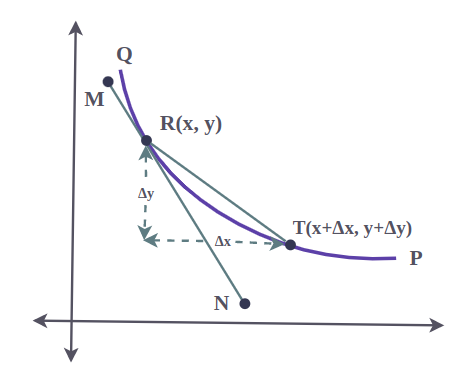
A line that touches a curve at a point but does not pass through it, is called the tangent to the curve at that point. A normal is a line that is perpendicular to a tangent. The equation of a tangent to a curve is shown in the graph below,
According to the definition of derivatives,
dy/dx = lim∆x ⇢ 0 (∆y / ∆x).
Therefore the equation of tangent MN: (Y - y) = dy/dx × (X - x).
This results in the equation of the tangent line at R.
If two lines are parallel to each other, they both have the same slope. If two lines are perpendicular to each other, the multiplication of their slopes is equal to -1.
As we know that a normal curve is perpendicular to the tangent, therefore, slope of normal × Slope of tangent = -1.
Let the slope of normal be m. We know that the slope of tangent = dy/dx. Therefore, m × dy/dx = -1 ⇒ m = - dx/dy
Therefore the equation of normal to the curve at R is given by,
(Y - y1) = (-dx/dy) × (X - x1)
Where, -dx/dy is the slope of normal at (x1, y1)
Hence, the concept of the derivatives is used in finding the equations of both the tangent and the normal to a curve at a given point.
Sample Problems
**Problem 1: Find the equation of the tangent and the normal to the circle having equation x2 + y2 = a2 at a point (3, 6).
Given, Equation of circle = x2 + y2 = a2.
Differentiating the above equation with respect to x,
2 × x + 2 × y dy/dx = 0
⇒ dy/dx = -(2 × x) / (2 × y)
⇒ dy/dx = -(x / y)Equation of tangent: (Y-y) = (dy/dx) × (X - x)
⇒ (Y - y) = -(x / y) × (X - x)
⇒ (Y × y) - y = -(X × x) + x2 [Multiplying left and right side by y]
⇒ (Y × y) + (X × x) = x2 + y2
⇒ (Y × y) + (X × x) = a2Putting x = 3 and y = 6,
(Y × 6) + (X × 3) = a2, this is the required equation.
Equation of normal: (Y - y) = (-dx/dy) × (X - x)
⇒ (Y - y) = (y / x) × (X - x), -dx/dy = y / x
⇒ (Y × x) - y × x = (X × y) - y × x
⇒ (Y × x) - (X × y) = 0Putting x = 3 and y = 6,
(Y × 3) - (X × 6) = 0, this is the required equation.
**Problem 2: Find the equation of the tangent to the ellipse having equation (x2 / a2) + (y2 / b2) = 1 at a point (x1, y1).
Given, Equation of ellipse = (x2 / a2) + (y2/ b2) = 1
Differentiating the above the equation with respect to x,
(2 × x) / a2 + ((2 × y) / b2 ) × (dy/dx) = 0
⇒ dy/dx = (-(2 × x) / a2) / ((2 × y) / b2)
⇒ dy/dx = (- x × b2) / (y × a2)Now, dy/dx at (x1, y1) = (-x1 × b2) / (y1 × a2)
Equation of tangent: (Y - y1) = (dy/dx) × (X - x1)
(Y - y1) = ((-x1 × b2) / (y1 × a2)) × (X - x1)
⇒ (Y × y1 × a2) - (y12 × a2) = (- X × x1 × b2) + (x12 × b2)Dividing both sides by (a2 × b2),
((Y × y1) / b2) - (y12 / b2) = -(( X × x1) / a2) + (x12 / a2)
⇒ ((X × x1) / a2) + ((Y × y1) / b2) = (x12 / a2) + (y12 / b2)
⇒ ((X × x1) / a2) + ((Y × y1) / b2) = 1, this is the required equation.
⇒ (x12 / a2) + (y12 / b2) = 1
**Problem 3: Find the equation of normal to a curve having equation x2+ y2 - 2 × x - 10 × y + 16 = 0 at point (2, 2).
Given, Equation of curve: x2 + y2 - 2 × x - 10 × y + 16 = 0
Differentiating the equation with respect to x,
2 × x + 2 × y(dy/dx) - 2 - (10 × dy/dx) = 0
(2y − 10)dy/dx + 2x − 2 = 0
(2y − 10)dy/dx = − 2x+ 2Putting x = 2 and y = 2,
dy/dx = - 4 + 2/ 4 − 10 = −2/-6 = 1/3
Equation of normal: (Y - y) = (-dx/dy) × (X - x)
(Y − 2) = −3(X − 2)
Y−2 = −3X + 6Y
Y = 3x + 8
⇒ Y = 3x + 8, this is the required equation.