Domain and Range of Relations (original) (raw)
Last Updated : 6 Oct, 2025
The **domain is the set of all possible input values (the "x" values), and the **range is the set of all possible output values (the "y" values) in a relation.
For any two non-empty sets A and B, we define the relation R as the subset of the Cartesian product of A × B where each member of set A is related to a member of set B through some unique rule.
We defined relation as,
**R = {(x, y): x ∈ A and y ∈ B}
**Example: The relation R = {(1, 1), (2, 4), (3, 9)} is represented using the following diagram:
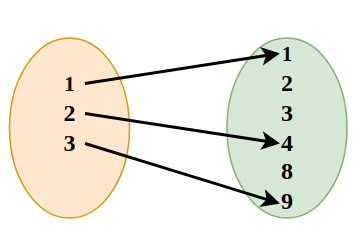
Set Relation Diagram
As we know, any set of ordered pairs that are related to a unique relation we have domain and range, i.e., for R such that R(A × B,) such that {(a, b) where a ∈ A and b ∈ B} we have domain and range of R.
Here, the set of values of A is called the domain, and the set of values of b is called the range.
**Domain of a Relation
The domain of any Relation is the set of input values of the relation. For example, if we take two sets A and B, and define a relation R: {(a, b): a ∈ A, b ∈ B}, then the set of values of A is called the domain of the function.
The image given below represents the domain of a relation.

Domain of the Relation
**Range of a Relation
Range of any Relation is the set of output values of the relation. For example, if we take two sets A and B, and define a relation R: {(a,b): a ∈ A, b ∈ B}, then the set of values of B is called the range of the function.
The image given below represents the range of a relation.

Range of the Relation
**Codomain of a Relation
We define the codomain of the relation R as the set B of the Cartesian product A×B on which the relation is defined. Now it is clear that the range of the function is a proper subset of the Codomain.
**Range ⊆ Codomain

Range and Co domain
**Example: Take a set S = {4, 5, 6, 9, 10, 11, 12, 13, 17} and define a relation A from S to S such that in the ordered pair (x, y) in A, y is two more than x.
**Solution:
We define R as,
S = {4, 5, 6, 9, 10, 11, 12, 13, 17}
y = x + 2 , we want to pair it with another element y from the same set such that y is exactly 2 more than x.
Pairs:
x = 4, x + 2 = 6 ∈ S ⇒ (4, 6) ∈ A
x = 5, x + 2 = 7 ∉ S ⇒ (5, 7) ∉ A
.
.
.
**Valid pairs we found: (4, 6), (9, 11), (10, 12),(11, 13)R = {(4, 6), (9, 11), (10, 12),(11, 13)}
Thus,
- Domain of R is (4, 9, 10, 11)
- Range of R is (6, 11, 12, 13)
- Codomain is (4, 5, 6, 9,10,11,12,13, 17)
How to Find the Domain and Range of a Relation?
Steps to find theDomain and Range of any relation are given as follows:
Steps to Find the Domain
We can find the domain of relation in many different ways, depending on the provided information. Steps to find the domain are listed below:
**From a Set of Ordered Pairs
- List all the unique x-values from the given ordered pairs.
- Example: For the relation {(1, 2), (3, 4), (5, 6)}, the domain is {1, 3, 5}.
**From an Equation
- Identify the values of x for which the relation is defined.
- Exclude x-values that make the equation undefined, such as:
Division by zero: For y = 1/x, x ≠ 0, so the domain is x ∈ R∖{0}. - Square roots of negative numbers (for real-valued relations).
For y = √(x − 3): x − 3 ≥ 0, so the domain is x ≥ 3.
**From a Graph
- Observe the horizontal extent of the graph.
- Identify all the x-values covered by the graph.
Steps to Find Range
We can find the range of relation in many different ways, depending on the provided information. Steps to find the domain are listed below:
**From a Set of Ordered Pairs
- List all the unique y-values from the given ordered pairs.
- Example: For the relation {(1, 2), (3, 4), (5, 6)}, the range is {2, 4, 6}.
**From an Equation
- Express y in terms of x, and determine all possible y-values.
- For y = x2, y ≥ 0, so the range is y ∈ [0,∞).
- Consider restrictions on y based on the equation.
- For y = 1/x, y ≠ 0, so the range is y ∈ R∖{0}.
**From a Graph
- Observe the vertical extent of the graph.
- Identify all the y-values covered by the graph.
**Related Articles
Solved Question on Domain and Range of a Relation
**Question 1: Find the domain and range of the relation R: {(a,a2) | a ∈ A, a2 ∈ A} which is defined on A×A and the set A = {1, 2, 3, 4, 5, 6, 7, 8, 9}.
**Solution:
Set A = {1, 2, 3, 4, 5, 6, 7, 8, 9}
Relation R = {(a,a2) | a ∈ A, a2 ∈ A}, defined on A×A
If
a = 1 : a2 = 1 ⇒ (1, 1) a2∈ A
a = 2 : a2 = 4 ⇒ (2, 4) a2∈ A
a = 3 : a2 = 9 ⇒ (3, 9) a2∈ A
a = 4 : a2 = 16 ⇒ (4, 16) a2∉ ARelation R is defined as,
R = {(1,1), (2,4), (3,9)}
- Domain of R = {1,2,3}
- Range of R = {1,4,9}
- Codomain of R = Set A = = {1,2,3,4,5,6,7,8,9}
**Question 2: Find the domain and range of the relation R: {(a, a+3) | a ∈ A, a + 3 ∈ A} which is defined on A×A and the set A = {1, 2, 3, 4, 5, 6, 7, 8, 9}.
**Solution:
Set A = {1, 2, 3, 4, 5, 6, 7, 8, 9}
Relation R={(a, a + 3 ) | a ∈ A , a + 3 ∈ A}, defined on A × A
Check values of a in A for which a + 3 ∈ A
If
a = 1 : a + 3 = 4 ⇒ (1, 4) a + 3 ∈ A
a = 2 : a + 3 = 5 ⇒ (2, 5) a + 3 ∈ A
a = 3 : a + 3 = 6 ⇒ (3, 6) a + 3 ∈ A
a = 4 : a + 3 = 7 ⇒ (4, 7) a + 3 ∈ A|
a = 5 : a + 3 = 8 ⇒ (5, 8) a + 3 ∈ A
a = 6 : a + 3 = 9 ⇒ (6, 9) a + 3 ∈ A
a = 7 : a + 3 = 10 ⇒ (7, 10) a + 3 ∉ A
a = 8 : a + 3 = 11 ⇒ (8, 11) a + 3 ∉ A
a = 9 : a + 3 = 12 ⇒ (9, 12) a + 3 ∉ ANow form the ordered pairs (a, a + 3):
Fora = 1 : (1, 4)
a = 2 : (2, 5)
a = 3 : (3, 6)
a = 4 : (4, 7)
a = 5 : (5, 8)
a = 6 : (6, 9)Relation R is defined as,
R = {(1, 4),(2, 5),(3, 6), (4, 7), (5, 8), (6, 9)}
- Domain of R = {1, 2, 3, 4, 5, 6}
- Range of R = {4, 5, 6, 7, 8, 9}
- Codomain of R = Set A = {1, 2, 3, 4, 5, 6, 7, 8, 9}
**Question 3: Find the domain and range of the relation R: {(a, b) | a+b = 7 a ∈ A, b ∈ B} which is defined on A×B and the set A = {1, 2, 3, 4} B = {5, 6, 7, 8, 9}.
**Solution:
Set A={1, 2, 3, 4}
Set B={5, 6, 7, 8, 9}
Relation R={(a, b)∣a + b = 7, a ∈ A, b ∈ B}
If
a = 1 : a + b = 7, b = 6 ⇒ (1, 6) b ∈ B
a = 2 : a + b = 7, b = 5⇒ (2, 5) b ∈ B
a = 3 : a + b = 7, b = 4⇒ (3, 4) b ∉ B
a = 4 : a + b = 7, b = 3⇒ (4, 3) b ∉ BRelation R is defined as,
R = {(1,6), (2,5)}
- Domain of R = {1, 2}
- Range of R = {6, 5}
- Codomain of R = Set B = {5, 6, 7, 8, 9}