Introduction to Lines and Angles (original) (raw)
Last Updated : 1 May, 2026
In mathematics, a line is used to represent a straight path that has length but no width or depth. Helps us describe the shape and direction of objects around us.
An angle is formed when two lines, line segments, or rays meet at a common point. When two rays intersect in the same plane, the opening between them is called an angle. Helps us understand turns, corners, and directions in geometry.
Lines
A line is a one-dimensional figure that extends infinitely in both directions and has no width.
- It is made up of infinitely many points placed close together.
- In a Cartesian plane, a line is represented by the equation ax + by = c.
Lines can also be categorised as,
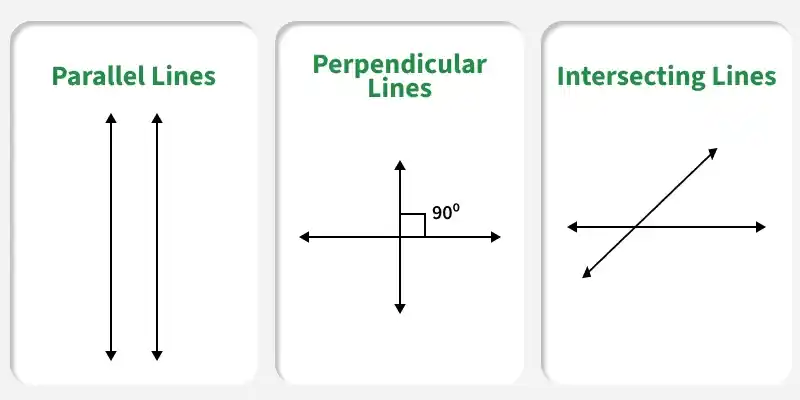
Angles
When two rays meet at a point, they form an angle.
- Measured in degrees (°), which represent the amount of rotation.
- Angle can range from 0° to 360° and is represented by the symbol ∠.
There are various types of lines and angles in geometry based on the measurements and different scenarios.
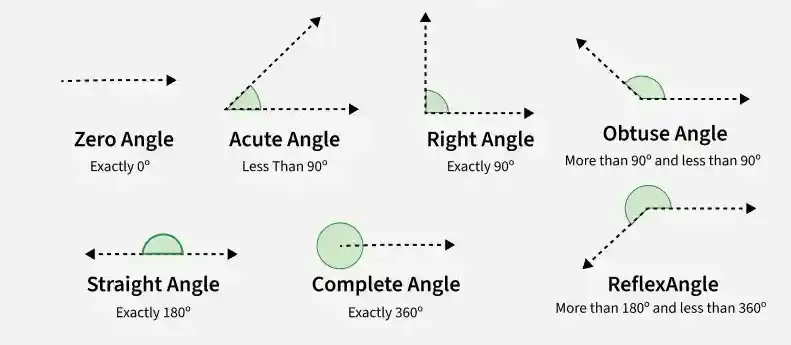
Properties of Lines and Angles
Some general properties of lines and angles:
**Lines
- Line has only one dimension, i.e., length. It does not have breadth and height.
- A line has infinite points on it.
- Three points lying on a line are called collinear points
**Angles
- Angles tell about how much a line has rotated from its position.
- Angles are formed when two lines meet, and they are called arms of the angle.
Solved Examples
**Example 1: Find the reflex angle of ∠x if the value of ∠x is 75 degrees.
**Solution:
Let the reflex angle of ∠x be ∠y.
Now, according to the properties of lines and angles, the sum of an angle and its reflex angle is 360°.
Thus,
∠x + ∠y = 360°
75° + ∠y = 360°
∠y = 360° − 75°
∠y = 285°
Thus, the reflex angle of 75° is 285°.
**Example 2: Find the complementary angle of ∠x if the value of ∠x is 75 degrees.
**Solution:
Let the complementary angle of ∠x be ∠y.
Now, according to the properties of lines and angles, the sum of an angle and its complementary angle is 90°.
Thus,
∠x + ∠y = 90°
75° + ∠y = 90°
∠y = 90° − 75°
∠y = 15°
Thus, the complementary angle of 75° is 15°.
**Example 3: Find the supplementary angle of ∠x, if the value of ∠x is 75 degrees.
**Solution:
Let the supplementary angle of ∠x be ∠y.
Now, according to the properties of lines and angles, the sum of an angle and its supplementary angle is 180°.
Thus,
∠x + ∠y = 180°
75° + ∠y = 180°
∠y = 180° − 75°
∠y = 105°
Thus, the supplementary angle of 75° is 105°.
**Example 4: Find the value of ∠A and ∠B if ∠A = 4x and ∠B = 6x are adjacent angles and they form a straight line.
**Solution:
According to the properties of lines and angles, the sum of the adjacent linear angles formed by a line is 180°.
Thus,
∠A + ∠B = 180°
4x + 6x = 180°
10x = 180°
x = 180°/10 = 18°
Thus,
- ∠A = 4x = 4×18 = 72°
- ∠B = 6x = 6×18 = 108°
Practice Questions
**Question 1: Find the complementary angle of ∠P, if the value of ∠P is 35 degrees.
**Question 2: Find the supplementary angle of ∠Z, if the value of ∠Z is 120 degrees.
**Question 3: Find the reflex angle of ∠A, if the value of ∠A is 110 degrees.
**Question 4: Find the reflex angle of ∠B, if the value of ∠B is 45 degrees.
**Question 5: Find the value of ∠X and ∠Y if ∠X = 5y and ∠Y = 7y are adjacent angles and they form a straight line.
**Question 6: Find the value of ∠A and ∠B if ∠A = 3x and ∠B = 7x are adjacent angles and they form a straight line.