Isosceles Triangle (original) (raw)
Last Updated : 23 Jul, 2025
An **isosceles triangle is a type of triangle in geometry that has at **leasttwo sides of equal length. The angles opposite these sides are also equal.
Suppose we have any triangle △PQR then it is an **isosceles triangle if any one of the given conditions is true:
- PR = QR
- ∠P = ∠Q
In the figure below the Side **AC = BC, also **∠A = ∠B making it an **Isosceles Triangle.

**Note: **Every equilateral triangle is an isosceles triangle .
Real-life Examples of Isosceles triangle:

**Read More: Real-Life Examples of Isosceles triangle
Angles of Isosceles Triangle
A triangle has three angles so an isosceles triangle also has three angles but an isosceles triangle is a special case as it has two angles of the three angles equal. The angle sum property of the triangle also holds for the Isosceles triangle. Suppose we have an isosceles triangle △ABC where AB = AC, and ∠B = ∠C. If the unknown angle ∠A is given then we can easily find the other angle of the Isosceles triangle. For example,
**Example: In Isosceles triangle △ABC where ∠B = ∠C and ∠A = 80°. Find other angles.
**Solution:
We know that, in any triangle △ABC
∠A + ∠B + ∠C = 180°
Also, ∠B = ∠C and ∠A = 80°
Using angle sum property of triangle,
80° + ∠B + ∠B = 180°
⇒ 2∠B = 100°
⇒ ∠B = 50°Thus, measure of other two angles of an isosceles triangle is 50°.
Types of Isosceles Triangles
Isosceles triangles are classified into three types depending on the measures of angles, which include,
- Isosceles Right Triangle
- Isosceles Obtuse Triangle
- Isosceles Acute Triangle
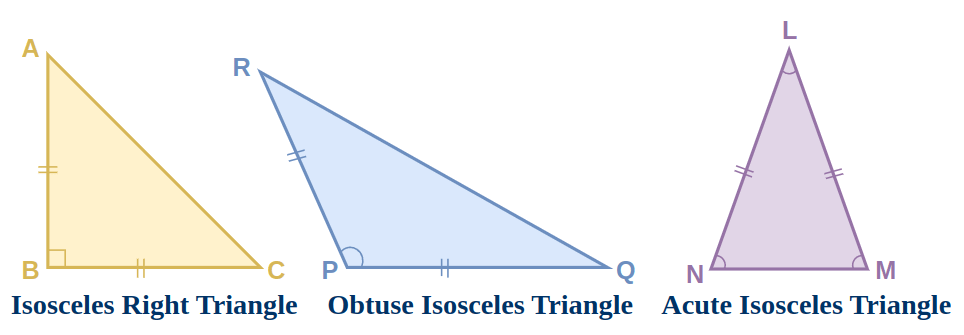
Types of Isosceles Triangle
**Isosceles Right Triangle
An isosceles triangle that has a right angle is called an Isosceles Right triangle. Examples of isosceles right triangles are,
- Triangle with angles 45°, 45° and 90°
**Isosceles Obtuse Triangle
An isosceles triangle in which any one angle is obtuse angles and the other two are acute angles is called an Isosceles Acute triangle. Some examples of isosceles obtuse triangles are,
- Triangle with angles 40°, 40° and 100°
- Triangle with angles 35°, 35° and 110°, etc.
**Isosceles Acute Triangle
An isosceles triangle in which all the angles are acute is called an Isosceles Acute triangle. Some examples of isosceles acute triangles are,
- Triangle with angles 50°, 50° and 80°
- Triangle with angles 65°, 65° and 50°, etc.
Properties of Isosceles Triangles
The following are some important characteristics of an isosceles triangle:
- An isosceles triangle will always have at least two equal sides and two equal angles.
- In an isosceles triangle, the two sides of equal length are called the legs, and the third side of the triangle is called the base.
- The angle between the legs of an isosceles triangle is called the apex angle or vertex angle.
- The perpendicular drawn from the apex angle bisects the base of the isosceles triangle and the apex angle.
- The perpendicular drawn from the apex angle is also known as the line of symmetry as it divides the isosceles triangle into two congruent triangles.
Isosceles Triangle Theorem
There are two common theorems related to isosceles triangles i.e.,
- Base Angle Theorem
- Isosceles Triangle Theorem
Base Angle Theorem
Angle Theorem states that,
****"If two sides in any isosceles triangle are equal then the angle opposite to them are also equal."**
Isosceles Triangle Theorem
The converse of the base angle theorem is also true which states that
****"If two angles in any isosceles triangle are equal then the side opposite to them are also equal."**
If we have an Isosceles triangle ABC then,
**AB = AC ⟺ ∠ABC = ∠ACB
Isosceles Triangles Formulas
The height, perimeter, and area are the three basic formulas of an isosceles triangle, which are discussed below.
Perimeter of Isosceles Triangle
The perimeter of an isosceles triangle is equal to the sum of its three side lengths. As an isosceles triangle has two equal sides, the perimeter of the isosceles triangle will be (2a + b) units, where "a" is the length of the two equal sides and "b" is the base length.

**Perimeter of an Isosceles Triangle = (2a + b) units
Where,
- ****"a"** is the length of the two equal sides, and
- ****"b"** is the base length
**Learn more: **Perimeter of a Triangle
Isosceles Triangle Area
The total region bounded by the three sides of a triangle in a two-dimensional plane is known as the area of a triangle. The area of an isosceles triangle is equal to half the product of its base length and its height.

**Area of an Isosceles Triangle = ½ × base × height
- If the three side lengths of an isosceles triangle are given, then its area can be calculated using Heron's formula.
Area of an Isosceles Triangle = \frac{1}{2}\times b\times\sqrt{[a^{2}-(b/2)^{2}]}
Where,
- ****"a"** is Length of Two Equal Sides
- ****"b"** is Base Length
Isosceles Triangle Altitude
The perpendicular drawn from the apex angle bisects the base of the isosceles triangle and the apex angle. The formula to calculate the height of an isosceles triangle if its side lengths are given is as follows:
Height of an Isosceles Triangle (h) =\sqrt{[a^{2}-(b/2)^{2}]}
Where,
- ****"a"** is Length of Two Equal Sides
- ****"b"** is Base Length
**Related Articles:
Solved Examples on Isosceles Triangle
**Example 1: Determine the perimeter of an isosceles triangle with equal sides measuring 7 cm and a base length of 10 cm.
**Solution:
Given,
Lengths of equal sides of the triangle (a) = 7 cm
Base length (b) = 10 cmWe know that,
Perimeter of an isosceles triangle (P) = 2a + b
⇒ P = 2 × 7 + 10
⇒ P = 14 + 10 = 24 cmThus, the perimeter of the given isosceles triangle is 24 cm.
**Example 2: Determine the area of an isosceles triangle whose base length is 14 cm, and its height is 7.5 cm.
**Solution:
Given,
Height (h) = 7.5 cm
Base length (b) = 14 cmWe know that, Area of an isosceles triangle (A) = ½ × b × h
⇒ A = ½ × 14 × 7.5
⇒ A = ½ × 105
⇒ A = 52.5 sq. cmHence, the area of the given isosceles triangle is 52.5 sq. cm.
**Example 3: Determine the height of an isosceles triangle with equal sides measuring 13 cm and a base length of 10 cm.
**Solution:
Given,
Lengths of equal sides of the triangle (a) = 13 cm
Base length (b) = 10 cmWe know that,
Height of an isosceles triangle (h) = \sqrt{[a^{2}-(b/2)^{2}]}
⇒ h = \sqrt{[13^{2}-(10/2)^{2}]}
⇒ h = \sqrt{[13^{2}-5{}^{2}]}
⇒ h = \sqrt{[169-25]}
⇒ h = √144 = 12 cmHence, the height of the given isosceles triangle is 12 cm.