Log Table (original) (raw)
Last Updated : 29 Dec, 2025
A Log Table in math is a reference tool to ease computations using logarithmic functions.
- It usually provides pre-computed logarithm values for various integers, commonly in a base like 10 or the natural logarithm base (e.g., ≈ 2.71828).
- Log tables allow users to obtain the logarithm of a given number without completing difficult computations, as the logarithmic value may be read straight from the table.
Before calculators and computers, log tables were commonly employed to simplify difficult arithmetic computations requiring exponentiation and multiplication by translating them into simpler addition and subtraction operations using logarithmic principles.
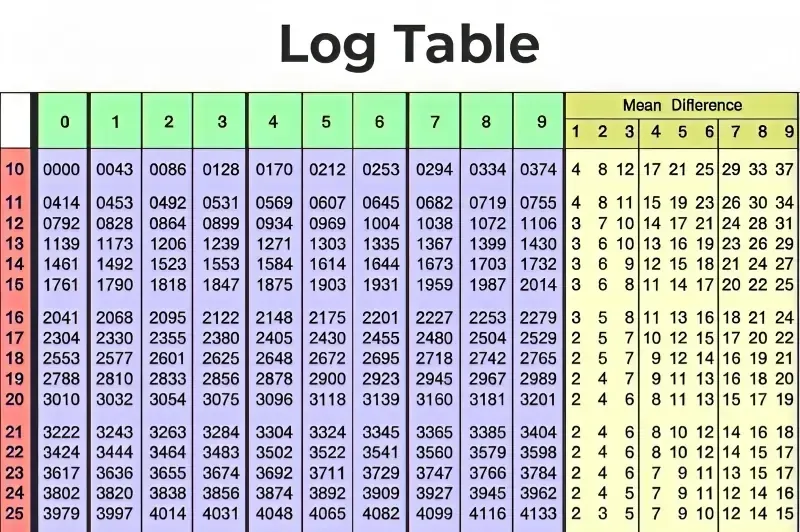
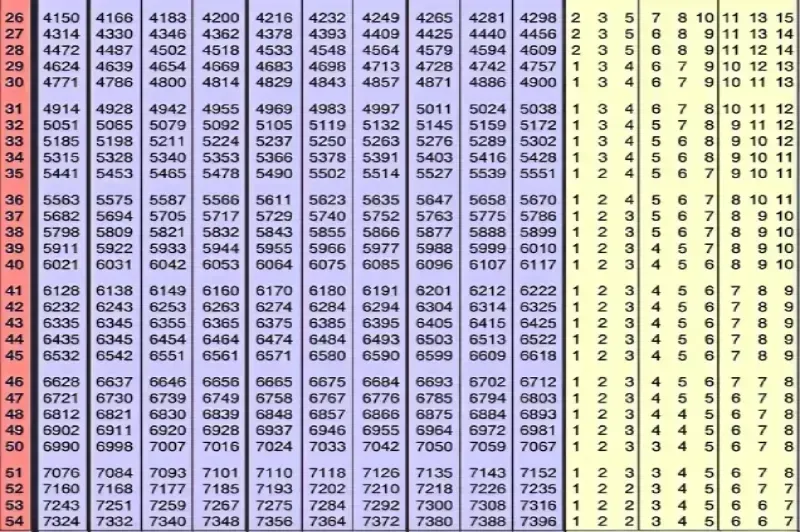
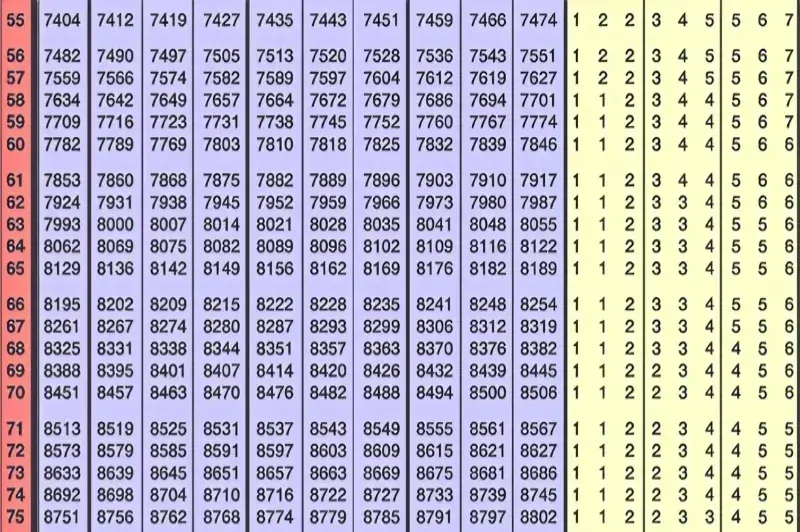
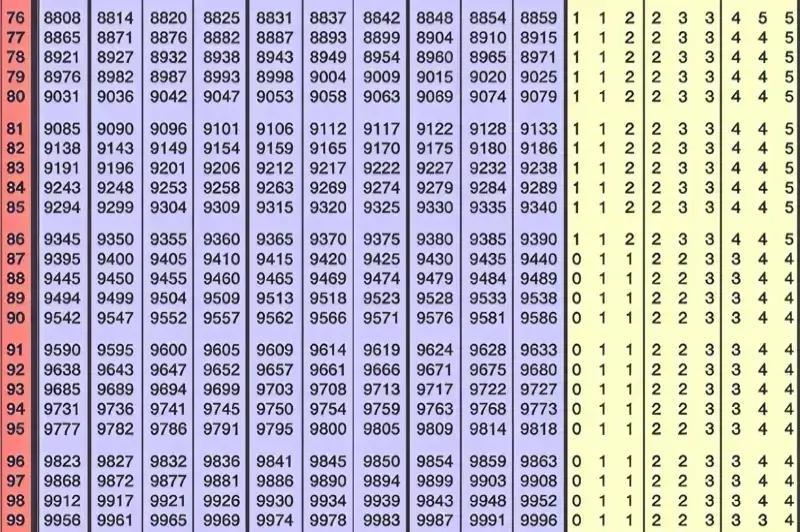
Log Values
Logarithm Table PDF
Click here to download the PDF version of the log table:
| **Log Table PDF |
|---|
Calculation of Log
Each item in a log table is made up of two parts: the characteristic and the mantissa. These components help us find the true value of a logarithm for a given logarithmic value. Any Logarithmic value can be represented as
**Log of any number = Characteristic + Mantissa
Let's discuss these components in detail.
**Characteristic
The **characteristic is the integer part of a logarithm. It represents the order of magnitude or the power of 10 that is closest to the given number.
In mathematical terms, if you have a number "N" expressed in scientific notation as "N = M × 10k," where "M" is a number greater than or equal to 1 and less than 10, and "k" is an integer exponent, then the characteristic is "k."
The characteristic of the logarithm of a number is determined by its position in scientific notation and can be either positive or negative. If the number is greater than 1, the characteristic is found by counting the digits to the left of the decimal point minus one. If the number is less than 1, the characteristic is calculated by counting the zeros immediately following the decimal point, negating the result, and subtracting one. For example,
- In log(500), the characteristic is 2, as in 500.0, the number of digits left to the decimal place is 3.
- In log(1000), the characteristic is 3, as in 1000.0, the number of digits left to the decimal place is 4.
- In log(0.01), then the characteristic is -2, as in 0.01, the number of zeros to the right to the decimal place is 1.
**Mantissa
The mantissa is the fractional part of the result of any logarithm. When paired with the characteristic, it completes the logarithmic value. It is always positive and lies between 0 and 1. It can be calculated with the help of a log table, which we will learn in the article further.
- If log(500) = 2.698, then the mantissa here is 698.
- If log(1000) = 3.0, then the mantissa is 0.
- If log(0.01) = -2.0, then the mantissa is 0.
- If log x = 14.31 = 1.431 × 101, then the mantissa is 431.
How to Use the Logarithm Table
To find the logarithmic value of a number using a log table, students need to know how to read and interpret it. Here’s a simple, step-by-step explanation with an example:
**Step 1: Determine the base for the table.
A distinct log table is utilized for each of the bases. The preceding table is for base 10. As a result, only the log value of a number to the base 10 may be found. Students will need to consult a separate table to determine Natural Logarithms or Binary Logarithms.
**Step 2: Determine the whole number's integer and decimal components.
Assume we wish to calculate the log of n = 22.35. So, first and foremost, we remove the integer from the decimal.
Integer Part: 22
Decimal Part: 35
**Step 3: Return to the common log table and search for the cell value at the intersections.
The row is tagged with the first two digits of n, whereas the column header is labelled with the third digit of n.
⇒ Log10(22.35) row 22, column 3 cell value 3483. As a result, the result is 3483.
**Step 4: Always use a mean difference with the Common Logarithm table.
Return to the mean difference table and find row 22 and column 5 (fourth digit of n).
⇒ Log10(22.35) row 22, mean difference column 5 cell value 10 is used in this example. Make a note of the equivalent value, which is 10.
**Step 5: Combine the values acquired in steps 3 and 4.
This equals 3483 + 10= 3493.
**Step 6: Locate the characteristic part.
Find the integer value of p such that ap < n and ap+1 > n through trial and error. Here, a is the base and p is the characteristic part. Simply count the amount of digits remaining in the decimal and remove one for common (base 10) logs.
So, characteristic part = Total number of digits to the left of the decimal – 1
In this case, characteristic part = 2 - 1 = 1**Step 7: Combine the characteristic and mantissa.
By combining the characteristic and the Mantissa portion, students will obtain the final value of 1.3493.
So, log10 (22.35) = 1.3493.


Logarithmic Table: 1 To 10
Common logarithm tables offer logarithms to the base 10, commonly known as base-10 logarithms or decimal logarithms.
The following are the common log tables 1 through 10:
| **Common Logarithm to a Number (log 10 x) | **Log Values |
|---|---|
| Log Table from 1 To 10 values | |
| log 1 | 0 |
| log 2 | 0.3010 |
| log 3 | 0.4771 |
| log 4 | 0.6020 |
| log 5 | 0.6989 |
| log 6 | 0.7781 |
| log 7 | 0.8450 |
| log 8 | 0.9030 |
| log 9 | 0.9542 |
| log 10 | 1 |
Natural Log Table: 1 To 10
Natural logarithm tables give logarithms to the base "e," where "e" is the mathematical constant 2.71828. These logarithms are also known as natural logarithms or exponential logarithms. Natural logarithms are utilized in mathematics, particularly in calculus and statistics. The following are the natural log tables 1 through 10:
| Natural Log Table for 1 To 10 Values | |
|---|---|
| **Natural Logarithm to a Number ( e ) | **Log Values |
| In (1) | 0 |
| In (2) | 0.693147 |
| In (3) | 1.098612 |
| In (4) | 1.386294 |
| In (5) | 1.609438 |
| In (6) | 1.791759 |
| In (7) | 1.94591 |
| In (8) | 2.079442 |
| In (9) | 2.197225 |
| In (10) | 2.302585 |
Log and Antilog Table
The key differences between both log and antilog tables are listed in the following table:
| Parameter | Log Table | Antilog Table |
|---|---|---|
| Purpose | Used to find the logarithms of numbers. | Used to find antilogarithms (exponentials) of numbers. |
| Input | Typically contains logarithms of numbers. | Typically contains antilogarithms of numbers. |
| Example Entry | log10(2) = 0.3010 | antilog10(0.3010) = 2.00 |
| Common Base | Commonly base 10 (log10) and e (Euler's Number) | Commonly base 10 (antilog10) and e (Euler's Number) |
| Use Cases | Used for simplifying multiplication and division. | Used for simplifying exponentiation and power calculations. |
| Table Contents | Contains logarithmic values for various numbers, typically arranged in a tabular format. | Contains antilogarithmic values for various logarithmic values, typically arranged in a tabular format. |
**Related Articles:
**Important Notes on Log Table:
- Log table can be used to find logarithm of number if the number of first non-zero digit is less than or equal to 4. if the number of digiht is greater than 4 . We simply ignore the digit from 5 th digit onwards.
- The log of a number has two parts: Characteristic (Integral Part) and Mantissa ( Decimal Part).
- Characteristics can be positive or negative.
- Mantinssa should always be positive.
- If we have to find the logarithm of base (other than 10), we first use a change of base rule log ba= (log a)/(log b) and then use the same table of common logs.
**Also Check: Tricks to Solve Logarithm Questions
Solved Examples on Using the Log Table
**Example 1: A log table is used to compute the logarithms of various values. Determine their characteristics and mantissa if log x = -3.4606.
**Solution:
We know that a number's logarithm is the sum of its characteristics and mantissa. However, keep in mind that the mantissa is always positive.
log x = -3.4606
⇒ log x = -3 - 0.4606However, mantissa cannot be negative. So we add and subtract 1.
log x = (-3 - 1) + (1 - 0.4606)
log x = -4 + 0.5394
Thus, log x = characteristic + mantissaAs a result, the characteristic is -4 and the mantissa is 0.5394.
**Example 2: Determine the value of log10 5.632.
**Solution:
To find the common logarithm of the number 5.632 we need to evaluate characteristic and mantissa and add them together.
To find mantissa find the row labeled "56" and the column "3" in the log table.
The intersection of this row and column gives you the mantissa without mean difference: 7505.And then find the mean difference for the same row and column 2 i.e., 2.
Thus, Mantissa = 7505 + 2 = 7507.To find the characteristic, since 5.632 is greater than 1, the characteristic is the number of digits to the left of the decimal point minus 1.
In this case, there are two digits to the left of the decimal point, so the characteristic is 0.
Thus, log10 (5.632) = characteristic + mantissalog10 (5.632) = 0 + 0.7507 = 0.7507.
So, log10 (5.632) ≈ 0.7507.
**Example 3: Find the value of log10 0.0751 using the log table.
**Solution:
To find the common logarithm of the number 0.0751 we need to evaluate characteristic and mantissa and add them together.
To find mantissa find the row labeled "75" and the column "1" in the log table.
The intersection of this row and column gives you the mantissa without mean difference: 8756.As there is not digit after that, we don't need to check the mean difference.
Thus, Mantissa is 8756.To find the characteristic, since 0.0751 is smaller than 1, the characteristic of 7.5 × 10⁻² is -2.
Thus, log10 0.0751 = characteristic + mantissalog10 0.0751 = -2 + 0.8756 = -1.1244
So, log10 0.0751 ≈ -1.1244