Percentage Shortcuts and Tricks (original) (raw)
Last Updated : 9 Mar, 2026
Percentages are a fundamental part of quantitative aptitude and play a crucial role in various competitive exams and placement tests. Although the basic concept is simple, percentage problems are often combined with other topics to make them more challenging.
Mastering a few smart techniques can help you solve these questions quickly and accurately, giving you an edge in your preparation.
Basic Concepts of Percentage
- **Percent: A unit of measurement equal to one-hundredth of a whole. For example, 1% is equivalent to 1/100.
- **Whole: The complete amount or total to which the percentage refers. For example, the total number of students in a class.
- **Part: The portion or fraction of the whole that the percentage represents. For example, the number of students who scored A grades.
Percentage Formula
The percentage formula is used to determine the proportion or share of a quantity in terms of 100. To calculate a percentage, we typically work with three variables:
- **Total value (V₁) – the whole or original amount
- **Part value (V₂) – the portion or specific amount out of the total
- **Percentage (P%) – the result representing how much V₂ is of V₁ in percent terms
The formula is given by:
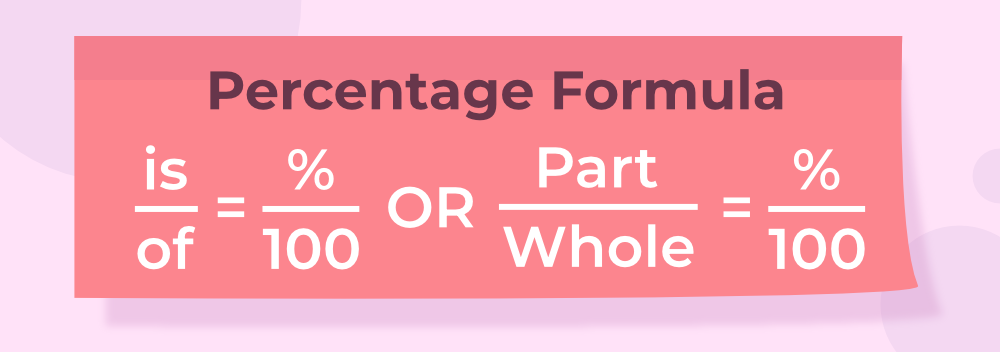
\text{Percentage (P\%)} = \left( \frac{\text{Part (V₂)}}{\text{Whole (V₁)}} \right) \times 100
Also, the percentage formula can be understood in two equivalent forms, as shown below:
**Percentage Table with Common Fractions
Remember the following conversion to increase your calculation speed.
| Fraction | Percentage | Fraction | Percentage |
|---|---|---|---|
| 1/1 | 100% | 1/20 | 5% |
| 1/2 | 50% | 1/25 | 4% |
| 1/3 | 33.33% | 1/50 | 2% |
| 1/4 | 25% | 1/100 | 1% |
| 1/5 | 20% | 3/4 | 75% |
| 1/6 | 16.67% | 2/3 | 66.67% |
| 1/7 | 14.29% | 3/5 | 60% |
| 1/8 | 12.5% | 5/6 | 83.33% |
| 1/9 | 11.11% | 7/8 | 87.5% |
| 1/10 | 10% | 9/8 | 112.5% |
Maths Trick to Find Percentage
Here are a few of the tricks to find percentages quickly:
Numerator Swapping Trick
For x% of y, we have x% of y = (x/100) × y.
This can also be written as x% of y = x × (y/100).
We can swap the positions of x and y (commutative and associative property of multiplication):
x% of y = y% of x.
Let's say you want to calculate 20% of 50. Using this trick, we can quickly solve it by finding the 50% of 20, that is 10.
This trick is useful for simplifying calculations and understanding that percentage calculations can be swapped between the two numbers.
10% Trick
Finding 10% of any number is easy: simply move the decimal point one place to the left. For example:
- 10% of 250 is 25.0
- 10% of 78 is 7.8
Once you have 10%, you can easily find multiples of 10%:
- 20% is just 10% doubled. So, 20% of 250 is 25.0 * 2 = 50
- 30% is three times 10%. So, 30% of 78 is 7.8 * 3 = 23.4
1% Trick
Similarly, finding 1% of any number involves moving the decimal point two places to the left. This is particularly useful for fine-tuned adjustments.
- 1% of 250 is 2.5
- 1% of 78 is 0.78
To find other percentages:
- 5% is five times 1%. So, 5% of 250 is 2.5 * 5 = 12.5
- 15% is 10% plus 5%. So, 15% of 78 is 7.8 + 3.9 = 11.7
Using Fractions to Simplify Percentages
Percentages are essentially fractions of 100, so some common fractions can make percentage calculations easier. For example:
- 50% is 1/2. So, 50% of 200 is 200 / 2 = 100
- 25% is 1/4. So, 25% of 60 is 60 / 4 = 15
- 75% is 3/4. So, 75% of 80 is 80 * 3 / 4 = 60
Doubling and Halving Strategy
This trick is helpful for percentages like 5%, 20%, and 40%:
- To find 20%, you can find 10% and then double it. For instance, 20% of 150 is 15 (10% of 150) doubled, which is 30.
- For 5%, find 10% and halve it. So, 5% of 300 is 30 (10% of 300) halved, which is 15.
- To find 40%, double 20%. For example, 40% of 50 is 10 (20% of 50) doubled, which is 20.
Quick Estimate Method
For a quick mental estimate, round the numbers to make the math easier:
- To estimate 19% of 47, round 19% to 20% and 47 to 50. Then calculate 20% of 50, which is 10. This gives you an approximate idea.
Percentage Increase and Decrease
To quickly determine a percentage increase or decrease:
- Find the percentage (e.g., 20%) of the original amount (e.g., 50) using the methods above (10).
- Add (for increase) or subtract (for decrease) this result from the original number: 50 + 10 = 60 for a 20% increase; 50 10 = 40 for a 20% decrease.
Reverse Percentage Calculation
If you know the final amount after a percentage increase or decrease and want to find the original amount:
- For a 20% increase, the final amount is 120% of the original. Divide the final amount by 1.2. For example, if the final amount is 72, the original is 72 / 1.2 = 60.
- For a 25% decrease, the final amount is 75% of the original. Divide the final amount by 0.75. For example, if the final amount is 45, the original is 45 / 0.75 = 60.
Splitting Percentages
Splitting Percentages is a mental math technique that involves decomposing a percentage into smaller, more easily calculated parts.
For example: To calculate 47% of 9834
Step 1: 47% can be split into 50%, 1% and 3%
Step 2: 50% of 9834 = 4917
Step 3: 1% of 9834 = 98.34 so 3% = 98.34 × 3 =295.02
Step 4: Now , 47% = 50% - 3% = 4917 - 295.02 = 4621.98
so, 4621.98 is the 47% of the 9834.
Common Exam Questions and Quick Formulas for Solving Them
**Type 1: What is the the **y percent of number A?
To find the y percent of a number A, use the formula:
Required number = (y × A/100)
**Example: What is **30% of **500?
Required number = (30 × 500/100) = 150
So, 30% of 500 is 150.
**Type 2: Comparison between 2 variables
For questions like one variable what percent of other or vice versa?
| A is what percent of B? | B is what percent of A? |
|---|---|
| Required percentage = ( A/B × 100) % | Required percentage = ( B/A × 100) % |
| Example:Let's say A = 30 and B = 50.Required percentage = (30/50 × 100) = 60%So, 30 is 60% of 50. | Example:Using the same values, A = 30 and B = 50.Required percentage = (50/30 × 100) = 166.67%So, 50 is 166.67% of 30. |
For questions like one variable is how much more or less than the other.
| A is what percent less than B? | B is what percent more than A? |
|---|---|
| Required percentage = ((B − A)/B × 100) % | Required percentage= ((B − A)/A × 100) % |
| Example:Suppose A = 30 and B = 50.Required percentage = ((50 − 30)/50 × 100) = 40%So, 30 is 40% less than 50. | Example:Using the same values, A = 30 and B = 50.Required percentage = ((50 − 30)/30) × 100 = 66.67%So, 50 is 66.67% more than 30. |
Type 3: Product Constant Ratio (decreases/increase) / comparison
If the price of a commodity increases by R%, the required reduction in consumption to maintain the same expenditure is given by the formula:
\left( \frac{R}{100 + R} \times 100 \right) \%
**Example: The price of rice increases by 40%. By what percentage should a family reduce its consumption of rice to keep the total expenditure on rice the same?
**Solution:
Percentage increase in price (R) = 40%
Substitute R = 40:
= (40/(100 + 40) × 100)%
= (40/140 × 100)%
= (0.2857 × 100)%
= 28.57%
The family should reduce its rice consumption by approximately **28.57% to keep the expenditure the same.
If the price of a commodity decreases by R%, the necessary increase in consumption to keep the expenditure unchanged is given by the formula:
\left( \frac{R}{100 - R} \times 100 \right) \%
**Example: The price of milk decreases by 20%. By what percentage should a family increase its consumption of milk to keep the total expenditure the same?
**Solution:
Percentage decrease in price (R) = 20%
Substitute R = 20:
= (20/(100 - 20) × 100)%
= (20/80 × 100)%
= (0.25 × 100)%
= 25%
The family should increase its milk consumption by **25% to keep the expenditure unchanged.
Type 4: Successive Change
When a number is first adjusted (increased or decreased) by a% and then further adjusted by b%, the total percentage change in the number is given by the formula:
= (\pm a \pm b \pm \frac{ab}{100}) \%
**Note: An increase is represented by a positive sign, while a decrease is represented by a negative sign. The net percentage change, whether an increase or decrease, depends on the sign (positive/negative). This overall effect is also referred to as the successive percentage change.
**Example: The price of a gadget increases by 8%, while the demand for it decreases by 5%. What is the net percentage change in the total revenue from the gadget?
**Solution:
Percentage increase in price (a) = 8%
Percentage decrease in demand (b) = -5%
Substitute a = 8 and b = −5:
( (8) + (-5) + \frac{(8)(-5)}{100}) \%
8-5+ \frac{-40}{100} \%
= 8 − 5 − 0.4
= 2.6%
The net percentage change in total revenue is **2.6%, meaning the total revenue increases by 2.6%
**Percentage - Questions and Answers
**Question 1 : A defect finding machine rejects 0.085% of all the cricket bats. Find the number of bats manufactured on a particular day if it is given that on that day, the machine rejected only 34 bats.
**Solution :
Let the total number of bats on that day be n.
=> 0.085 % of n = 34
=> (0.085 / 100) x n = 34
=> n = 34 x (100 / 0.085)
=> n = 40,000
Therefore, total number of bats manufactured on the day = 40,000
**Question 2 : 25 % of a number is 8 less than one third of that number. Find the number.
**Solution :
Let the number be n.
=> (n / 3) - 25 % of n = 8
=> (n / 3) - (n / 4) = 8
=> n / 12 = 8
=> n = 96
Thus, 96 is the required number.
**Question 3 : Difference of two numbers 'x' and 'y' (x > y) is 100. Also, 10 % of 'x' is equal to 15 % of 'y'. Find the numbers.
**Solution :
We are given that x - y = 100 and 10 % of x = 15 % of y
=> x - y = 100 and (10 / 100) x = (15 / 100) y
=> x - y = 100 and 10 x = 15 y
=> x - y = 100 and 2 x = 3 y
=> x - y = 100 and x = 1.5 y
=> 1.5 y - y = 100
=> 0.5 y = 100
=> y = 200
=> x = 1.5 y = 300
Thus, the required numbers are 300 and 200.
**Question 4 : In a gaming event, 75 % of the registered participants actually turned up. Out of those, 2 % were declared unfit for participation. The winner defeated 9261 participants which are 75 % of the total valid participation. Find the number of registered participants.
**Solution :
Let the number of registered participants be n.
Number of participants who actually turned up = 75 % of n
Number of valid participations = 98 % of (75 % of n) [because 2% were invalid]
Number of participants defeated by the winner = 75 % of 98 % of (75 % of n) = 9261
=> 0.75 x 0.98 x 0.75 x n = 9261
=> 0.55125 x n = 9261
=> n = 16800
Therefore, number of registered participants = 16800
**Question 5 : In a test, a geek could answer 70 % C++ questions, 40 % C questions and 60 % Java questions correctly. The test had a total of 75 questions, 10 from C++, 30 from C and 35 from Java. A minimum of 60 % in aggregate was required to be considered for interview. The geek could not clear the test and was not shortlisted for interview. Find by how much marks did the geek miss the interview call, given that each question was of 1 mark and there was no negative marking for incorrect answers.
**Solution :
We are given that the geek could answer 70 % C++ questions, 40 % C questions and 60 % Java questions correctly and there were total 75 questions : 10 from C++, 30 from C and 35 from Java.
=> C++ questions answered correctly = 70 % of 10 = 7
=> C questions answered correctly = 40 % of 30 = 12
=> Java questions answered correctly = 60 % of 35 = 21
=> Total questions answered correctly = 7 + 12 + 21 = 40
=> Marks secured = 40 x 1 = 40
Now, marks required = 60 % of 75 = 45
=> Shortfall in marks = 45 - 40 = 5
Therefore, the geek missed the interview call by 5 marks.