Minkowski Distance (original) (raw)
Last Updated : 23 Jul, 2025
Minkowski Distance is a generalized metric that unifies various distance measures used in mathematics and machine learning. It provides a flexible way to compute distances between points in an n-dimensional space.
It is a powerful distance function that encompasses several well-known distance metrics, such as **Manhattan Distance and **Euclidean Distance, as special cases, with different values of p leading to well-known distances such as Manhattan Distance (p=1), Euclidean Distance (p=2), and Chebyshev Distance (p→∞).
The Minkowski Distance between two points A = (A1, A2, …, An) and B = (B1, B2, …, Bn) in an n-dimensional space is given by:
D(A, B) = \left( \sum_{i=1}^{n} |A_i - B_i|^p \right)^{\frac{1}{p}}
where p is a parameter that determines the nature of the distance metric.
Generalization of Other Distance Metrics
The Minkowski Distance can represent different types of distances based on the value of p:
1. Manhattan Distance (p = 1)
D(A, B) = \sum_{i=1}^{n} |A_i - B_i|
Also called **Taxicab Distance, it represents movement along grid-based paths, such as city blocks where diagonal movement is restricted.
2. Euclidean Distance (p = 2)
D(A, B) = \sqrt{\sum_{i=1}^{n} (A_i - B_i)^2}
This is the straight-line distance between two points, making it the most commonly used metric in geometry, physics, and machine learning.
3. Chebyshev Distance (p→∞)
D(A, B) = \max_{i} |A_i - B_i|
This measures the maximum absolute coordinate difference, often used in chess for king movement and in warehouse logistics for **max-step constraints.
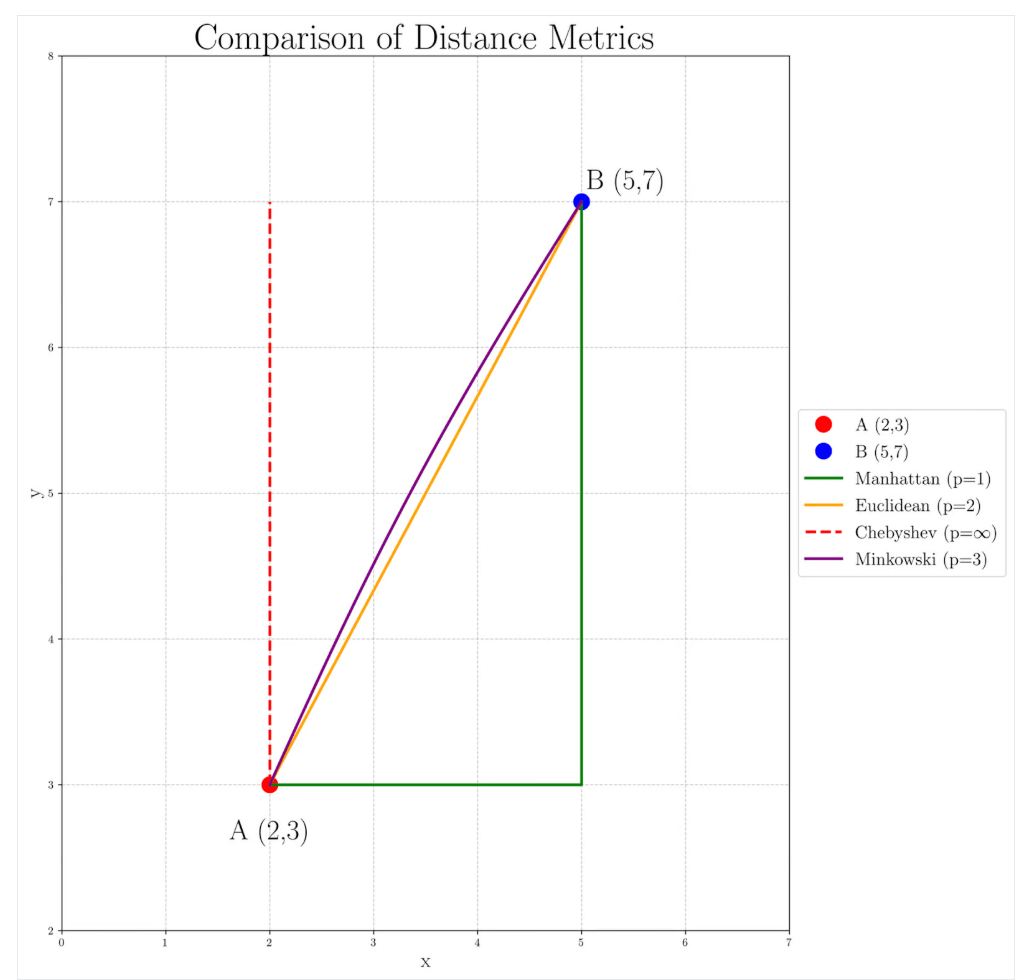
Distance Metrics
Numerical Example
Consider two points in 3D space:
A = (2, 5, 8), B = (3, 1, 6)
**For Manhattan Distance (p = 1)
D(A, B) = |2 - 3| + |5 - 1| + |8 - 6| = 1 + 4 + 2 = 7
**For Euclidean Distance (p = 2)
D(A, B) = \sqrt{(2 - 3)^2 + (5 - 1)^2 + (8 - 6)^2}
D(A, B) = \sqrt{1 + 16 + 4} = \sqrt{21} \approx 4.58
**For Chebyshev Distance (p→∞)
D(A, B) = \max(|2 - 3|, |5 - 1|, |8 - 6|) = \max(1, 4, 2) = 4
Mathematical Properties
1. Non-negativity
D(A, B) \geq 0
Distance is always non-negative, meaning it can never be less than zero, ensuring a valid metric for measuring separations between points.
2. Identity of Indiscernibles
D(A, B) = 0 \iff A = B
The distance between two points is zero if and only if they are identical, ensuring that distinct points always have a nonzero distance.
3. Symmetry
D(A, B) = D(B, A)
The distance remains unchanged when the order of points is swapped, making the metric independent of direction.
4. Triangle Inequality (Only for p≥1)
D(A, C) \leq D(A, B) + D(B, C)
This ensures that taking a direct path between two points is always the shortest, reinforcing the foundational property of metric spaces.
5. Generalization
\lim_{p \to \infty} D(A, B) = \max_{i} |A_i - B_i|
As p increases, the Minkowski Distance approaches the **Chebyshev Distance, meaning only the largest coordinate difference dominates the overall distance measure.
Implementation in Python
Below is the Python implementation of Minkowski Distance, including visualization:
Python `
import numpy as np import matplotlib.pyplot as plt
def minkowski_distance(A, B, p): """Compute Minkowski Distance between two points A and B for given p.""" return np.power(np.sum(np.abs(np.array(A) - np.array(B)) ** p), 1 / p)
Sample points
A = np.array([2, 5, 8]) B = np.array([3, 1, 6])
Compute distances for different values of p
p_values = [1, 2, 10] distances = [minkowski_distance(A, B, p) for p in p_values]
Print results
for p, d in zip(p_values, distances): print(f"Minkowski Distance (p={p}): {d:.4f}")
Visualization
plt.figure(figsize=(6, 4)) plt.plot(p_values, distances, marker='o', linestyle='-', color='b') plt.xlabel("p (Minkowski Parameter)") plt.ylabel("Distance") plt.title("Minkowski Distance for Different p Values") plt.grid(True) plt.show()
`
**Output:
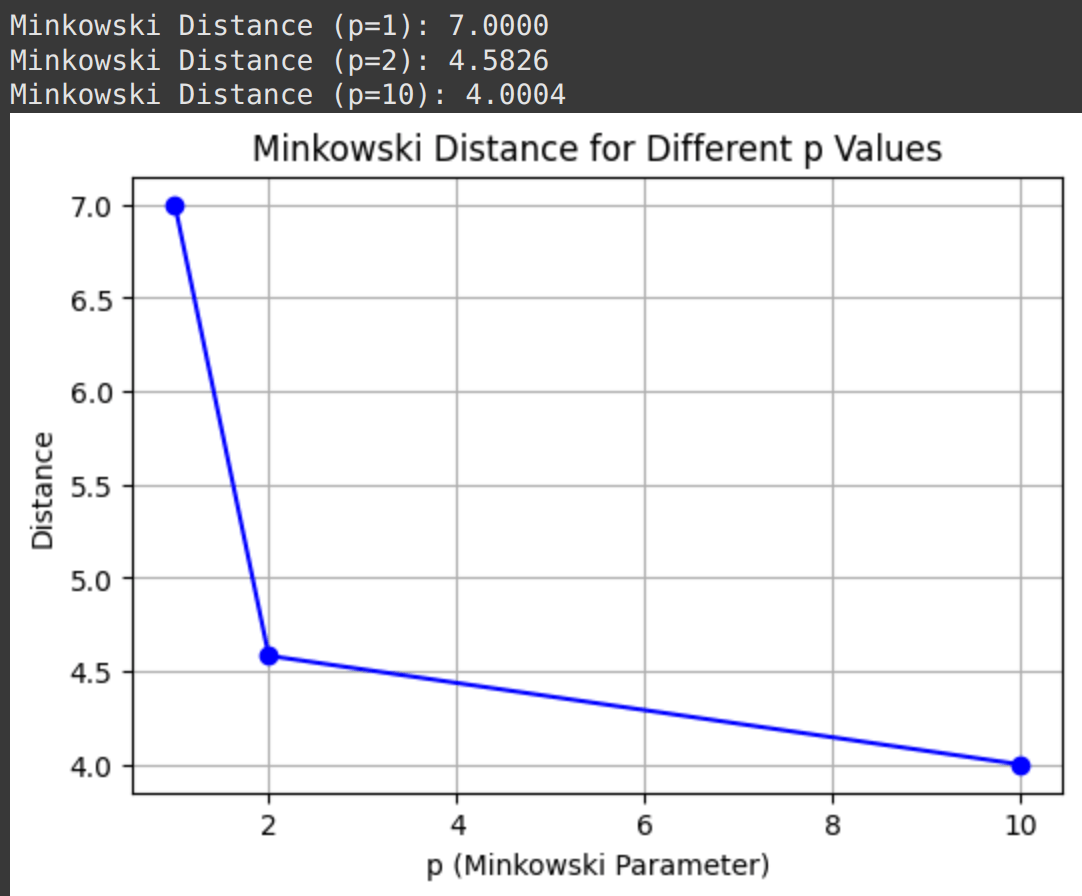
Minkowski Parameters
The plot shows how Minkowski Distance varies for different p values.
Real-Life Applications
1. Machine Learning & Clustering
Used in K-Nearest Neighbors (KNN) and K-Means Clustering to measure the similarity between data points.
2. Image Processing
Used in measuring similarity between images, especially in image retrieval systems.
3. Finance & Risk Analysis
Employed in portfolio analysis to compute risk distances between financial assets.
4. Robotics & Path Planning
Manhattan and Euclidean distances (special cases) are widely used in robot motion planning and autonomous navigation.