NCERT Solutions Class 10 Chapter 3 Pair of Linear Equations in Two Variables Exercise 3.3 (original) (raw)
Last Updated : 23 Apr, 2024
Question 1. Solve the following pair of linear equations by the elimination method and the substitution method:
(i) x + y = 5 and 2x – 3y = 4
**Solution:
Here, the two given eqn. are as follows:
x + y = 5 ..........(I)
2x – 3y = 4 ...........(II)
**ELIMINATION METHOD:
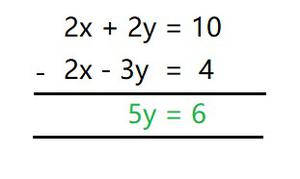
Multiply equation (I) by 2, and then subtract (II) from it, we get
5y = 6
y = 6/5
Now putting y=6/5 in eqn. (I), we get
x + 6/5 = 5
x = (5–(6/5))
x = 19/5
**SUBSTITUTION METHOD:
From (I), we get
y=5–x.......(III)
Now substituting the value of y in eqn. (II), we get
2x – 3(5–x) = 4
2x – 15+3x = 4
5x = 4+15
x = 19/5
As, putting x = 19/5, in eqn. (III), we get
y = 5 – 19/5
y = 6/5
Hence, by elimination method and substitution method we get,
**x = 19/5 and y = 6/5.
(ii) 3x + 4y = 10 and 2x – 2y = 2
**Solution:
Here, the two given eqn. are as follows:
3x + 4y = 10 ..........(I)
2x – 2y = 2 ...........(II)
**ELIMINATION METHOD:
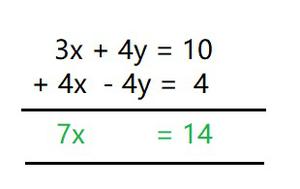
Multiply equation (II) by 2, and then add it to (I), we get
7x = 14
x = 14/7
x = 2
Now putting x = 2 in eqn. (I), we get
3(2) + 4y = 10
4y = 10 – 6
y = 4/4
y = 1
**SUBSTITUTION METHOD:
From (II), we get
x = (2+2y)/2
x = y+1 .......(III)
Now substituting the value of x in eqn. (I), we get
3(y+1) + 4y = 10
3y + 3 + 4y = 10
7y = 10 – 3
y = 7/7
y = 1
As, putting y = 1, in eqn. (III), we get
x = 1+1
x = 2
Hence, by elimination method and substitution method we get,
**x = 2 and y = 1.
(iii) 3x – 5y – 4 = 0 and 9x = 2y + 7
**Solution:
Here, the two given eqn. are as follows:
3x – 5y – 4 = 0
9x = 2y + 7
By rearranging we get,
3x – 5y = 4 ..........(I)
9x – 2y = 7 ...........(II)
**ELIMINATION METHOD:
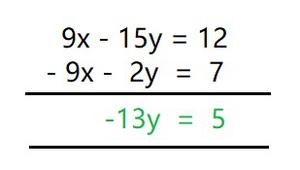
Multiply equation (I) by 3, and then subtract (II) from it, we get
–13y = 5
y = -5/13
Now putting y = – 5/13 in eqn. (I), we get
3x – 5(– 5/13) = 4
3x = 4 – (25/13)
3x = 27/13
x = 9/13
**SUBSTITUTION METHOD:
From (I), we get
3x – 5y = 4
x = (4+5y)/3 .......(III)
Now substituting the value of x in eqn. (II), we get
9((4+5y)/3) – 2y = 7
3(4+5y) – 2y = 7
12+15y – 2y = 7
13y = – 5
y = – 5/13
As, putting y = – 5/13, in eqn. (III), we get
x=(4+5(– 5/13))/3
x = 9/13
Hence, by elimination method and substitution method we get,
****x=9/13 and y=**– **5/13.
(iv) x/2 + 2y/3 = -1 and x - y/3 = 3
**Solution:
Here, the two given eqn. are as follows:
x/2 + 2y/3 = –1 ...........(A)
x – y/3 = 3 ...................(B)
by rearranging (multiply (A) by 6 and multiply (B) by 3) we get,
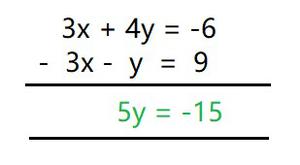
3x + 4y = – 6 ..........(I)
3x – y = 9 ...........(II)
**ELIMINATION METHOD:
Subtract (II) from (I), we get
5y = – 15
y = – 3
Now putting y = -3 in eqn. (II), we get
3x – (– 3) = 9
3x = 9 – 3
x = 6/3
x = 2
**SUBSTITUTION METHOD:
From (II), we get
3x – y = 9
y = 3x – 9 .......(III)
Now substituting the value of y in eqn. (I), we get
3x + 4(3x – 9) = – 6
3x + 12x – 36 = – 6
15x = – 6 + 36
x = 30/15
x = 2
As, putting x = 2, in eqn. (III), we get
y = 3(2) – 9
y = – 3
Hence, by elimination method and substitution method we get,
****x=2 and y=**– **3.
Question 2. Form the pair of linear equations in the following problems, and find their solutions (if they exist) by the elimination method:
(i) If we add 1 to the numerator and subtract 1 from the denominator, a fraction reduces to 1. It becomes ½ if we only add 1 to the denominator. What is the fraction?
**Solution:
Let the fraction be p/q, where p is numerator and q is denominator.
Here, According to the given condition,
(p+1)/(q – 1) = 1 ....................(A)
and,
p/(q+1) = 1/2 .......................(B)
Solving (A), we get
(p+1) = q – 1
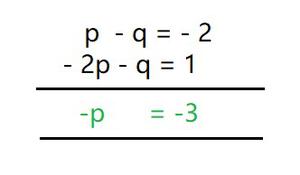
**p – q = – 2 ............................(I)
Now, solving (B), we get
2p = (q+1)
**2p – q = 1 ****............................(II)**
When equation (I) is subtracted from equation (II) we get,
p = 3
Now putting p = 3 in eqn. (I), we get
3 – q = – 2
q = 3+2
q = 5
So, p = 3 and q = 5.
**Hence, the fraction p/q is 3/5.
(ii) Five years ago, Nuri was thrice as old as Sonu. Ten years later, Nuri will be twice as old as Sonu. How old are Nuri and Sonu?
**Solution:
Let us assume, present age of Nuri is x
And present age of Sonu is y.
Here, According to the given condition, the equation formed will be as follows :
x – 5 = 3(y – 5)
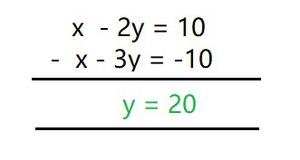
**x – 3y = – **10 …………………………………..(I)
Now,
x + 10 = 2(y +10)
**x – 2y = 10 …………………………………….(II)
Subtract eqn. (I) from (II), we get
y = 20
Now putting y = 20 in eqn. (II), we get
x – 2(20) = 10
x = 10+40
x = 50
Hence,
**Age of Nuri is 50 years
**Age of Sonu is 20 years.
(iii) The sum of the digits of a two-digit number is 9. Also, nine times this number is twice the number obtained by reversing the order of the digits. Find the number.
**Solution:
Let the unit digit and tens digit of a number be x and y respectively.
Then, Number = 10y + x
And, reverse number = 10x + y
**eg: 23
**x = 3 and y = 2
**So, 23 can be represented as = 10(2) + 3 = 23
Here, According to the given condition
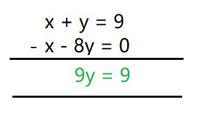
**x + y = 9 …………………….(I)
and,
9(10y + x) = 2(10x + y)
90y + 9x = 20x + 2y
88y = 11x
x = 8y
**x – 8y = 0 ………………………………………………………….. (II)
Subtract eqn. (II) from (I) we get,
9y = 9
y = 1
Now putting y = 1 in eqn. (II), we get
x - 8(1) = 0
x = 8
Hence, the number is 10y + x
=10 × 1 + 8
**Number = 18
(iv) Meena went to a bank to withdraw ₹ 2000. She asked the cashier to give her ₹ 50 and ₹ 100 notes only. Meena got 25 notes in all. Find how many notes of ₹ 50 and ₹ 100 she received.
**Solution:
Let the number of ₹ 50 notes be x and the number of ₹100 notes be y
Here, According to the given condition
**x + y = 25 ……………………………….. (I)
**50x + 100y = 2000 ………………………………(II)
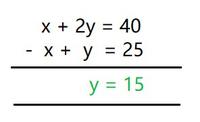
Divide (II) by 50 and then subtract (I) from it.
y = 15
Now putting y = 15 in eqn. (I), we get
x + 15 = 25
x = 10
**Hence, Manna has 10 notes of ₹ 50 and 15 notes of ₹ 100.
(v) A lending library has a fixed charge for the first three days and an additional charge for each day thereafter. Saritha paid ₹ 27 for a book kept for seven days, while Susy paid ₹ 21 for the book she kept for five days. Find the fixed charge and the charge for each extra day.
**Solution:
Let the fixed charge for the first three days be ₹ x and,
The charge for each day extra be ₹ y.
Here, According to the given condition,
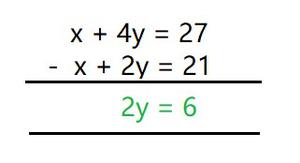
**x + 4y = 27 …….…………………………. (I)
**x + 2y = 21 ………………………………………….. (II)
Subtract (II) from (I), we get
2y = 6
y = 3
Now putting y = 3 in eqn. (II), we get
x + 4(3) = 27
x = 27 – 12
x = 15
**Hence, the fixed charge is ₹15
**And the Charge per day is ₹ 3