NCERT Solutions for Class 10 Maths Chapter 13 Surface Areas and Volumes (original) (raw)
Last Updated : 23 Jul, 2025
**NCERT Solutions for Class 10 Maths Chapter 13 - Surface Areas and Volumes- This article contains detailed NCERT Solutions for Class 10 Maths Chapter 13 Surface Areas and Volumes. It has been developed by the team of experts at GFG as a tool to help students in answering questions from the NCERT textbook.
All of the problems in the exercises included in Class 10 Maths Chapter 13 Surface Areas and Volumes from the NCERT textbook have been covered in the NCERT Solutions for Class 10 Maths.
| Class 10 Maths NCERT Solutions Chapter 13 Surface Areas and Volumes Exercises |
|---|
| **NCERT Solutions for Class 10 Maths Chapter 13 Surface Areas and Volumes Exercise 13.1 – 9 Questions (2 Short Answers, 7 Long Answers) |
| **NCERT Solutions for Class 10 Maths Chapter 13 Surface Areas and Volumes Exercise 13.2 – 8 Questions (1 Short Answer, 7 Long Answers) |
| **NCERT Solutions for Class 10 Maths Chapter 13 Surface Areas and Volumes Exercise 13.3 – 9 Questions (9 Long Answers) |
| **NCERT Solutions for Class 10 Maths Chapter 13 Surface Areas and Volumes Exercise 13.4 – 5 Questions (5 Long Answers) |
| **NCERT Solutions for Class 10 Maths Chapter 13 Surface Areas and Volumes Exercise 13.5– 7 Questions (7 Long Answers) |
This chapter covers important topics related to calculating the surface area and volume of different geometric solids, including :
- cubes, cuboids, cylinders, cones, and spheres using specific formulas and methods
- volumes of these solids.
Additionally, the chapter includes the conversion of units for length, area, and volume.
NCERT Solutions for Class 10 Maths Chapter 13 Surface Areas and Volumes: Exercise 13.1
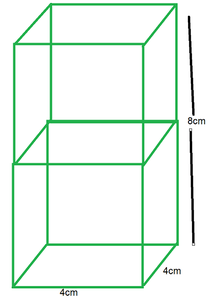
**Question 1. 2 cubes each of volume 64 cm 3 are joined end to end. Find the surface area of the resulting cuboid.
**Solution:
Volume of cube=64cm3 = (side)3
(Side)3 = 64
Side = (64cm3) 1/3
= (2*2*2*2*2*2 cm3)1/3
= 2*2
= 4 cm
Hence, now
Length = 8 cm
breadth = 4 cm
Height = 4 cm
Surface area of cuboid=2(lb+bh+hl)
=2(8*4+4*4+4*8)
=2(32+16+32)
=2(80)
=160cm2
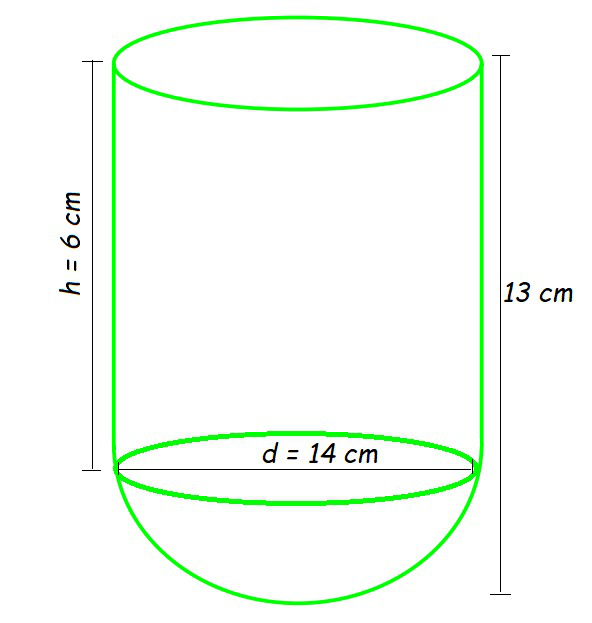
**Question 2. A vessel is in the form of a hollow hemisphere mounted by a hollow cylinder. The diameter of the hemisphere is 14 cm and the total height of the vessel is 13 cm. Find the inner surface area of the vessel.
**Solution:
Height of cylinder = 13-7 = 6 cm
Inner surface area of vessels=C.S.A of cylinder+ C.S.A of Hemisphere
=2πrh+2πr2
=2πr(h+r)
=2*22/7*7(6+7)
=44(13)
=572cm2
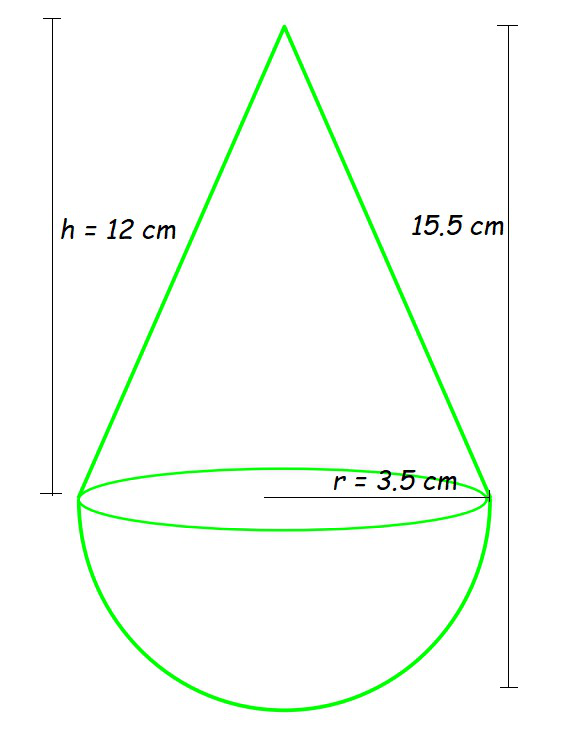
**Question 3. A toy is in the form of a cone of radius 3.5 cm mounted on a hemisphere of same radius. The total height of the toy is 15.5 cm. Find the total surface area of the toy.
**Solution:
Height of cone(h)=15.5-3=12cm
l=√(h2+r2)
l=√(122+3.52)
l=√(144+12.25)
=√256.25
=12.5cm
Total surface area of toy=C.S. A of cone+ C.S.A of hemisphere
=πrl+2πr2
=πr(l+2r)
=22/7*3.5(12.5+2(3.5))
=11(12.5*7)
=11(19.5)
=214.5cm2
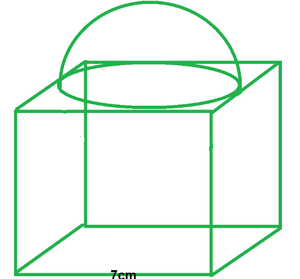
**Question 4. A cubical block of side 7 cm is surmounted by a hemisphere. What is the greatest diameter the hemisphere can have? Find the surface area of the solid.
**Solution:
Surface area of solid=T.S.A of cube-Area of circle+ C.S.A of hemisphere
=6*side*side-πr2+2πr2
=6*side*side+πr2
=6*7*7+22/7*7/2*7/2
=294+72/2
=294+38.5
=332.5cm2
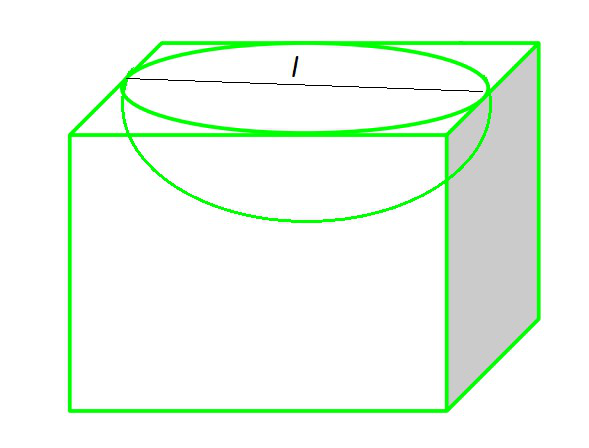
**Question 5. A hemispherical depression is cut out from one face of a cubical wooden block such that the diameter l of the hemisphere is equal to the edge of the cube. Determine the surface area of the remaining solid.
**Solution:
Surface area remaining solid=T.S.A of cube -Area of circle+ C.S.A of hemisphere
=6*side*side- πr2+2πr2
=6*l*l- πr2
=6l2-πr2
=6l2 - π(l/2)2
=6l2 - πl2/4
=(24l2+ πl2)/4
=l2(24+π)/4
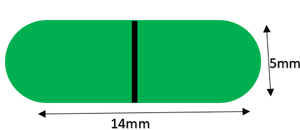
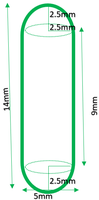
**Question 6. A medicine capsule is in the shape of a cylinder with two hemispheres stuck to each of its ends. The length of the entire capsule is 14 mm and the diameter of the capsule is 5 mm. Find its surface area.
**Solution:
D=5mm r=5/2mm
h=14-5=9
Surface area of cylinder=C.S. A of cylinder+ C.S.A of 2 Hemisphere
=2πrh+2πr2*2
=2πr(h+2r)
=2*22/7*5/2(9+2*5/2)
=110/7(9+5)
=110/7*14
=220mm2
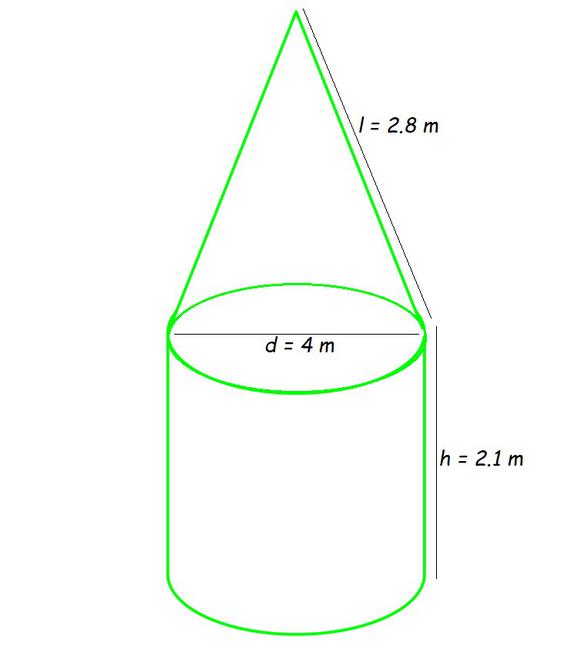
**Question 7. A tent is in the shape of a cylinder surmounted by a conical top. If the height and diameter of the cylindrical part are 2.1 m and 4 m respectively, and the slant height of the top is 2.8 m, find the area of the canvas used for making the tent. Also, find the cost of the canvas of the tent at the rate of Rs 500 per m 2 . (Note that the base of the tent will not be covered with canvas.)
**Solution:
**i) d=4m r=4/2=2m
Area of canvas =C.S.A of cone+ C.S.A of cylinder
=πrl+2πrh
=πr(l+2h)
=22/7(2.8+2*2.1)
=44(2.8+4.2)/7
=44×7/7
=44m2
**ii) cost of canvas=Area×rate
=44m2×Rs. 500/m2
=Rs. 22,000
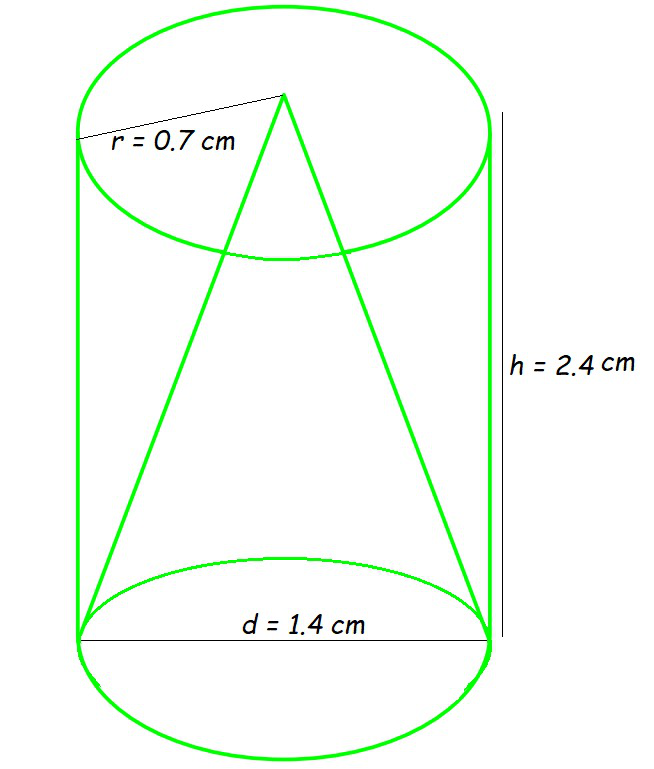
**Question 8. From a solid cylinder whose height is 2.4 cm and diameter 1.4 cm, a conical cavity of the same height and same diameter is hollowed out. Find the total surface area of the remaining solid to the nearest cm 2 .
**Solution:
D=1.4 cm, r=1.4/2=14/20=7/10=0.7
l= √(h2+r2)
= √((2.4)2+(0.7)2)
= √(5.76+0.49)
= √6.25
= 2.5cm2
Total surface area of remaining solid=C.S.A of cylinder+ C.S.A of cone+ Area of circular base
= 2πrh+πrl+πr2
= πr(2h+l+r)
= 22/7*7/10(2(2.4)+2.5+0.7)
= 22(4.8+2.5+0.7)/10
= 22(8)/10
= 176/10
= 17.6cm2
Nearest ten=18cm2
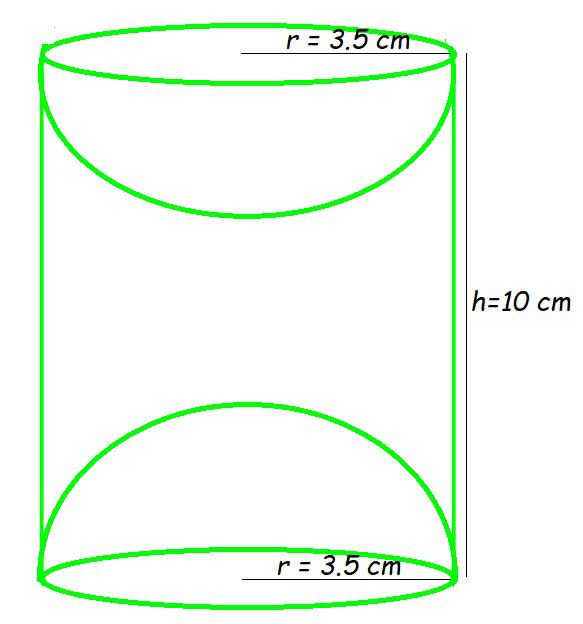
**Question 9. A wooden article was made by scooping out a hemisphere from each end of a solid cylinder, as shown in figure. If the height of the cylinder is 10 cm and its base is of radius 3.5 cm, find the total surface area of the article.
**Solution:
Total surface area of article=C.S.A of cylinder+2*C.S.A of hemisphere
=2πrh+2*2πr2
=2πr(h+2r)
=2*22/7*3.5(10+2(3.5))
=22(10+7)
=22(17)
=374cm2
NCERT Solutions for Class 10 Maths Chapter 13 Surface Areas and Volumes: Exercise 13.2
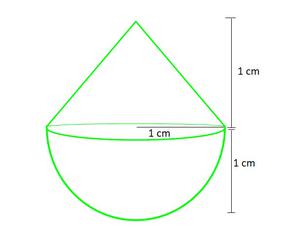
Question 1. A solid is in the shape of a cone standing on a hemisphere with both their radii being equal to 1 cm and the height of the cone is equal to its radius. Find the volume of the solid in terms of π.
**Solution:
**Given:
Height of cone (h)= 1 cm
Radius of hemisphere (r) = 1 cm
**Total Volume = Volume of cone + Volume of Hemisphere
= \frac{1}{3} πr2h + \frac{2}{3} πr3
= \frac{1}{3} πr2(h+2r)
= \frac{1}{3} × π × 1 × 1 × (1+2)
**= π cm 3
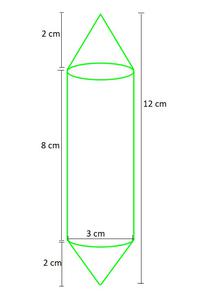
Question 2. Rachel, an engineering student, was asked to make a model shaped like a cylinder with two cones attached at its two ends by using a thin aluminum sheet. The diameter of the model is 3 cm and its length is 12 cm. If each cone has a height of 2 cm, find the volume of air contained in the model that Rachel made. (Assume the outer and inner dimensions of the model to be nearly the same.)
**Solution:
**Given:
Radius of cone and cylinder (r) = \frac{3}{2} cm
Height of cone (h) = 2 cm
Height of cylinder (H) = 12- (2+2) = 8 cm
**Total Volume = Volume of two cones + Volume of cylinder
= \frac{1}{3} πr2h + \frac{1}{3} πr2h + πr2H
= \frac{2}{3} πr2h + πr2H
= πr2((\frac{2}{3} )h+H)
= \frac{22}{7} × \frac{3}{2} × \frac{3}{2} (\frac{(2 × 2)}{3} + 8) (taking π=\frac{22}{7} )
= \frac{22}{7} × \frac{3}{2} × \frac{3}{2} × \frac{28}{3}
= \frac{21 × 22}{ 7}
**= 66 cm 3
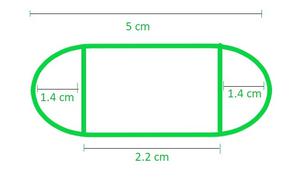
Question 3. A gulab jamun, contains sugar syrup up to about 30% of its volume. Find approximately how much syrup would be found in 45 gulab jamuns, each shaped like a cylinder with two hemispherical ends with length 5 cm and diameter 2.8 cm (see Fig.).
**Solution:
**Given,
For 1 gulab jamun,
Height of cylindrical part (H)= 5-(2.8) = 2.2 cm
Radius of cylindrical and hemispherical part (r)= \frac{2.8}{2} = 1.4 cm
**Total Volume of one gulab jamun = Volume of two Hemisphere + Volume of cylinder
= \frac{2}{3} πr3 + \frac{2}{3} πr3 + πr2H
= πr2 (\frac{4}{3} r + H)
= \frac{22}{7} × 1.4 × 1.4 × ((\frac{4}{3} × 1.4) + 2.2) (taking π=\frac{22}{7} )
=25.05 cm3
Hence, volume of 45 gulab jamun = 45 × Volume of 1 gulab jamun
= 45 × 25.05
= 1127.28 cm3
As, gulab jamun contains sugar syrup up to about 30% of its volume
**Sugar syrup in 45 gulab jamun = 30% of its total volume
= \frac{30}{100} × 1127.28
= \frac{33818.4}{100}
**= 338.184 cm 3
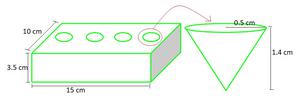
Question 4. A pen stand made of wood is in the shape of a cuboid with four conical depressions to hold pens. The dimensions of the cuboid are 15 cm by 10 cm by 3.5 cm. The radius of each of the depressions is 0.5 cm and the depth is 1.4 cm. Find the volume of wood in the entire stand (see Fig.).
**Solution:
**Given:
Length of cuboid (l) = 15 cm
Breadth of cuboid (b) = 10 cm
Height of cuboid (h) = 3.5 cm
Radius of conical part (r) = 0.5 cm
Height of conical part (H) = 1.4 cm
**Total Volume wood in the entire stand = Volume of Cuboid - Volume of four conical part
= (l × b × h) - 4 × (\frac{1}{3} πr2H)
= (15 × 10 × 3.5) - (4 × \frac{1}{3} × \frac{22}{7} × 0.5 × 0.5 × 1.4) (taking π=\frac{22}{7} )
= 525 - (1.466)
**= 523.5333 cm 3
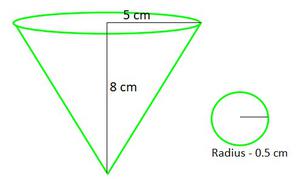
Question 5. A vessel is in the form of an inverted cone. Its height is 8 cm and the radius of its top, which is open, is 5 cm. It is filled with water up to the brim. When lead shots, each of which is a sphere of radius 0.5 cm are dropped into the vessel, one-fourth of the water flows out. Find the number of lead shots dropped in the vessel.
**Solution:
**Given:
Height of cone (h) = 8 cm
Radius of cone (r) = 5 cm
Radius of sphere (R)= 0.5 cm
Let, No. of sphere in cone = n
**Volume of water = Volume of cone
= \frac{1}{3} πr2h
= \frac{1}{3} × π × 5 × 5 × 8
= \frac{200 π}{ 3} cm3
**Volume of water flows out = \frac{1}{4} (total volume of water)
= \frac{1}{4} × \frac{200 π}{ 3}
= \frac{50 π}{ 3} cm3
Hence, the volume of n spheres = \frac{50 π}{ 3} cm3
**Volume of each sphere = \frac{4}{3} πr3
= \frac{4}{3} × π × 0.5 × 0.5 ×0.5
= \frac{π}{6} cm3
Hence, n =\frac{(Volume\hspace{0.1cm} of\hspace{0.1cm} n\hspace{0.1cm} sphere)}{ (volume \hspace{0.1cm}of \hspace{0.1cm}each \hspace{0.1cm}sphere)}
n =\frac{\frac{50 π}{3}} {\frac{π}{6}}
**n = 100 spheres
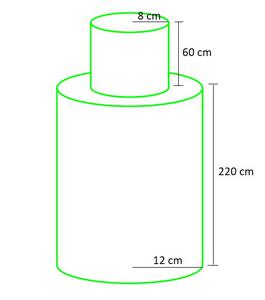
Question 6. A solid iron pole consists of a cylinder of height 220 cm and base diameter 24 cm, which is surmounted by another cylinder of height 60 cm and radius 8 cm. Find the mass of the pole, given that 1 cm3 of iron has approximately 8g mass. (Use π = 3.14)
**Solution:
**Given:
Height of large cylinder (H)= 220 cm
Radius of large cylinder (R)= \frac{24}{2} = 12 cm
Height of small cylinder (h)= 60 cm
Radius of small cylinder (r)= 8 cm
**Total Volume = Volume of large cylinder + Volume of small cylinder
= **πR 2 H + πr 2 h
**= π (R2H + r2h)
= 3.14 × ((12 × 12 × 220) + (8 × 8 × 60)) (taking π=3.14)
= 3.14 (31680 + 3840)
= 111532.8 cm3
As given, Mass of 1cm3 = 8 g
Mass for 111532.8 cm3 = 8 × 111532.8 g
**= 892,262.4 grams
**= 892.2624 kg
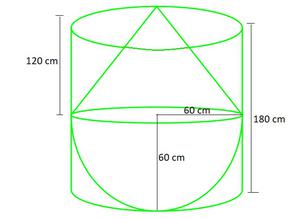
Question 7. A solid consisting of a right circular cone of height 120 cm and radius 60 cm standing on a hemisphere of radius 60 cm is placed upright in a right circular cylinder full of water such that it touches the bottom. Find the volume of water left in the cylinder, if the radius of the cylinder is 60 cm and its height is 180 cm.
**Solution:
**Given:
Height of cylinder (H)= 180 cm
Height of cone (h)= 180 - 60 = 120 cm
Radius of cone, cylinder and hemisphere (r) = 60 cm
**Volume of water left in the cylinder = Volume of cylinder - (Volume of cone + Volume of hemisphere)
= πr2H - (\frac{1}{3} πr2h + \frac{2}{3} πr3)
= πr2 (H - \frac{1}{3} h + \frac{2}{3} r)
= \frac{22}{7} × 60 × 60 × (180 - (\frac{1}{3} ×120 + \frac{2}{3}×60)) (taking π=\frac{22}{7} )
= \frac{22}{7} × 60 × 60 × (100)
**= 1131428.571 cm 3
**= 1.131 m 3
**Hence, the volume of water left in the cylinder = 1.131 m 3
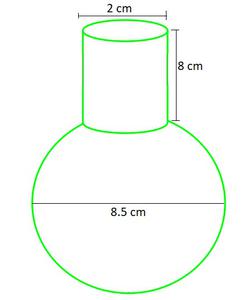
**Question 8. A spherical glass vessel has a cylindrical neck 8 cm long, 2 cm in diameter; the diameter of the spherical part is 8.5 cm. By measuring the amount of water it holds, a child finds its volume to be 345 cm 3 . Check whether she is correct, taking the above as the inside measurements, and π = 3.14.
**Solution:
**Given:
Height of cylinder (h)= 8 cm
Radius of cylinder (r) = 2/2 = 1 cm
Radius of sphere (R) = \frac{8.5}{2} cm
**Amount of water it can hold = Total Volume of this vessel
**= Volume of cylinder + Volume of sphere
= πr2h + \frac{4}{3} πR3
**= (π × 1 × 1 × 8) + (\frac{4}{3} × π × \frac{8.5}{2} × \frac{8.5}{2} × \frac{8.5}{2})
= 8π + 102.35π
= 110.35π (taking π=3.14)
**= 346.499 cm 3
Volume measured by child = 345 cm3, which is **INCORRECT
**Correct volume = 346.5 cm 3
NCERT Solutions for Class 10 Maths Chapter 13 Surface Areas and Volumes: Exercise 13.3
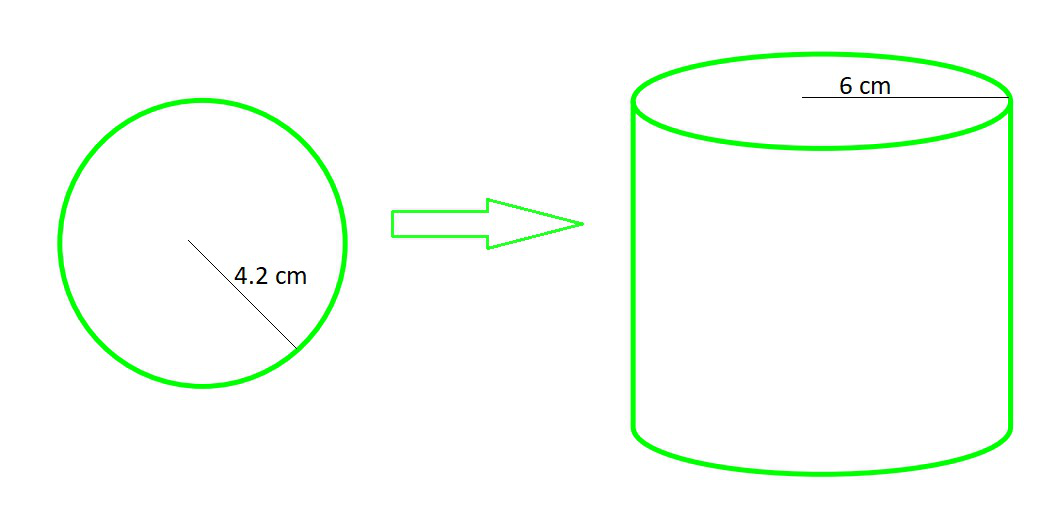
**Question 1. A metallic sphere of radius 4.2 cm is melted and recast into the shape of a cylinder of radius 6 cm. Find the height of the cylinder.
**Solution:
Radius of sphere (R)= 4.2 cm
Radius of cylinder (r)= 6 cm
**In recasting process the volume will be same, so
**Volume of cylinder = Volume of sphere
πr2h = \frac{4}{3} πR3
π(6)2h = \frac{4}{3} π(4.2)3 (cancel π from both side)
36h = \frac{4}{3} (4.2 × 4.2 × 4.2)
h = \frac{4 \times 4.2 \times 4.2 \times 4.2} {3 \times 36} (cm)
h = 1.4 × 1.4 × 1.4 (cm)
**h = 2.74 cm
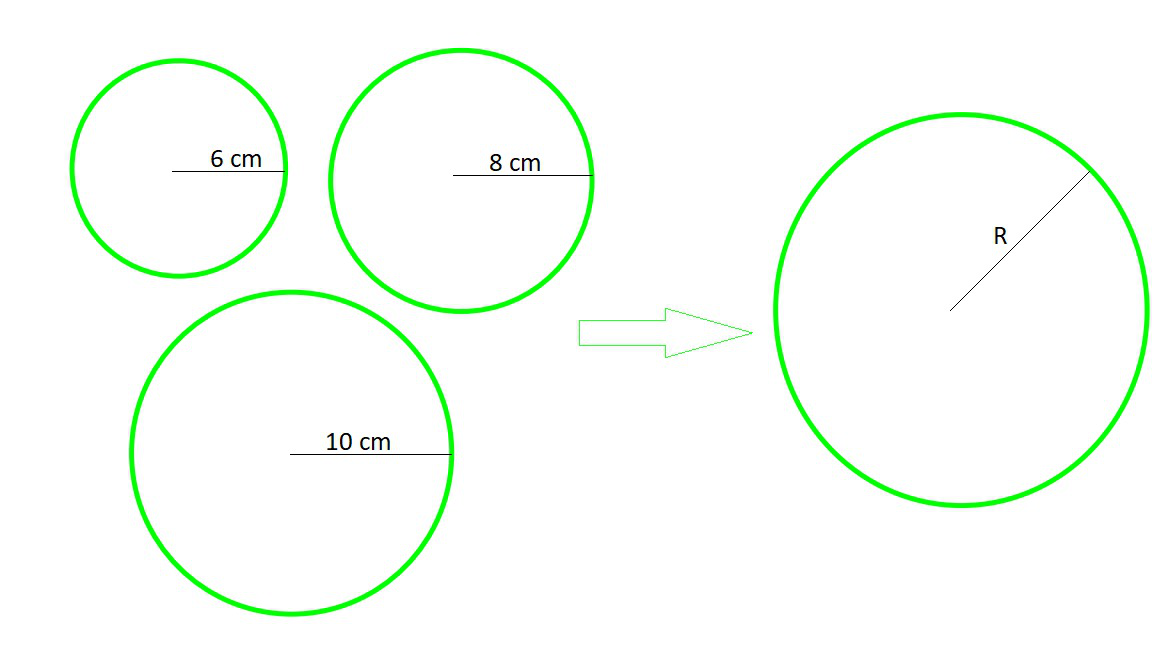
**Question 2. Metallic spheres of radii 6 cm, 8 cm and 10 cm, respectively, are melted to form a single solid sphere. Find the radius of the resulting sphere.
**Solution:
Radius of sphere 1 (r1)= 6 cm
Radius of sphere 2 (r2)= 8 cm
Radius of sphere 3 (r3)= 10 cm
Let Radius of resulting sphere = R
In recasting process the **volume will be same, so
**Volume of Resulting sphere = Volume of sphere 1 + Volume of sphere 2 + Volume of sphere 3
\frac{4}{3} π(R)3 = \frac{4}{3} π(r1)3 + \frac{4}{3} π(r2)3 +\frac{4}{3} π(r3)3 (cancel \frac{4}{3} π from both side)
R3 = (r1)3 + (r2)3 + (r3)3
R3 = (6)3 + (8)3 + (10)3
R3 = 216 + 512 + 1000
R3 = 1728
R = (1728) 1/3
**R = 12 cm
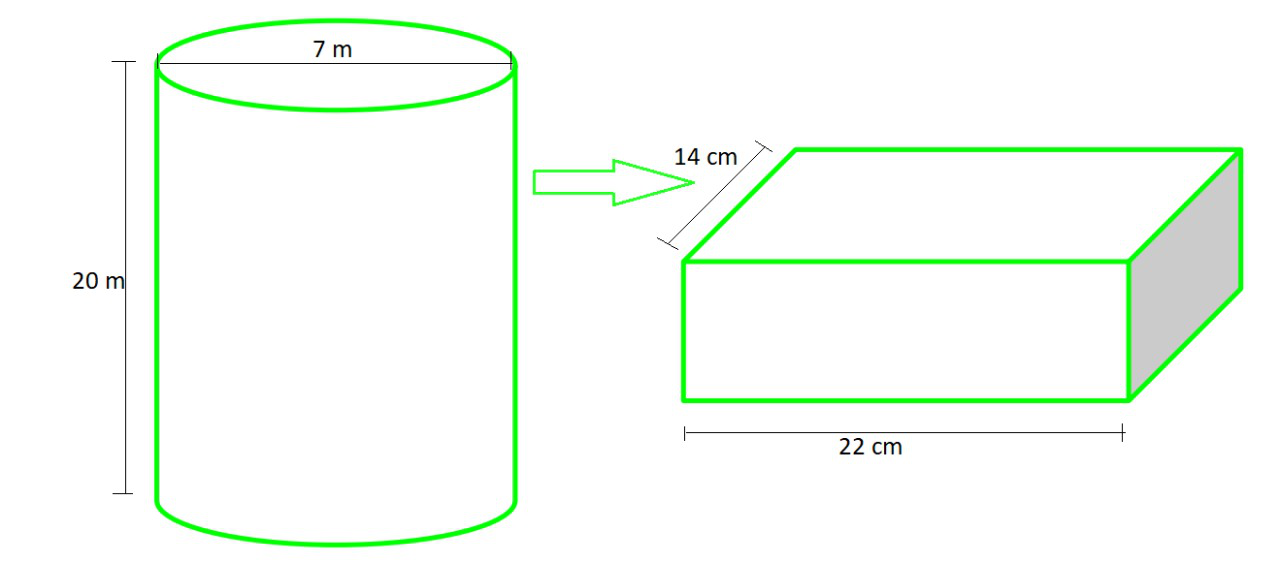
**Question 3. A 20 m deep well with diameter 7 m is dug and the earth from digging is evenly spread out to form a platform 22 m by 14 m. Find the height of the platform.
**Solution:
So basically here, the digging of cylindrical shape is changed to cuboidal shape
Given values,
Diameter of cylinder = 7 m
Radius of cylinder (r)= \frac{7}{2} m
Height of cylinder (H)= 20 m
Length of Cuboid (l) = 22 m
Breadth of Cuboid (b) =14 m
Let Height of Cuboid = h
**In this process the volume will be same, so
**Volume of Cuboid = Volume of Cylinder
**l × b × h = πr 2 H
22 × 14 × h = π × (\frac{7}{2})^2 × 20
h = \frac{\frac{22}{7} \times \frac{7}{2} \times \frac{7}{2} \times 20}{22 \times 14} m (taking π = \frac{22}{7} )
h = \frac{5}{2} m
**h = 2.5 m
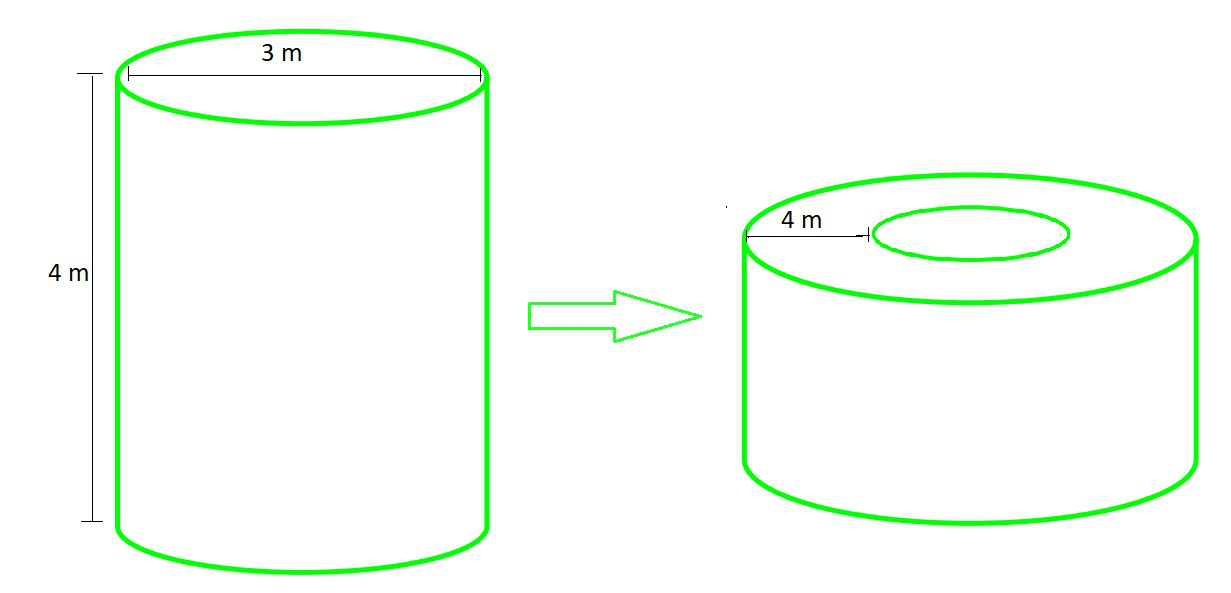
**Question 4. A well of diameter 3 m is dug 14 m deep. The earth taken out of it has been spread evenly all around it in the shape of a circular ring of width 4 m to form an embankment. Find the height of the embankment.
**Solution:
So basically here, the digging of cylindrical shape is changed to another Hollow cylindrical shape
Given values,
Diameter of cylinder = 3 m
Radius of cylinder (r) = \frac{3}{2} m
Height of cylinder (h) = 14 m
Width of embankment = 4 m
Outer Radius of embankment R1= radius of cylinder + width = 3/2 + 4 = \frac{11}{2} m
Inner Radius of embankment R2= radius of cylinder = \frac{3}{2} m
Height of embankment = H
**In this process the volume will be same, so
**Volume of Embankment = Volume of Cylinder
****(πR** 1 2 H) - (πR 2 2 H) = πr 2 h
(R12 - R22)H = (\frac{3}{2} )2× 14 (cancel π from both side)
H = \frac{(\frac{3}{2})^2 × 14}{(\frac{11}{2})^2 - (\frac{3}{2})^2}
H = \frac{\frac{63}{2}}{(\frac{121}{4} - \frac{9}{4})}
H = \frac{\frac{63}{2}} {\frac{112}{4}}
H = \frac{\frac{63}{2}} {28}
H = \frac{63}{2×28}
H = \frac{9}{8} m
**H = 1.125 m
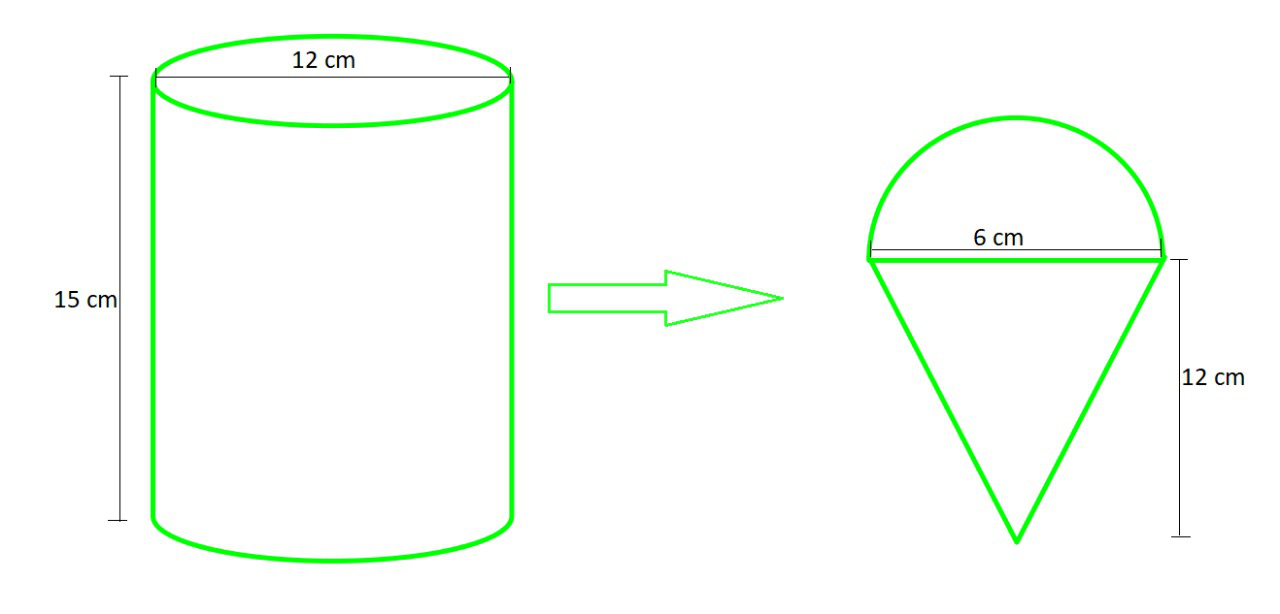
**Question 5. A container shaped like a right circular cylinder having diameter 12 cm and height 15 cm is full of ice cream. The ice cream is to be filled into cones of height 12 cm and diameter 6 cm, having a hemispherical shape on the top. Find the number of such cones which can be filled with ice cream.
**Solution:
Given values,
Radius of cylinder (r) = 6 cm
Height of cylinder (h) = 15 cm
Radius of each cone (R) = 3 cm
Height of each cone (H) = 12 cm
Let n be the total number of ice creams
**In this process the volume will be same, so
**n × (Volume of each Cone + Volume of each hemisphere) = Volume of Cylinder
n × (\frac{1}{3} πR2H + \frac{2}{3} πR3) = πr2h
n = \frac{π(6^2×15)}{π(\frac{1}{3}3^2 ×12 + \frac{2}{3}3^3)} (cancel π from both side)
n = \frac{36 \times 15}{\frac{1\times 9 \times12 + 2 \times 27}{3}}
n = \frac{36 \times15}{\frac{162}{3}}
n = \frac{540}{54}
**n = 10
**Hence, 10 numbers of cones filled with ice-cream.
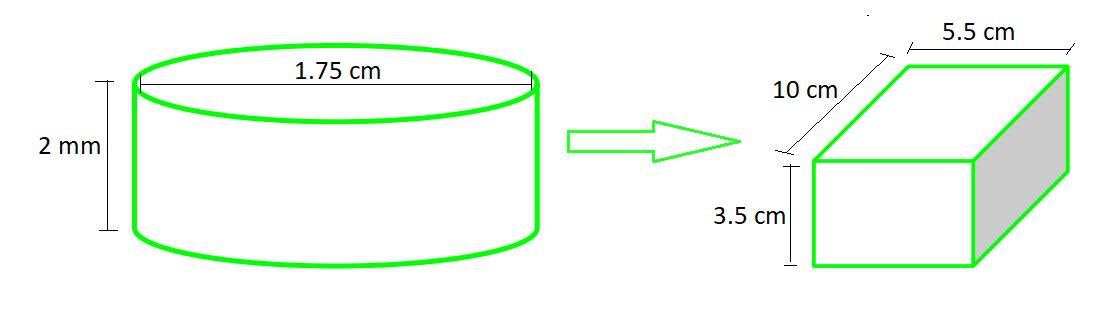
**Question 6. How many silver coins, 1.75 cm in diameter and of thickness 2 mm, must be melted to form a cuboid of dimensions 5.5 cm × 10 cm × 3.5 cm?
**Solution:
Given values,
Radius of cylindrical coin (r) = \frac{1.75}{2} cm = \frac{175}{200} cm
Height of cylindrical coin (H) = 2 mm = \frac{2}{10} cm
Length of Cuboid (l) = 5.5 cm
Breadth of Cuboid (b) =10 cm
Height of Cuboid (h)= 3.5 cm
Let n be the total number of coins
In this process the volume will be same, so
**n × (Volume of each Coin) = Volume of Cylinder
**n × (πR 2 H) = l × b × h
n × π × (\frac{175}{200} )2× \frac{2}{10} = 5.5 × 10 × 3.5
n = \frac{\frac{55}{10} × 10 × \frac{35}{10}}{\frac{22}{7} × (\frac{7}{8})^2× \frac{2}{10}} (taking π = \frac{22}{7} )
n = \frac{55 \times 10 \times 35 \times 8 \times 8 \times 10 \times 7}{22 \times 7 \times 7 \times 2 \times10 \times 10}
n = 400
**Hence, 400 silver coins must be melted to form this cuboid.
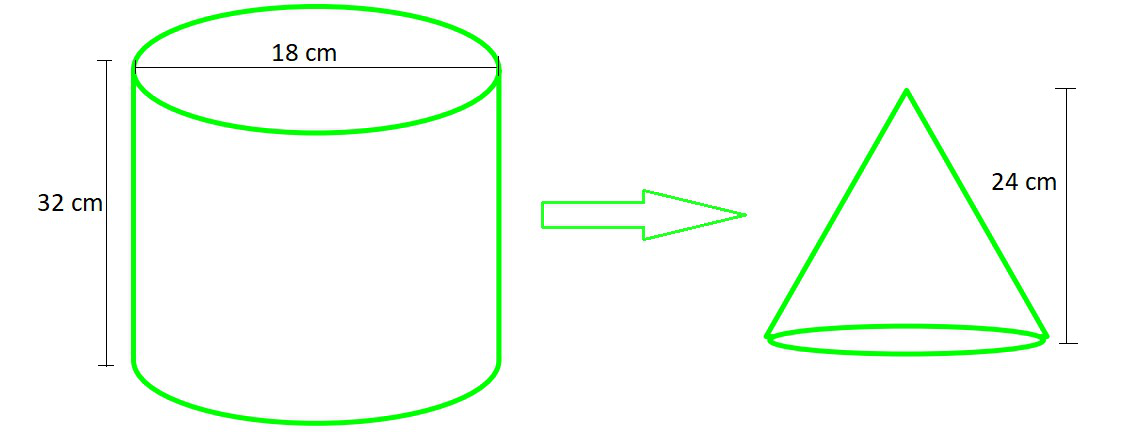
**Question 7. A cylindrical bucket, 32 cm high and with radius of base 18 cm, is filled with sand. This bucket is emptied on the ground and a conical heap of sand is formed. If the height of the conical heap is 24 cm, find the radius and slant height of the heap.
**Solution:
So basically here, the cylindrical shape is changed to conical shape
Given values,
Radius of cylinder (r) = 18 cm
Height of cylinder (h) = 32 cm
Height of cone (H) = 24 cm
Let Radius of cone = R
**In this process the volume will be same, so
**Volume of Cone = Volume of Cylinder
\frac{1}{3} πR2H = πr2h
\frac{1}{3} R2 × (24) = 182 × 32 (cancel π from both side)
R2 = \frac{18 \times 18 \times 32 \times 3}{24}
R = √(18 × 18 × 4)
**R = 36 cm
**Slant height (l) = √H 2 **+ R 2
l = √(242 + 362)
l = √(12×2)2 + (12×3)2
l =12 √(4+9)
**l = 12 √13 cm
**Question 8. Water in a canal, 6 m wide and 1.5 m deep, is flowing with a speed of 10 km/h. How much area will it irrigate in 30 minutes, if 8 cm of standing water is needed?
**Solution:
Given values,
Width of canal (w) = 6 m
Depth of canal (h) = 1.5 m
Speed of canal = 10 km/hr = (10,000 m/hr)
**For 1hr (60 mins), we can take length (l) as = 10,000 m and
**Volume in 1hr = (l × w × h)
= (10,000 × 6 × 1.5) m3
= 90,000 m3
So for **30 mins volume will be = \frac{90000}{30} m3
= 45,000 m3
Area irrigated in 30 minutes will be as:
**Area × length of standing = Volume of canal in 30mins
Area = \frac{45000}{\frac{8}{100}}
**Area = 562500 m 2
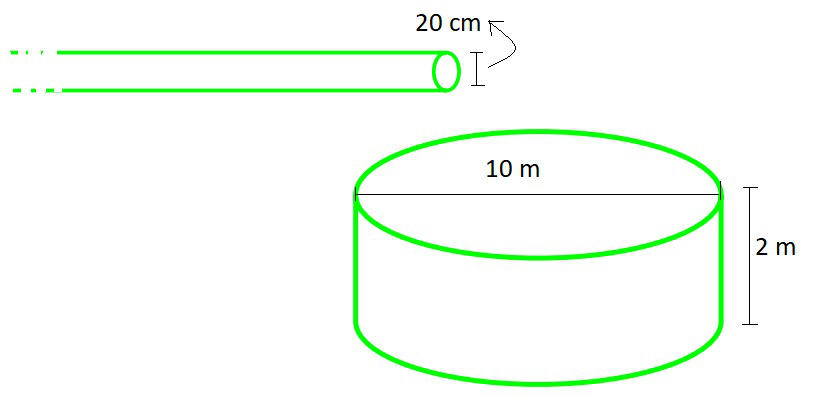
**Question 9. A farmer connects a pipe of internal diameter 20 cm from a canal into a cylindrical tank in her field, which is 10 m in diameter and 2 m deep. If water flows through the pipe at the rate of 3 km/h, in how much time will the tank be filled?
**Solution:
Given values,
Radius of Pipe (R) = 10 cm = \frac{10}{100} m
Radius of Cylindrical tank (r) = 5 m
Depth of Cylindrical tank (h) = 2 m
Speed of water flows in pipe = 3 km/hr = (3,000 m/hr)
Let Time to fill cylindrical tank = t
**For 1hr (60 mins), we can take height of Pipe (H) as = 3,000 m and
Volume in 1hr = (πR2H)
= (π × (\frac{1}{10} )2 × 3,000) m3
= 30π m3
**In this process the volume will be same, so
**t (in hr) × (Volume of Pipe in 1hr) = Volume of Cylindrical Tank
t × (30π) = πr2h
t × (30π) = π × 52 × 2
t = \frac{5 \times 5 \times 2}{30}
t = \frac{5}{3} hr
t = \frac{5}{3} × 60 mins
**t = 100 minutes
**Hence, 100 minutes will be taken to fill the tank.
NCERT Solutions for Class 10 Maths Chapter 13 Surface Areas and Volumes: Exercise 13.4
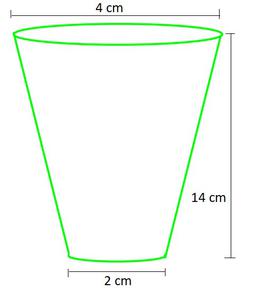
Question 1. A drinking glass is in the shape of a frustum of a cone of height 14 cm. The diameters of its two circular ends are 4 cm and 2 cm. Find the capacity of the glass.
**Solution:
Given values:
Height of frustum (h) = 14 cm
Radius of larger circle end (R) = \frac{4}{2} = 2 cm
Radius of smaller circle end (r)= \frac{2}{2} = 1 cm
**Capacity of frustum-shaped glass = Volume of Frustum
= \frac{1}{3} πh (r2 + R2 + rR)
= \frac{1}{3} × π × 14 ((1 × 1) + (2 × 2) × (2 × 1))
= \frac{1}{3} × \frac{22}{7} × 14 × 7 (taking π=\frac{22}{7} )
= \frac{(22 × 14)}{3}
**= 102.67 cm 3
Hence, the capacity of frustum-shaped glass = 102.67 cm3
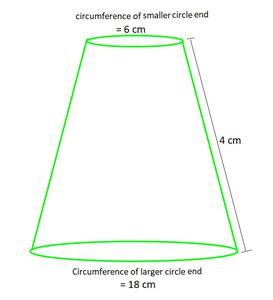
Question 2. The slant height of a frustum of a cone is 4 cm and the perimeters (circumference) of its circular ends are 18 cm and 6 cm. Find the curved surface area of the frustum.
**Solution:
Slant height of frustum (l) = 4 cm
Let radius of smaller circle end = r
Let radius of larger circle end = R
**Circumference of circle = 2π × (radius of circle)
Circumference of larger circle = 2πR
18 cm2 = 2πR
R = \frac{18}{2π}
R = \frac{9}{π} cm
Circumference of smaller circle = 2πr
6 cm2 = 2πr
r = \frac{6}{2π}
r = \frac{3}{π} cm
**Now, as curve surface area of frustum = π (r+R) l
= π × (\frac{9}{π}+\frac{3}{π} ) × 4
= 12 × 4 (Taking π common and canceling it)
**= 48cm 2
Hence, the curved surface area of the frustum = 48cm2
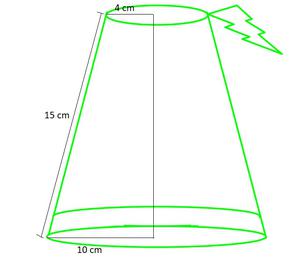
Question 3. A fez, the cap used by the Turks, is shaped like the frustum of a cone (see Fig.). If its radius on the open side is 10 cm, radius at the upper base is 4 cm and its slant height is 15 cm, find the area of material used for making it.
**Solution:
Given values:
Slant height of frustum (l)= 15 cm
Let radius of smaller circle end (r) = 4 cm
Let radius of larger circle end (R) = 10 cm
Area of material used for making it = Curve surface area + area of upper base
**= (π(r+R)l) + (πr 2 )
= π ((r+R)l + r2) (Taking π common)**
**= π ((4+10) × 15 + (4 × 4))
= \frac{22}{7} × (226) (Taking π = \frac{22}{7} )
**= 710.286 cm 2
Hence, the area of material used for making it = 710.286 cm2
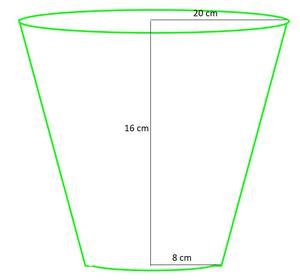
Question 4. A container, opened from the top and made up of a metal sheet, is in the form of a frustum of a cone of height 16 cm with radii of its lower and upper ends as 8 cm and 20 cm, respectively. Find the cost of the milk which can completely fill the container, at the rate of ₹ 20 per litre. Also find the cost of metal sheet used to make the container, if it costs ₹ 8 per 100 cm2. (Take π = 3.14)
**Solution:
Given values:
Height of frustum (h)= 16 cm
Let radius of smaller circle end (r) = 8 cm
Let radius of larger circle end (R) = 20 cm
**The amount of milk to fill the container = Volume of frustum
= \frac{1}{3} πh (r2 + R2 + rR)
= \frac{1}{3} × 3.14 × 16 (8×8 + 20×20 + 8×20) (Taking π=3.14)
= \frac{1}{3} × 3.14 × 16 × (624)
= 10449.92 cm3
Cost of 1 litre milk = ₹ 20
**And as, 1 m 3 **= 1000 cm 3 **= 1 litre
10449.92 cm3 = (\frac{1}{1000} ) ×10449.92 litres
cost of 10449.92 cm3 = (\frac{10449.92}{1000} ) × 20
**= ₹ 208.998
Now, metal sheet used to make the container = Curve surface area + area of lower base
**= (π(r+R)l) + (πr 2 )
= π ((r+R)l + r2) (Taking π common)
= π ((20+8) × (√(162+(20-8)2)) + (8 × 8)) (**Slant height (l) = √(h 2 +(R-r) 2 ))
= 3.14 × (28 × √400 + 64) (Taking π = 3.14)
= 3.14 × (624)
= 1959.36 cm2
Hence, the metal sheet used to make the container = 1959.36 cm2
As, cost of 100 cm2= ₹ 8
1959.36 cm2 = (8/100) × 1959.36
**= ₹156.748
Hence, the cost of the milk which can completely fill the container = ₹ 208.998
and, the cost of metal sheet used to make the container = ₹156.748
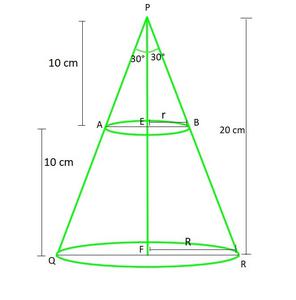
Question 5. A metallic right circular cone 20 cm high and whose vertical angle is 60° is cut into two parts at the middle of its height by a plane parallel to its base. If the frustum so obtained be drawn into a wire of diameter 1/16 cm, find the length of the wire.
**Solution:
As the angle is cut into two equal parts, the height gets half too.
Let radius of smaller circle end = r
Let radius of larger circle end = R
In ∆PFR and ∆PEB
tan ∝ = \frac{(opposite \hspace{0.1cm}side)}{(adjacent \hspace{0.1cm}side)}
tan 30° = \frac{EB}{PE} = \frac{FR}{PF}
\frac{1}{√3} = \frac{r} {10} = \frac{R}{20}
R = \frac{20}{√3}
r = \frac{10}{√3}
and as height of frustum = 10 cm
So according to the question,
**Frustum is converted to cylindrical wire having diameter \mathbf{\frac{1}{16}} cm
**Volume of Frustum = Volume of Cylinder
Volume of Frustum = \frac{1}{3} πh (r2 + R2 + rR)
= \frac{1}{3} × π × 10 (\frac{10}{√3} × \frac{10}{√3} + \frac{20}{√3} × \frac{20}{√3} + \frac{20}{√3} × \frac{10}{√3})
= \frac{1}{3} × π × 10 × (\frac{100}{3} + \frac{400}{3} + \frac{200}{3})
= \frac{1}{3} × π × 10 × \frac{700}{3}
= \frac{7000π}{ 9} cm3 .............................(1)
Volume of Cylinder = \frac{1}{3} π(radius)2H
**= \frac{1}{3} π(\frac{1}{16×2} )2H .....................(2)
As (1) = (2) , then
7000π / 9 = 1/3 π(1/(16×2))2H
H = \frac{7000π × 32 × 32}{9 × π} (cancel π from both side)
**H = 796444.443 cm
**H = 7964.44 m
Hence, the length of the wire = 7964.44 m
NCERT Solutions for Class 10 Maths Chapter 13 Surface Areas and Volumes: Exercise 13.5
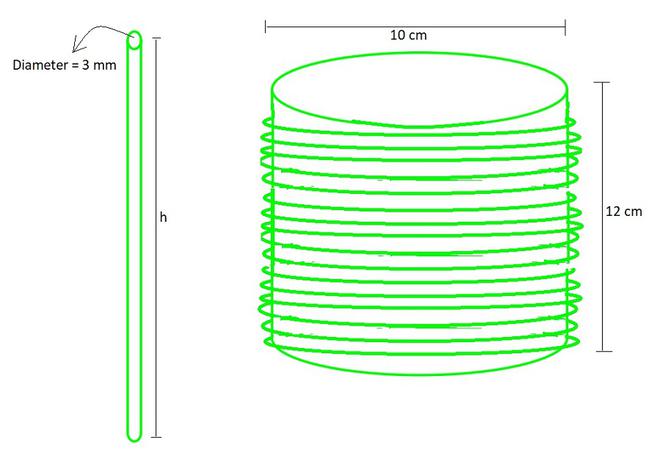
Question 1. A copper wire, 3 mm in diameter, is wound about a cylinder whose length is 12 cm, and diameter 10 cm, so as to cover the curved surface of the cylinder. Find the length and mass of the wire, assuming the density of copper to be 8.88 g per cm3.
**Solution:
Given,
Radius of copper wire (r) = \frac{3}{2} mm = \frac{3}{20} cm
Height of cylinder (H) = 12 cm
Radius of Cylinder (R) = \frac{10}{2} = 5 cm
Length of copper wire needed for one round will be circumference of cylindrical circle end = **2πR
=2π(5)
**length of each round = 10π cm
Now, to completely cover the cylinder with wire no of rounds (n) of copper wire should be:
n = height of cylinder / diameter of copper wire
n = \frac{12}{\frac{3}{10}}
**no. of rounds = 40
Now, Total length of copper wire will be:
h = no. of rounds × length of each round
h = 40×10π
h = 400×3.14 (taking π = 3.14)
**h = 1256 cm
**Volume of copper wire = πr 2 h
=π×(\frac{3}{20} )2×1256
=π×\frac{3}{20} ×\frac{3}{20} ×1256
**= 88.82 cm 3 (taking π = \frac{22}{7} )
Now, as it is given that,
For 1cm3 = 8.88 g of wire
so, for 88.82 cm3 = 8.88×88.82 g
**Mass of copper wire = 788.7216 g
**Hence, the length and mass of the wire are 1256 cm and **788.216 grams respectively.
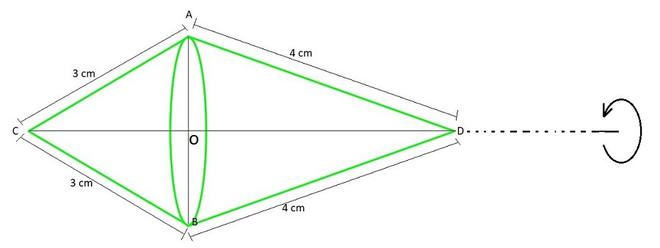
Question 2. A right triangle, whose sides are 3 cm and 4 cm (other than hypotenuse) is made to revolve about its hypotenuse. Find the volume and surface area of the double cone so formed. (Choose value of π as found appropriate.)
**Solution:
After revolving the triangle about its hypotenuse, we get two cones having slant height as 3 cm and 4 cm each.
Hypotenuse of triangle (CD) = √(32 + 42) = 5 cm
l1 = 3 cm
l2 = 4 cm
**ar(△ACD) = \frac{1}{2} ×AC×AD = ½×AO×CD (as AC⊥AD and AO⊥CD)
⇒ AC×AD = AO×CD
⇒ 4×3 = AO×5
AO = \frac{12}{5} cm
Hence, radius of cone base is \frac{12}{5} cm
Now, **Volume of double cone = Volume of cone 1 + Volume of cone 2
= (\frac{1}{3} )πr2×OD + (\frac{1}{3} )πr2×OC
= (\frac{1}{3} )πr2×(OD+OC)
**= \mathbf{\frac{1}{3}} **πr 2 ×CD
= \frac{1}{3}×\frac{22}{7}×\frac{12}{5}×\frac{12}{5}×5
**= 30.17 cm 3
Now, **Curve Surface area of double cone = CSA of cone 1 + CSA of cone 2
**= πrl 1 + πrl 2
= πr(l1+l2)
= \frac{22}{7}×\frac{12}{5} ×(3+4)
**= 30.17 cm 2
Hence, the volume and surface area of the double cone so formed is **30.17 cm 3 and **30.17 cm 2 .
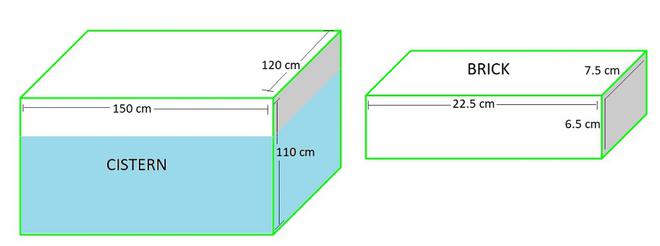
Question 3. A cistern, internally measuring 150 cm × 120 cm × 110 cm, has 129600 cm3 of water in it. Porous bricks are placed in the water until the cistern is full to the brim. Each brick absorbs one-seventeenth of its own volume of water. How many bricks can be put in without overflowing the water, each brick being 22.5 cm × 7.5 cm × 6.5 cm?
**Solution:
Given,
Length of Cistern (L) = 150 cm
Breadth of Cistern (W) = 120 cm
Height of Cistern (H) = 110 cm
Length of Brick (l) = 22.5 cm
Breadth of Brick (w) = 7.5 cm
Height of Brick (h) = 6.5 cm
**Volume of Cistern = L×B×H
= 150×120×110
= 1980000 cm3
Volume of Water = 129600 cm3
Empty space left in Cistern = 1980000-129600
= 1850400 cm3
**Volume of Brick = l×b×h
= 22.5×7.5×6.5
= 1096.88 cm3
Volume of n Bricks = 1096.88×n cm3
Volume absorbed by each brick = (\frac{1}{17} )th (volume of brick)
= \frac{1}{17} ×1096.88 cm3
= 64.522 cm3
Then, **Volume absorbed by n bricks = 64.522×n
**Volume of brick = Empty space left in Cistern + volume absorbed by bricks
1096.88×n = 1850400 + 64.522×n
n×(1096.88-64.522) = 1850400
n = \frac{1850400}{1032.358}
n = 1792.40
**n ≈ 1792
**Hence, 1792 bricks can be put in without overflowing the water.
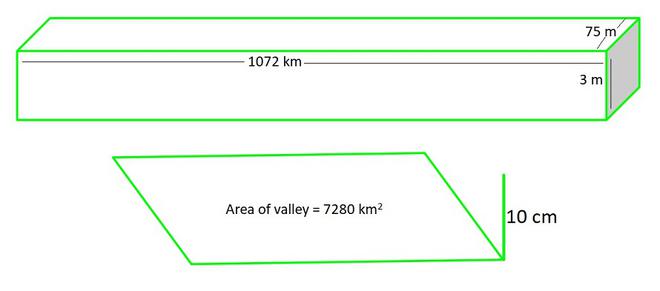
Question 4. In one fortnight of a given month, there was a rainfall of 10 cm in a river valley. If the area of the valley is 7280 km2, show that the total rainfall was approximately equivalent to the addition to the normal water of three rivers each 1072 km long, 75 m wide and 3 m deep.
**Solution:
Length of river (l) = 1072 km
Width of river (w) = \frac{75}{1000} km = 0.075 km
Depth of river (h) = \frac{3}{1000} = 0.003 km
Depth of rainfall = \frac{10}{(1000×100)} km
The total rainfall was approximately equivalent to the addition to the normal water of three rivers each
Which means,
****(Volume of three rivers = ((Surface area of a valley)×Depth of rainfall)** has to be equal.
Let's check, for each case,
**so,
**Volume of three rivers = 3×(l×b×h)
= 3×(1072×0.075×0.003) km3
= 0.7236 km 3 ****.............................(1)**
**Volume of rainfall in valley = Area of valley×depth of rainfall
= 7280×\frac{10}{100000}
**= 0.728 km 3 .....................................(2)
From (1) and (2) we can see that,
**Hence, proved, Total rainfall was approximately equivalent to the addition to the normal water of three rivers each.
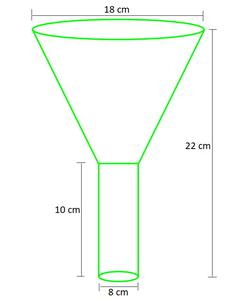
Question 5. An oil funnel made of tin sheet consists of a 10 cm long cylindrical portion attached to a frustum of a cone. If the total height is 22 cm, diameter of the cylindrical portion is 8 cm and the diameter of the top of the funnel is 18 cm, find the area of the tin sheet required to make the funnel (see Fig. 13.25).
**Solution:
Oil funnel contains two shapes = frustum + Cylinder
Given values,
Larger radius of frustum (R) = \frac{18}{2} = 9 cm
Smaller radius of frustum (r) = \frac{8}{2} = 4 cm
Height of frustum (H) = 22-10 = 12 cm
Radius of cylinder (r) = \frac{8}{2} = 4 cm
Height of cylinder (h) = 10 cm
**Area of the tin sheet required = CSA of frustum + CSA of cylinder
**CSA of frustum = π(r+R)l
**= π×(9+4)×√(122 + (9-4)2) (l =√(H 2 + (R-r) 2 ))
**= π×13×13
= 169π cm2
**CSA of cylinder = 2πrh
**= 2×π×4×10
= 80π cm2
Area of the tin sheet required = 169π + 80π
= 249π
**= 782.571 cm 2 (Taking π=\frac{22}{7} )
Hence, the area of the tin sheet required to make the funnel is **782.571 cm 2
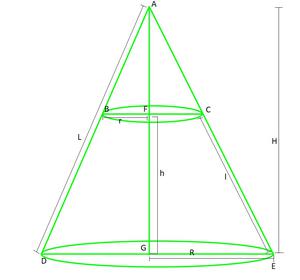
Question 6. Derive the formula for the curved surface area and total surface area of the frustum of a cone, given to you in Section 13.5, using the symbols as explained.
**Solution:
Let ADE be a cone. From the cone the frustum BCDE is cut by a plane parallel to its base. Here, r and R are the radii of the frustum ends of the cone and h be the frustum height.
Here, as BC||DE
In △ADG and △ABF
So, ΔADG ∼ ΔABF (as BC||DE)
\frac{AB}{AD} = \frac{AF}{AG} = \frac{BF}{GD}
\frac{L-l}{L} = \frac{H-h}{H} = \frac{r}{R} ..............(1)
from (1), we get
1-(\frac{l}{L} ) = \frac{r}{R}
\frac{l}{L} = 1 - \frac{r}{R}
\frac{l}{L} = \frac{(R-r)}{R}
L(R-r) = Rl...........................(2) (By rearranging)
**Total surface area of frustum = CSA of frustum + Area of upper circular end + Area of the lower circular end
- **CSA of frustum = CSA of cone ADE - CSA of cone ABC
= πRL - πr(L-l)
= πL(R-r)+πrl
= πRl+πrl (from (2) replacing L(R-r) = Rl )
**= π(R+r)l
- **Area of upper circular end = πR2
- **Area of the lower circular end = πr2
**Total surface area of frustum = π(R+r)l + πR 2 **+ πr 2
Question 7. Derive the formula for the volume of the frustum of a cone, given to you in Section 13.5, using the symbols as explained.
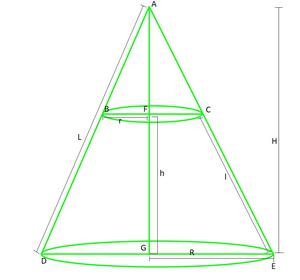
**Solution:
Let ADE be a cone. From the cone the frustum BCDE is cut by a plane parallel to its base. Here, r and R are the radii of the frustum ends of the cone and h be the frustum height.
Here, as BC||DE
In △ADG and △ABF
So, ΔADG ∼ ΔABF (as BC||DE)
\frac{AB}{AD} = \frac{AF}{AG} = \frac{BF}{GD}
\frac{L-l}{L} = \frac{H-h}{H} = \frac{r}{R} .....................(1)
from (1), we get
1-(\frac{h}{H} ) = \frac{r}{R}
\frac{h}{H} = 1 - \frac{r}{R}
\frac{h}{H} = \frac{R-r}{R}
H(R-r) = Rh...........................(2) (By rearranging)
**Total volume of frustum of the cone will be = Volume of cone ADE – Volume of cone ABC
= \mathbf{\frac{1}{3}} πR2H - \mathbf{\frac{1}{3}} πr2(H-h)
= \frac{1}{3} πR2H - \frac{1}{3} πr2H + \frac{1}{3} πr2h
= \frac{1}{3} π(H(R2-r2)+r2h)
= \frac{1}{3} π(H(R-r)(R+r)+r2h) (Replacing (R2-r2) = (R-r)(R+r))
= \frac{1}{3} π(Rh(R+r)+r2h) (from (2) replacing H(R-r) = Rh )
= \frac{1}{3} π(R2h+Rrh+r2h)
= \frac{1}{3} πh(R2+Rr+r2) (Taking h common)
Hence, Total volume of frustum of the cone will be = \frac{1}{3} πh(R2+Rr+r2)
NCERT Solutions for Class 10 Maths Chapter 13 Surface Areas and Volumes: Exercise 13.5
Question 1. A copper wire, 3 mm in diameter, is wound about a cylinder whose length is 12 cm, and diameter 10 cm, so as to cover the curved surface of the cylinder. Find the length and mass of the wire, assuming the density of copper to be 8.88 g per cm3.
**Solution:
Given,
Radius of copper wire (r) = \frac{3}{2} mm = \frac{3}{20} cm
Height of cylinder (H) = 12 cm
Radius of Cylinder (R) = \frac{10}{2} = 5 cm
Length of copper wire needed for one round will be circumference of cylindrical circle end = **2πR
=2π(5)
**length of each round = 10π cm
Now, to completely cover the cylinder with wire no of rounds (n) of copper wire should be:
n = height of cylinder / diameter of copper wire
n = \frac{12}{\frac{3}{10}}
**no. of rounds = 40
Now, Total length of copper wire will be:
h = no. of rounds × length of each round
h = 40×10π
h = 400×3.14 (taking π = 3.14)
**h = 1256 cm
**Volume of copper wire = πr 2 h
=π×(\frac{3}{20} )2×1256
=π×\frac{3}{20} ×\frac{3}{20} ×1256
**= 88.82 cm 3 (taking π = \frac{22}{7} )
Now, as it is given that,
For 1cm3 = 8.88 g of wire
so, for 88.82 cm3 = 8.88×88.82 g
**Mass of copper wire = 788.7216 g
**Hence, the length and mass of the wire are 1256 cm and **788.216 grams respectively.
Question 2. A right triangle, whose sides are 3 cm and 4 cm (other than hypotenuse) is made to revolve about its hypotenuse. Find the volume and surface area of the double cone so formed. (Choose value of π as found appropriate.)
**Solution:
After revolving the triangle about its hypotenuse, we get two cones having slant height as 3 cm and 4 cm each.
Hypotenuse of triangle (CD) = √(32 + 42) = 5 cm
l1 = 3 cm
l2 = 4 cm
**ar(△ACD) = \frac{1}{2} ×AC×AD = ½×AO×CD (as AC⊥AD and AO⊥CD)
⇒ AC×AD = AO×CD
⇒ 4×3 = AO×5
AO = \frac{12}{5} cm
Hence, radius of cone base is \frac{12}{5} cm
Now, **Volume of double cone = Volume of cone 1 + Volume of cone 2
= (\frac{1}{3} )πr2×OD + (\frac{1}{3} )πr2×OC
= (\frac{1}{3} )πr2×(OD+OC)
**= \mathbf{\frac{1}{3}} **πr 2 ×CD
= \frac{1}{3}×\frac{22}{7}×\frac{12}{5}×\frac{12}{5}×5
**= 30.17 cm 3
Now, **Curve Surface area of double cone = CSA of cone 1 + CSA of cone 2
**= πrl 1 + πrl 2
= πr(l1+l2)
= \frac{22}{7}×\frac{12}{5} ×(3+4)
**= 30.17 cm 2
Hence, the volume and surface area of the double cone so formed is **30.17 cm 3 and **30.17 cm 2 .
Question 3. A cistern, internally measuring 150 cm × 120 cm × 110 cm, has 129600 cm3 of water in it. Porous bricks are placed in the water until the cistern is full to the brim. Each brick absorbs one-seventeenth of its own volume of water. How many bricks can be put in without overflowing the water, each brick being 22.5 cm × 7.5 cm × 6.5 cm?
**Solution:
Given,
Length of Cistern (L) = 150 cm
Breadth of Cistern (W) = 120 cm
Height of Cistern (H) = 110 cm
Length of Brick (l) = 22.5 cm
Breadth of Brick (w) = 7.5 cm
Height of Brick (h) = 6.5 cm
**Volume of Cistern = L×B×H
= 150×120×110
= 1980000 cm3
Volume of Water = 129600 cm3
Empty space left in Cistern = 1980000-129600
= 1850400 cm3
**Volume of Brick = l×b×h
= 22.5×7.5×6.5
= 1096.88 cm3
Volume of n Bricks = 1096.88×n cm3
Volume absorbed by each brick = (\frac{1}{17} )th (volume of brick)
= \frac{1}{17} ×1096.88 cm3
= 64.522 cm3
Then, **Volume absorbed by n bricks = 64.522×n
**Volume of brick = Empty space left in Cistern + volume absorbed by bricks
1096.88×n = 1850400 + 64.522×n
n×(1096.88-64.522) = 1850400
n = \frac{1850400}{1032.358}
n = 1792.40
**n ≈ 1792
**Hence, 1792 bricks can be put in without overflowing the water.
Question 4. In one fortnight of a given month, there was a rainfall of 10 cm in a river valley. If the area of the valley is 7280 km2, show that the total rainfall was approximately equivalent to the addition to the normal water of three rivers each 1072 km long, 75 m wide and 3 m deep.
**Solution:
Length of river (l) = 1072 km
Width of river (w) = \frac{75}{1000} km = 0.075 km
Depth of river (h) = \frac{3}{1000} = 0.003 km
Depth of rainfall = \frac{10}{(1000×100)} km
The total rainfall was approximately equivalent to the addition to the normal water of three rivers each
Which means,
****(Volume of three rivers = ((Surface area of a valley)×Depth of rainfall)** has to be equal.
Let's check, for each case,
**so,
**Volume of three rivers = 3×(l×b×h)
= 3×(1072×0.075×0.003) km3
= 0.7236 km 3 ****.............................(1)**
**Volume of rainfall in valley = Area of valley×depth of rainfall
= 7280×\frac{10}{100000}
**= 0.728 km 3 .....................................(2)
From (1) and (2) we can see that,
**Hence, proved, Total rainfall was approximately equivalent to the addition to the normal water of three rivers each.
Question 5. An oil funnel made of tin sheet consists of a 10 cm long cylindrical portion attached to a frustum of a cone. If the total height is 22 cm, diameter of the cylindrical portion is 8 cm and the diameter of the top of the funnel is 18 cm, find the area of the tin sheet required to make the funnel (see Fig. 13.25).
**Solution:
Oil funnel contains two shapes = frustum + Cylinder
Given values,
Larger radius of frustum (R) = \frac{18}{2} = 9 cm
Smaller radius of frustum (r) = \frac{8}{2} = 4 cm
Height of frustum (H) = 22-10 = 12 cm
Radius of cylinder (r) = \frac{8}{2} = 4 cm
Height of cylinder (h) = 10 cm
**Area of the tin sheet required = CSA of frustum + CSA of cylinder
**CSA of frustum = π(r+R)l
**= π×(9+4)×√(122 + (9-4)2) (l =√(H 2 + (R-r) 2 ))
**= π×13×13
= 169π cm2
**CSA of cylinder = 2πrh
**= 2×π×4×10
= 80π cm2
Area of the tin sheet required = 169π + 80π
= 249π
**= 782.571 cm 2 (Taking π=\frac{22}{7} )
Hence, the area of the tin sheet required to make the funnel is **782.571 cm 2
Question 6. Derive the formula for the curved surface area and total surface area of the frustum of a cone, given to you in Section 13.5, using the symbols as explained.
**Solution:
Let ADE be a cone. From the cone the frustum BCDE is cut by a plane parallel to its base. Here, r and R are the radii of the frustum ends of the cone and h be the frustum height.
Here, as BC||DE
In △ADG and △ABF
So, ΔADG ∼ ΔABF (as BC||DE)
\frac{AB}{AD} = \frac{AF}{AG} = \frac{BF}{GD}
\frac{L-l}{L} = \frac{H-h}{H} = \frac{r}{R} ..............(1)
from (1), we get
1-(\frac{l}{L} ) = \frac{r}{R}
\frac{l}{L} = 1 - \frac{r}{R}
\frac{l}{L} = \frac{(R-r)}{R}
L(R-r) = Rl...........................(2) (By rearranging)
**Total surface area of frustum = CSA of frustum + Area of upper circular end + Area of the lower circular end
- **CSA of frustum = CSA of cone ADE - CSA of cone ABC
= πRL - πr(L-l)
= πL(R-r)+πrl
= πRl+πrl (from (2) replacing L(R-r) = Rl )
**= π(R+r)l
- **Area of upper circular end = πR2
- **Area of the lower circular end = πr2
**Total surface area of frustum = π(R+r)l + πR 2 **+ πr 2
Question 7. Derive the formula for the volume of the frustum of a cone, given to you in Section 13.5, using the symbols as explained.
**Solution:
Let ADE be a cone. From the cone the frustum BCDE is cut by a plane parallel to its base. Here, r and R are the radii of the frustum ends of the cone and h be the frustum height.
Here, as BC||DE
In △ADG and △ABF
So, ΔADG ∼ ΔABF (as BC||DE)
\frac{AB}{AD} = \frac{AF}{AG} = \frac{BF}{GD}
\frac{L-l}{L} = \frac{H-h}{H} = \frac{r}{R} .....................(1)
from (1), we get
1-(\frac{h}{H} ) = \frac{r}{R}
\frac{h}{H} = 1 - \frac{r}{R}
\frac{h}{H} = \frac{R-r}{R}
H(R-r) = Rh...........................(2) (By rearranging)
**Total volume of frustum of the cone will be = Volume of cone ADE – Volume of cone ABC
= \mathbf{\frac{1}{3}} πR2H - \mathbf{\frac{1}{3}} πr2(H-h)
= \frac{1}{3} πR2H - \frac{1}{3} πr2H + \frac{1}{3} πr2h
= \frac{1}{3} π(H(R2-r2)+r2h)
= \frac{1}{3} π(H(R-r)(R+r)+r2h) (Replacing (R2-r2) = (R-r)(R+r))
= \frac{1}{3} π(Rh(R+r)+r2h) (from (2) replacing H(R-r) = Rh )
= \frac{1}{3} π(R2h+Rrh+r2h)
= \frac{1}{3} πh(R2+Rr+r2) (Taking h common)
Hence, Total volume of frustum of the cone will be = \frac{1}{3}πh(R2+Rr+r2)
Key Features of NCERT Solutions for Class 10 Maths Chapter 13 Surface Areas and Volumes
- These NCERT solutions are developed by the GfG team, with a focus on students’ benefit.
- These solutions are entirely accurate and can be used by students to prepare for their board exams.
- Each solution is presented in a step-by-step format with comprehensive explanations of the intermediate steps.
**Also Check:
- NCERT Solutions for Class 10 Maths Chapter 1 Real Numbers
- NCERT Solutions for Class 10 Maths Chapter 2 Polynomials
- NCERT Solutions for Class 10 Maths Chapter 3 Pair of Linear Equations in Two Variables
- NCERT Solutions for Class 10 Maths Chapter 4 Quadratic Equation
- NCERT Solutions for Class 10 Maths Chapter 5 Arithmetic Progressions
- NCERT Solutions for Class 10 Maths Chapter 6 Triangles
- NCERT Solutions for Class 10 Maths Chapter 7 Coordinate Geometry