NCERT Solutions Class 11 Chapter 11 Introduction to three dimensional Geometry Miscellaneous Exercise (original) (raw)
Last Updated : 22 Apr, 2024
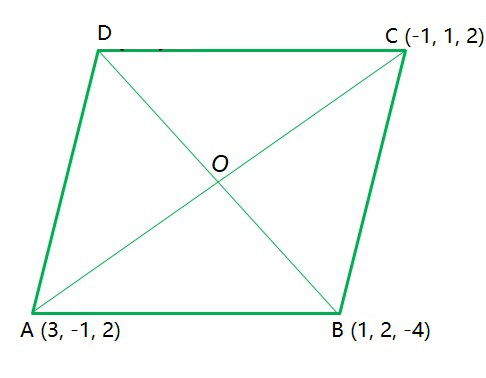
Question 1: Three vertices of a parallelogram ABCD are A(3, – 1, 2), B (1, 2, – 4), and C (– 1, 1, 2). Find the coordinates of the fourth vertex.
**Solution:
ABCD is a parallelogram, with vertices A (3, -1, 2), B (1, 2, -4), C (-1, 1, 2) and D (x, y, z).
Using the property:
**The diagonals of a parallelogram bisect each other,
Midpoint of AC = Midpoint of BD = Point O
Now, by using Midpoint section formula
Coordinates of O for the line segment joining (x1,y1,z1) and (x2,y2,z2) = (\frac{x_1+x_2}{2}, \frac{y_1+y_2}{2}, \frac{z_1+z_2}{2})
So, Coordinates of O for the line segment joining AC = (\frac{3+(-1)}{2}, \frac{-1+1}{2}, \frac{2+2}{2})
= (\frac{2}{2}, 0, \frac{4}{2})
= (1, 0, 2) ............................(1)
and, Coordinates of O for the line segment joining BD = (\frac{1+x}{2}, \frac{2+y}{2}, \frac{-4+z}{2}) .............(2)
Using the Eq(1) and Eq(2), we get
\frac{1+x}{2} = 1
**x = 1
\frac{2+y}{2} = 0
**y = -2
\frac{z-4}{2} = 2
**z = 8
Hence, the coordinates of the fourth vertex is **D (1, -2, 8).
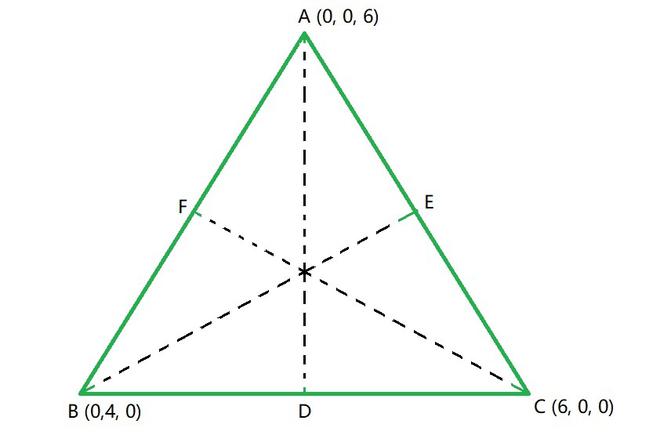
Question 2: Find the lengths of the medians of the triangle with vertices A (0, 0, 6), B (0,4, 0), and (6, 0, 0).
**Solution:
The vertices of the triangle are A (0, 0, 6), B (0, 4, 0) and C (6, 0, 0).
So, let the medians be AD, BE and CF corresponding to the vertices A, B and C respectively.
D, E and F are the midpoints of the sides BC, AC and AB respectively.
Coordinates of mid-point for the line segment joining (x1,y1,z1) and (x2,y2,z2) = (\frac{x_1+x_2}{2}, \frac{y_1+y_2}{2}, \frac{z_1+z_2}{2})
So, Coordinates of D for the line segment joining BC = (\frac{0+6}{2}, \frac{4+0}{2}, \frac{0+0}{2})
Coordinates of D = ****(3, 2, 0)**
and, Coordinates of E for the line segment joining AC = (\frac{6+0}{2}, \frac{0+0}{2}, \frac{0+6}{2})
Coordinates of E = ****(3, 0, 3)**
and, Coordinates of F for the line segment joining AB = (\frac{0+0}{2}, \frac{0+4}{2}, \frac{6+0}{2})
Coordinates of F = ****(0, 2, 3)**
By using the distance formula for two points, P(x1,y1,z1) and Q(x2,y2,z2)
**PQ = \mathbf{\sqrt{(x_1-x_2)^2+(y_1-y_2)^2+(z_1-z_2)^2}}
So, AD = \sqrt{(0-3)^2+(0-2)^2+(6-0)^2}
AD = \sqrt{9+4+36} = 7
and, BE = \sqrt{(0-3)^2+(4-0)^2+(0-3)^2}
BE = \sqrt{9+16+9} = \sqrt{34}
and, CF = \sqrt{(6-0)^2+(0-2)^2+(0-3)^2}
CF = \sqrt{36+4+9} = 7
Hence, **the lengths of the medians are 7, √34 and 7.
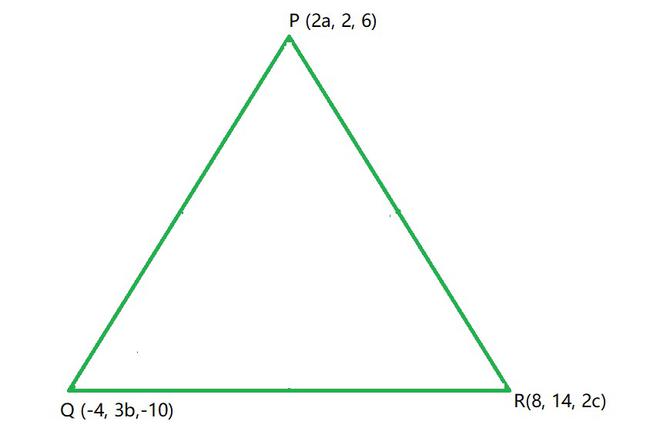
Question 3: If the origin is the centroid of the triangle PQR with vertices P (2a, 2, 6), Q (– 4, 3b, –10), and R(8, 14, 2c), then find the values of a, b and c.
**Solution:
The vertices of the triangle are P (2a, 2, 6), Q (-4, 3b, -10) and R (8, 14, 2c).
Coordinates of centroid(0, 0, 0) of the triangle having vertices (x1,y1,z1), (x2,y2,z2) and (x3,y3,z3) = (\frac{x_1+x_2+x_3}{3}, \frac{y_1+y_2+y_3}{3}, \frac{z_1+z_2+z_3}{3})
(0, 0, 0) = (\frac{2a-4+8}{3}, \frac{2+3b+14}{3}, \frac{6-10+2c}{3})
(0, 0, 0) = (\frac{2a+4}{3}, \frac{3b+16}{3}, \frac{2c-4}{3})
So, \frac{2a+4}{3} = 0
**a = -2
and, \frac{3b+16}{3} = 0
**b = \mathbf{\frac{-16}{3}}
and, \frac{2c-4}{3} = 0
**c = 2
**Hence, the values of a, b and c are a = -2, b = \mathbf{\frac{-16}{3}} and c = 2
Question 4: If A and B be the points (3, 4, 5) and (–1, 3, –7), respectively, find the equation of the set of points P such that PA2 + PB2 = k2, where k is a constant.
**Solution:
The points A (3, 4, 5) and B (-1, 3, -7)
Let the point be P (x, y, z).
Now by using distance formula,
Distance of point (x1, y1, z1) and (x2, y2, z2) = \mathbf{\sqrt{(x_1-x_2)^2+(y_1-y_2)^2+(z_1-z_2)^2}}
So, the distance between the points A (3, 4, 5) and P (x,y,z)) will be
Distance of PA = √[(3-x)2 + (4-y)2 + (5-z)2]
Distance of PB = √[(-1-x)2 + (3-y)2 + (-7-z)2]
As, **PA 2 + PB 2 = k 2
[(3 – x)2 + (4 – y)2 + (5 – z)2] + [(-1 – x)2 + (3 – y)2 + (-7 – z)2] = k2
[(9 + x2 – 6x) + (16 + y2 – 8y) + (25 + z2 – 10z)] + [(1 + x2 + 2x) + (9 + y2 – 6y) + (49 + z2 + 14z)] = k2
9 + x2 – 6x + 16 + y2 – 8y + 25 + z2 – 10z + 1 + x2 + 2x + 9 + y2 – 6y + 49 + z2 + 14z = k2
2x2 + 2y2 + 2z2 – 4x – 14y + 4z + 109 = k2
2x2 + 2y2 + 2z2 – 4x – 14y + 4z = k2 – 109
2 (x2 + y2 + z2 – 2x – 7y + 2z) = k2 – 109
(x2 + y2 + z2 – 2x – 7y + 2z) = \frac{(k^2 – 109)}{2}
Hence, **the required equation is (x 2 + y 2 + z 2 – 2x – 7y + 2z) = \mathbf{\frac{(k^2 – 109)}{2}}