NCERT Solutions Class 9 – Chapter 2 Polynomials – Exercise 2.3 (original) (raw)
Last Updated : 23 Jul, 2025
Chapter 2, titled “Polynomials” from the Class 9 NCERT Mathematics textbook explains about polynomials along with their degree and operation on polynomials. Exercise 2. 3 is specialized in identifying the roots of polynomials and learning about the graphical representation of these objects.
Polynomials – Exercise 2. 3
Converging on the Nature of Zeroes of Polynomials
In Exercise 2. 3, students receive the knowledge about how to look for the zeroes of the polynomial – these are the values of the variable this polynomial ‘takes’ its zeroes at. This section focuses on the position of zeroes of a polynomial with respect to the coefficients and more so for linear as well as quadratic polynomials.
Techniques for Identifying Correlate of Polynomials
In this exercise, various ways of determining the zeroes of polynomials have been offered to guide the learners. Linear polynomials are solved by easy calculations while calculations of quadratic polynomials involve factorization or else the use of the quadratic formulas.
Solutions to Exercise 2 – Step by Step. 3 Problems
This section provides solution to each problem in Exercise 2 in detail, step by step. 3, assisting students to reason and make sense of the way in which the zeroes many different polynomials can be found. These solutions are introduced with an aim of establishing a good base of problems solutions to more complex ones in polynomial equations.
Graphical Representation of Polynomials as well as Their zeros
As for polynomials, students are also introduced to graphical interpretation of polynomials and ways to comprehend graphs in order to find the zeroes. This section offers various means by which students can easily be able to grasp what zeroes mean specifically, the ability of the polynomial to cross the x-axis at those points.
NCERT Mathematics Solutions Class 9 – Exercise 2.3
1. Determine which of the following polynomials has (x + 1) as a factor:
****(i) x** 3 +x 2 +x+1
**Solution:
**p(x) = x 3 + x 2 + x + 1
Let x+1 be the factor of p(x)
Then x = -1 will be the zero of p(x)
value of p(-1) should be 0
Checking,
=> p(-1) = (-1)3 + (-1)2 + (-1) + 1
=> -1 + 1 -1 + 1
=> 0
As p(-1)=0 so (x + 1) is a factor of p(x).
****(ii) x** 4 +x 3 +x 2 +x+1
**Solution:
**p(x) = x 4 +x 3 +x 2 +x+1
Let x+1 be the factor of p(x)
Then x = -1 will be the zero of p(x)
value of p(-1) should be 0
Checking,
=> p(-1) = (-1)4 + (-1)3 + (-1)2 + (-1) + 1
=> - 1 + 1 - 1 + 1 -1
=> -1
=> -1 ≠ 0
As p(-1) ≠ 0 so (x + 1) is **not a factor of p(x).
****(iii) x** 4 +3x 3 +3x 2 +x+1
**Solution:
**p(x) = x 4 +3x 3 +3x 2 +x+1
Let x+1 be the factor of p(x)
Then x = -1 will be the zero of p(x)
value of p(-1) should be 0
Checking,
=> p(-1) = (-1)4 + 3(-1)3 + 3(-1)2 + (-1) + 1
=> 1 - 3 + 3 - 1 + 1
=> -1
=> -1 ≠ 0
As p(-1) ≠ 0 so (x + 1) is **not a factor of p(x).
****(iv) x** 3 – x 2 – (2+√2)x +√2
**Solution:
**p(x) = x 3 – x 2 – (2+√2)x +√2
Let x+1 be the factor of p(x)
Then x = -1 will be the zero of p(x)
value of p(-1) should be 0
Checking,
=> p(-1) = (-1)3 – (-1)2– (2+√2)(-1) +√2
=> -1 - 1 + 2 + √2 + √2
=> 2√2
=> 2√2 ≠ 0
As p(-1) ≠ 0 so (x + 1) is **not a factor of p(x).
Question 2. Use the Factor Theorem to determine whether g(x) is a factor of p(x) in each of the following cases:
****(i) p(x) = 2x** 3 +x 2 –2x–1, g(x) = x+1
**Solution:
**p(x) = 2x 3 +x 2 – 2x–1
**g(x) = x + 1
By Factor Theorem we know that if x + 1 is a factor of p(x)
Then value of p(-1) should be 0
Checking,
=> p(-1) = 2(-1)3 + (-1)2 - 2(-1) -1
=> -2 + 1 + 2 - 1
=> 0
As p(-1) = 0 therefore (x + 1) is a factor of 2x3 + x2 - 2x - 1
****(ii) p(x) = x** 3 +3x 2 +3x+1, g(x) = x+2
**Solution:
**p(x) = x 3 +3x 2 +3x+1
**g(x) = x + 2
By Factor Theorem we know that if x + 2 is a factor of p(x)
Then value of p(-2) should be 0
Checking,
=> p(-2) = (-2)3 + 3(-2)2 + 3(-2) +1
=> -8 + 12 - 6 + 1
=> -1
=> -1 ≠ 0
As p(-2) ≠ 0 therefore (x + 2) is **not a factor of x3 + 3x2 +3x + 1
****(iii) p(x)=x** 3 – 4x 2 +x+6, g(x) = x – 3
**Solution:
**p(x) = x 3 – 4x 2 +x+6
**g(x) = x - 3
By Factor Theorem we know that if x - 3 is a factor of p(x)
Then value of p(3) should be 0
Checking,
=> p(3) = (3)3 - 4(3)2 + 3 + 6
=> 27 - 36 + 3 + 6
=> 0
As p(3)=0 so (x - 3) is a factor of p(x).
Question 3. Find the value of k, if x–1 is a factor of p(x) in each of the following cases:
****(i) p(x) = x** 2 +x+k
**Solution:
**p(x) = x 2 + x + k
By Factor Theorem,
As x-1 is a factor of p(x)
then x = 1 is the zero of p(x)
Therefore p(1) = 0
=> p(1) = (1)2 + 1 + k
=> 1 + 1 + k = 0
=> 2 + k = 0
=> **k = -2
****(ii) p(x) = 2x** 2 +kx+√2
**Solution:
**p(x) = 2x 2 **+ kx + √2
By Factor Theorem,
As x-1 is a factor of p(x)
then x = 1 is the zero of p(x)
Therefore p(1) = 0
=> p(1) = 2(1)2 + k(1) + √2
=> 2 + k + √2 = 0
=> 2 + √2 + k = 0
=> **k = - (2 + √2)
****(iii) p(x) = kx** 2 –√2x+1
**Solution:
**p(x) = kx 2 - √2x + 1
By Factor Theorem,
As x-1 is a factor of p(x)
then x = 1 is the zero of p(x)
Therefore p(1) = 0
=> p(1) = k(1)2 - √2(1) + 1
=> k - √2 + 1 = 0
=> **k = √2 - 1
****(iv) p(x) = kx** 2 –3x+k
**Solution:
**p(x) = kx 2 -3x + k
By Factor Theorem,
As x-1 is a factor of p(x)
Then x = 1 is the zero of p(x)
Therefore, p(1) = 0
=> p(1) = k(1)2 - 3(1) + k
=> k - 3 + k = 0
=> 2k - 3 = 0
=> **k = 3/2
Question 4. Factorize:
****(i) 12x** 2 –7x+1
**Solution:
**p(x) = 12x 2 - 7x + 1
Using splitting the middle term method,
We need to find a pair of numbers whose sum is -7x
and product is 12x2
-7x can be written as the sum of -3x and -4x
12x2 can be written as the product of -3x and -4x
=> 12x2 - 7x + 1
=> 12x2 -3x -4x +1
=> 3x(4x -1) -1(4x -1)
=> ****(3x - 1)(4x - 1)** are the factors of 12x2 - 7x + 1
****(ii) 2x** 2 +7x+3
**Solution:
**p(x) = 2x 2 + 7x + 3
Using splitting the middle term method,
We need to find a pair of numbers whose sum is 7x
and product is 6x2
7x can be written as the sum of 1x and 6x
6x2 can be written as the product of 1x and 6x
=> 2x2 + 7x + 3
=> 2x2 + 1x + 6x + 3
=> 2x(x + 3) + 1(x + 3)
=> ****(2x + 1)(x + 3)** are the factors of 2x2 + 7x + 3
****(iii) 6x** 2 +5x-6
**Solution:
**p(x) = 6x 2 + 5x - 6
Using splitting the middle term method,
We need to find a pair of numbers whose sum is 5x
and product is -36x2
5x can be written as the sum of 9x and -4x
-36x2 can be written as the product of 9x and -4x
=> 6x2 + 5x - 6
=> 6x2 + 9x - 4x - 6
=> 3x(2x + 3) - 2(2x + 3)
=> ****(3x - 2)(2x + 3)** are the factors of 6x2 + 5x - 6
****(iv) 3x** 2 –x–4
**Solution:
**p(x) = 3x 2 - x - 4
Using splitting the middle term method,
We need to find a pair of numbers whose sum is -x
and product is -12x2
-x can be written as the sum of -4x and 3x
-12x2 can be written as the product of -4x and 3x
=> 3x2 - x - 4
=> 3x2 - 4x + 3x - 4
=> 3x(x + 1) - 4(x + 1)
=> ****(3x - 4)(x + 1)** are the factors of 3x2 - x - 4
Question 5. Factorize:
****(i) x** 3 –2x 2 –x+2
**Solution:
**p(x) = x 3 – 2x 2 – x + 2
Factors of 2 are ±1 and ± 2
Using Hit and Trial Method
p(1) = (1)3 - 2(1)2 - (1) + 2
p(1) = 1 - 2 - 1 + 2
p(1) = 0
Therefore, ****(x - 1)** is a factor of x3 - 2x2 - x + 2
Performing **Long Division :
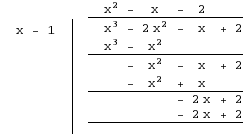
Quotient : x2 - x - 2 , Remainder : 0
Dividend = Divisor × Quotient + Remainder
=>p(x) = (x - 1)(x 2 - x - 2)
=> solving (x2 - x -2)
=> using Splitting the middle term method
=> x2 - 2x + x - 2
=> x(x - 2) + 1(x - 2)
=> (x + 1)(x - 2)
=>(x - 1)(x + 1)(x - 2)** are the factors of p(x)
****(ii) x** 3 –3x 2 –9x–5
**Solution:
**p(x) = x 3 –3x 2 –9x–5
Factors of -5 are ±1 and ± 5
Using Hit and Trial Method
let x = 1
p(1) = (1)3 - 3(1)2 - 9(1) - 5
p(1) = 1 - 3 - 9 -5
p(1) = -16
p(1) ≠ 0
let x = -1
p(-1) = (-1)3 - 3(-1)2 - 9(-1) - 5
p(-1) = -1 - 3 + 9 - 5
p(-1) = -9 + 9
p(-1) = 0
Therefore, ****(x + 1)** is a factor of p(x)
Performing **Long Division :
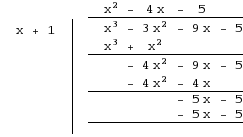
Quotient : x2 - 4x - 5, Remainder : 0
Dividend = Divisor × Quotient + Remainder
=>p(x) = (x + 1)(x 2 - 4x - 5)
=> solving (x2 - 4x - 5)
=> using splitting the middle term method
=> x2 -5x + x - 5
=> x(x - 5) + 1(x - 5)
=> (x + 1)(x - 5)
=>(x + 1)(x + 1)(x - 5) are the factors of p(x)
****(iii) x** 3 +13x 2 +32x+20
**Solution:
**p(x) = x 3 +13x 2 +32x+20
=> Factors of 20 are ±1, ±2, ±4, ±5, ±10 and ±20
Using Hit and Trial Method
let x = 1
p(1) = (1)3 + 13(1)2 + 32(1) + 20
p(1) = 1 + 13 + 32 + 20
p(1) = 66
p(1) ≠ 0
let x = -1
p(-1) = (-1)3 + 13(-1)2 + 32(-1) + 20
p(-1) = -1 + 13 - 32 + 20
p(-1) = -33 + 33
p(-1) = 0
Therefore, ****(x + 1)** is a factor of p(x)
Performing **Long Division :
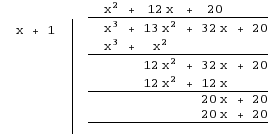
Quotient : x2 + 12x + 20, Remainder : 0
**Dividend = Divisor × Quotient + Remainder
**=> p(x) = (x + 1)(x 2 + 12x + 20)
=> solving x2 + 12x + 20
=> using Splitting the middle term method
=> x2 + 10x + 2x + 20
=> x(x + 10) + 2(x + 10)
=> (x + 2)(x + 10) are the factors of x2 + 12x + 20
=> ****(x + 1)(x + 2)(x + 10)** are the factors of p(x)
****(iv) 2y** 3 +y 2 –2y–1
**Solution:
**p(y) = 2y 3 +y 2 –2y–1
=> Factors of -1 are ±1
Using Hit and Trial Method
let x = 1
p(1) = 2(1)3 + (1)2 - 2(1) - 1
p(1) = 2 + 1 -2 - 1
p(1) = 0
Therefore, ****(y - 1)** is a factor of p(y)
Performing **Long Division :
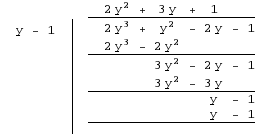
Quotient : 2y2 + 3y + 1, Remainder : 0
**Dividend = Divisor × Quotient + Remainder
**=> p(y) = (y - 1)(2y 2 + 3y + 1)
=> solving 2y2 + 3y +1
=> using splitting the middle term method
=> 2y2 + 2y +y +1
=> 2y(y + 1)+1(2y + 1)
=>(2y + 1)(2y + 1) are the factors of 2y2 + 3y + 1
=> ****(y - 1)(2y + 1)(2y + 1)** are the factors of p(y)
Related Articles:
Conclusion
The third chapter of the Class 9 NCERT Mathematics textbook covers polynomials in relation to zeros and graphs. Upon finishing this task, students will possess the ability to solve problems involving linear and quadratic polynomials and provide an explanation of their graphs, a skill that is essential for further algebraic study.