NCERT Solutions Class 9 Chapter 8 Quadrilaterals Exercise 8.2 (original) (raw)
Last Updated : 26 Apr, 2024
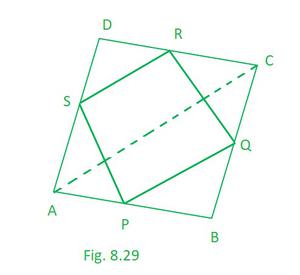
Question 1. ABCD is a quadrilateral in which P, Q, R, and S are mid-points of the sides AB, BC, CD, and DA (see Fig 8.29). AC is a diagonal. Show that:
****(i) SR || AC and SR = ½ AC**
****(ii) PQ = SR**
****(iii) PQRS is a parallelogram**
**Solution:
**Given that, P, Q, R and S are the mid points of quadrilateral ABCD
**Theorem 8.9: The line segment joining the mid-points of two sides of a triangle is parallel to the third side.
****(i)** So here, taking ∆ACD
we can see S and R are the mid points of side AD and DC respectively. [Given]
Hence, SR _|| AC and SR =_ **½ AC (NCERT Theorem 8.9)............................(1)
****(ii)** So here, taking ∆ACB
we can see P and Q are the mid points of side AB and BC respectively. [Given]
Hence, PQ || AC and PQ = ½ AC (**NCERT Theorem 8.9)..............................(2)
From (1) and (2) we can say,
**PQ = SR
****(iii)** so from (i) and (ii) we can say that
PQ || AC and SR || AC
so, PQ || SR and PQ = SR
**If each pair of opposite sides of a quadrilateral is equal, then it is a parallelogram.
Hence, **PQRS is a parallelogram.
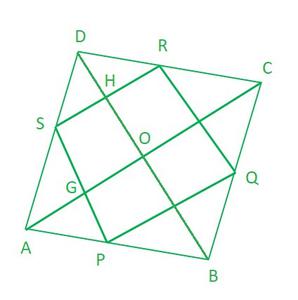
Question 2. ABCD is a rhombus and P, Q, R and S are the mid-points of the sides AB, BC, CD and DA respectively. Show that the quadrilateral PQRS is a rectangle.
**Solution:
**Given that, P, Q, R and S are the mid points of Rhombus ABCD.
**Theorem 8.9: The line segment joining the mid-points of two sides of a triangle is parallel to the third side.
**Construction: Join AC and BD
So here, taking ∆ABD
We can see P and S are the mid points of side AB and AD respectively. [Given]
Hence, PS || BD and PS = ½ BD (**NCERT Theorem 8.9)............................(1)
Similarly, is we take ∆CBD
We can see R and Q are the mid points of side CD and CB respectively. [Given]
Hence, RQ || BD and RQ = ½ BD (**NCERT Theorem 8.9)............................(2)
So from (1) and (2), we conclude that
PS || RQ and PS = RQ
**If each pair of opposite sides of a quadrilateral is equal, then it is a parallelogram.
Hence, PQRS is a parallelogram.
Now in ∆ACD
We can see S and R are the mid points of side AD and CD respectively. [Given]
Hence, SR || AC and RS = ½ AC (**NCERT Theorem 8.9)
from (2) RQ || BD and RQ = ½ BD (**NCERT Theorem 8.9)
Hence, **OGSH is a parallelogram.
∠HOG = 90°(**Diagonal of rhombus intersect at 90°)
So ∠HSG = 90° (opposite angle of a parallelogram are equal)
As, PQRS is a parallelogram having vertices angles equal to 90°.
Hence, **PQRS is a Rectangle.
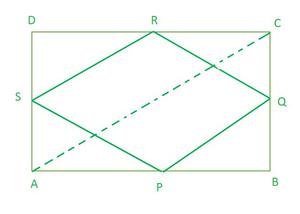
Question 3. ABCD is a rectangle and P, Q, R, and S are mid-points of the sides AB, BC, CD, and DA respectively. Show that the quadrilateral PQRS is a rhombus.
**Solution:
**Given that, P, Q, R and S are the mid points of Rectangle ABCD.
**Construction: Join AC
**Theorem 8.9 : The line segment joining the mid-points of two sides of a triangle is parallel to the third side.
So here, taking ∆ACD
we can see S and R are the mid points of side AD and DC respectively. [Given]
Hence, SR || AC and SR = ½ AC (NCERT Theorem 8.9)............................(1)
Now, taking ∆ACB
we can see P and Q are the mid points of side AB and BC respectively. [Given]
Hence, PQ || AC and PQ = ½ AC (NCERT Theorem 8.9)..............................(2)
So from (1) and (2), we conclude that
SR || PQ and SR = PQ
Hence, **PQRS is a parallelogram. (If each pair of opposite sides of a quadrilateral is equal, then it is a parallelogram)
Now in ∆QBP and ∆QCR
QC = QB (Q is the mid point of BC)
RC = PB (opposite sides are equal, hence half length is also equal)
∠QCR = ∠QBP (Each 90°)
**∆QBP ≅ ∆QCR (By SAS congruency)
QR = QP (**By C.P.C.T.)
As PQRS is a parallelogram and having adjacent sides equal
**Hence, PQRS is a rhombus
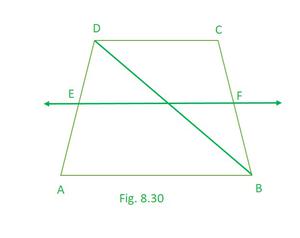
Question 4. ABCD is a trapezium in which AB || DC, BD is a diagonal and E is the mid-point of AD. A line is drawn through E parallel to AB intersecting BC at F (see Fig. 8.30). Show that F is the mid-point of BC.
**Solution:
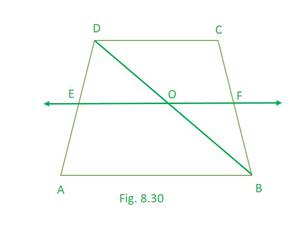
Let O be the point of intersection of lines BD and EF
**Theorem 8.10 : The line drawn through the mid-point of one side of a triangle, parallel to another side bisects the third side.
So here, taking ∆ADB
we can see S is the mid point of side AD and ED || AB [Given]
Hence, **OD = ½ BD ...........(NCERT Theorem 8.10)
Now, taking ∆BCD
we can see O is the mid point of side BD and OF || AB [Proved and Given]
Hence, CF = ½ BC........ (NCERT Theorem 8.10)
Hence proved!!
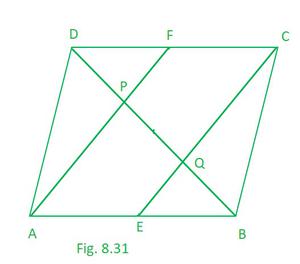
Question 5. In a parallelogram ABCD, E and F are the mid-points of sides AB and CD respectively (see Fig. 8.31). Show that the line segments AF and EC trisect the diagonal BD.
**Solution:
**Theorem 8.10 : The line drawn through the mid-point of one side of a triangle, parallel to another side bisects the third side.
**Given, E and F are the mid points of side AB and CD of parallelogram ABCD.
As, AB || CD and AB = CD (opposite sides of parallelogram)...........(1)
AE = CF (halves of opposite sides of parallelogram)...........................(2)
from (1) and (2)
**AECF is a parallelogram
Hence, AF || EC
Now taking ∆APB
we can see E is the mid point of side AB and EF || AP [Given and proved]
Hence, BQ = PQ...........(NCERT Theorem 8.10)......................(1)
Now taking ∆CQD
we can see F is the mid point of side CD and CQ || FP [Given and proved]
Hence, DP = PQ...........(NCERT Theorem 8.10)....................(2)
From (1) and (2) we conclude that,
BQ = PQ = DQ
Hence, we can say that **line segments AF and EC trisect the diagonal BD
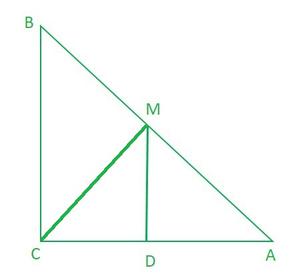
Question 6. ABC is a triangle right angled at C. A line through the mid-point M of hypotenuse AB and parallel to BC intersects AC at D. Show that
****(i) D is the mid-point of AC**
****(ii) MD ⊥ AC**
****(iii) CM = MA = ½ AB**
**Solution:
**Theorem 8.10 : The line drawn through the mid-point of one side of a triangle, parallel to another side bisects the third side.
****(i)** while taking ∆ABC
we can see M is the mid point of side AB and DM || BC [Given]
This implies, DC= AD ........... (NCERT Theorem 8.10)
Hence, **D is the mid-point of AC.
****(ii)** As we know MD || BC and AC is transversal
This implies, ∠ACB = ∠ADM = 90°
**Hence, MD ⊥AC
****(iii)** Considering ∆ADM and ∆CDM
AD = CD (D is the mid point of AC (Proved))
∠CDM = ∠ADM (proved, MD ⊥AC)
DM = DM (common)
∆ADM ≅ ∆CDM (**By SAS congruency)
CM = AM (By C.P.C.T.)
**CM = AM = ½ AB (M is the mid point of AB)