Class 9 NCERT Mathematics Solutions Chapter 3 Coordinate Geometry (original) (raw)
Last Updated : 23 Jul, 2025
Chapter 3 " Coordinate Geometry" of Class 9 NCERT Maths serves as a foundational building block for your future studies, as it paves the way for more advanced concepts in higher classes. This article contains detailed solution for all exercises of Class 9 NCERT Maths Chapter 3, this Coordinate Geometry Class 9 NCERT Solutions will help you to tackle any questions or doubts that may arise along the way.
**NCERT Solutions for Class 9 Maths Chapter 3 Coordinate Geometry will assist students in resolving questions related to Coordinate Geometry they may have as they go through problems from the NCERT textbook. To gain a comprehensive understanding of the principles and their real-world applications, it's essential to read the entire chapter and actively engage in all the associated activities. To assist with this, you will require NCERT Answers for Class 9 Mathematics Chapter 3. All of the problems in this chapter's exercise from the NCERT textbook are covered in the NCERT Solutions for Class 9 Maths.
**CBSE Class 9 NCERT Maths Chapter 3 Coordinate Geometry covers the following topics:
- Introduction to Coordinate Geometry
- Cartesian Plane
- Plotting Points in the Cartesian Plane
- Slope of a Line
- Distance Formula
- Coordinate Geometry Applications
| Class 9 Maths NCERT Solutions Chapter 3 Exercises |
|---|
| **NCERT Maths Solutions Class 9 Exercise 3.1 – 2 Questions (1 Short Answer, 1 Long Answer) |
| **NCERT Maths Solutions Class 9 Exercise 3.2 – 2 Questions (2 Short Answers) |
| **NCERT Maths Solutions Class 9 Exercise 3.3 – 2 Questions (1 Short Answer, 1 Long Answer) |
Class 9 NCERT Mathematics Solutions: Coordinate Geometry
Coordinate Geometry - Exercise 3.1
**Question 1: How will you describe the position of a table lamp on your study table to another person?
**Solution:
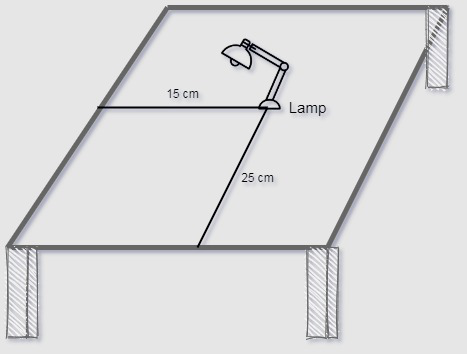
- From the figure above consider the position of the lamp as it is a point on a plane of x and y axis.
- Take two line one perpendicular and one horizontal, consider the perpendicular line as Y-axis and horizontal line as X-axis.
- Take the corner of the table as the origin.
- Measure the distance of lamp from Y-axis and X-axis respectively.
- Write the distance in terms of coordinates (15,25).
- Hence we can find the position of lamp on the table.
**Question 2: (Street Plan): A city has two main roads which cross each other at the centre of the city. These two roads are along the North-South direction and East-West direction.
**All the other streets of the city run parallel to these roads and are 200 m apart. There are 5 streets in each direction. Using 1cm = 200m, draw a model of the city on your notebook. Represent the roads/streets by single lines.
**There are many cross- streets in your model. A particular cross-street is made by two streets, one running in the North - South direction and another in the East - West direction. Each cross street is referred to in the following manner : If the 2nd street running in the North - South direction and 5th in the East - West direction meet at some crossing, then we will call this cross-street (2, 5). Using this convention, find:
****(i) how many cross - streets can be referred to as (4, 3).**
****(ii) how many cross - streets can be referred to as (3, 4).**
**Solution:
- Draw two perpendicular lines that will be referred as the two main roads, mark them as N-S and E-W.
- Take the scale as 1 cm = 200 m as given.
- Mark the intersection of the main road as point C.
- Draw 5-5 parallel line to both the main roads.
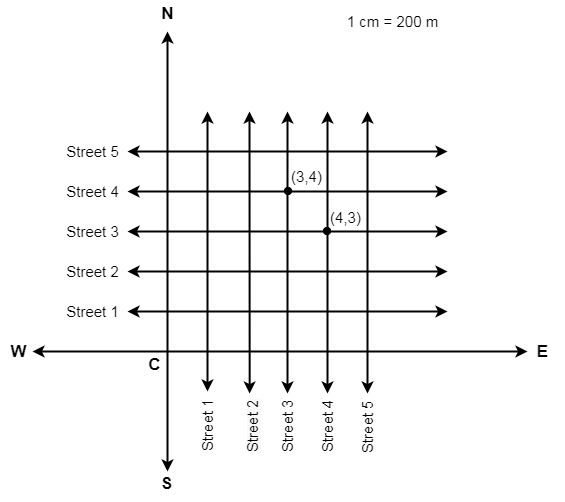
(i) We can clearly see that there is only one cross street that can be marked as (3,4).
(ii) We can clearly see that there is only one cross street that can be marked as (4,3).
Coordinate Geometry - Exercise 3.2
**Question 1: Write the answer to each of the following questions:
****(i) What is the name of** the **horizontal and the vertical lines drawn to determine the position of any point in the Cartesian plane?
****(ii) What is the name of each part of the plane formed by these two lines?**
****(iii) Write the name of the point where these two lines intersect.**
**Solution:
****(i)** Name of the horizontal and vertical lines are:
- The horizontal line drawn on the Cartesian plane is known as x-axis.
- The vertical line drawn on the Cartesian plane is known as y-axis.
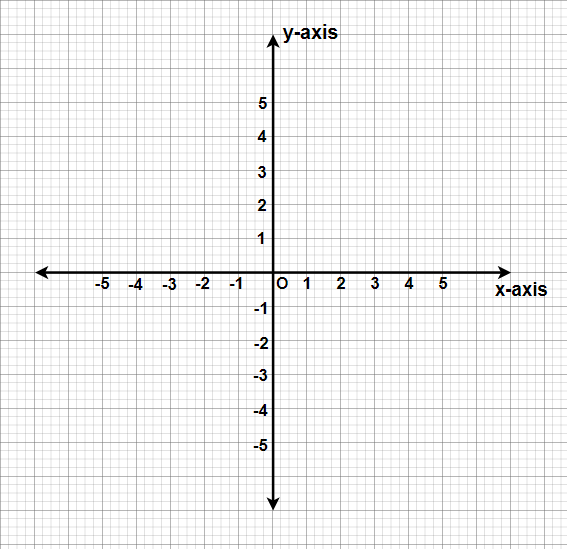
****(ii)** The name of each part of the plane formed by the two lines x-axis and y-axis is called as a quadrant (1/4th part).
****(iii)** Name of the point where there two lines intersect is called the origin(O).
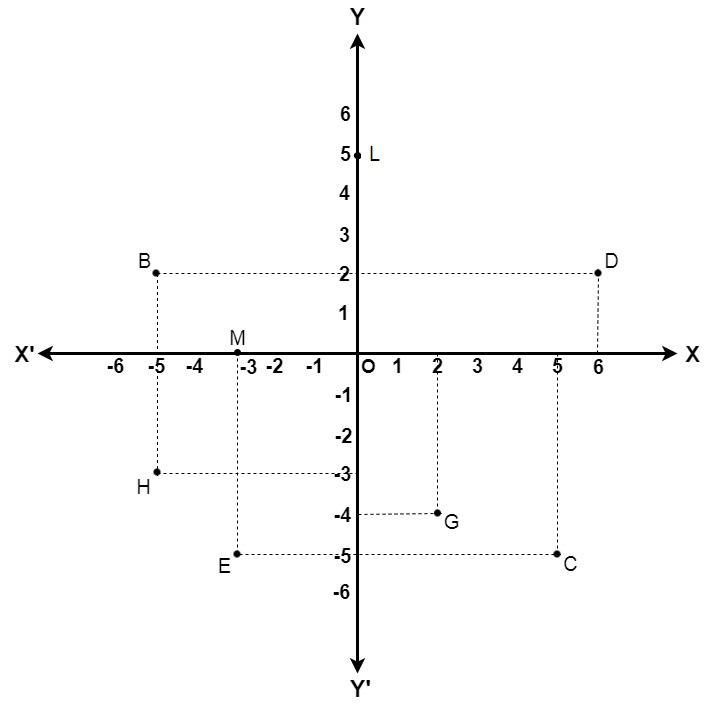
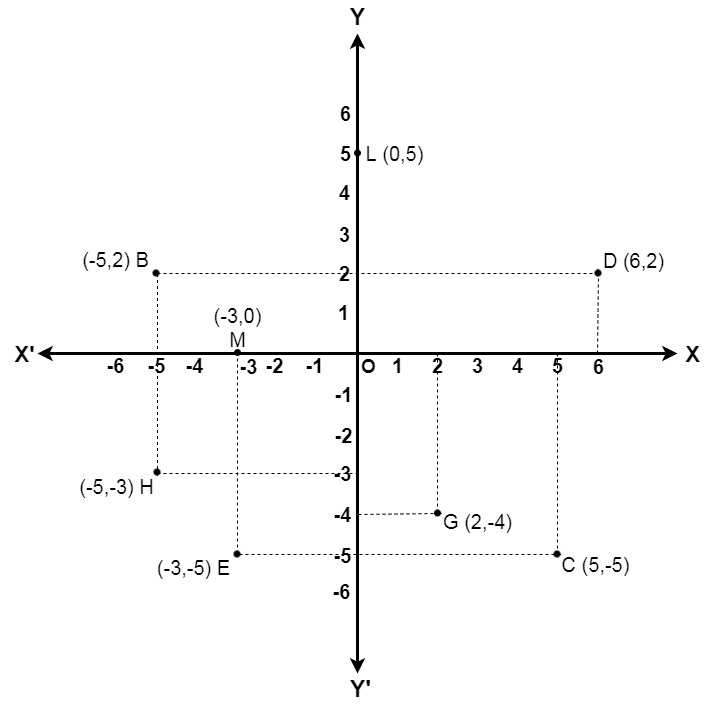
**Question 2: See the given figure, and write the following:
****(i) The coordinates of B.**
****(ii) The coordinates of C.**
****(iii) The point identified by the coordinates (–3, –5).**
****(iv) The point identified by the coordinates (2, – 4).**
****(v) The abscissa of the point D.**
****(vi) The ordinate of the point H.**
****(vii) The coordinates of the point L.**
****(viii) The coordinates of the point M.**
**Solution:
****(i)** The coordinates of point B is the distance of point B from x-axis and y-axis that is −5 and 2 respectively.
Therefore, the coordinates of point B are (−5, 2).****(ii)** The coordinates of point C is the distance of point C from x-axis and y-axis that is 5 and −5 respectively.
Therefore, the coordinates of point C are (5, −5).****(iii)** The point whose x-coordinate and y-coordinate are −3 and −5 respectively is point E.
****(iv)** The point whose x-coordinate and y-coordinate are 2 and −4 respectively is point G.
****(v)** The x-coordinate of point D is 6. Therefore, the abscissa of point D is 6.
****(vi)** The y-coordinate of point H is −3. Therefore, the ordinate of point H is −3.
****(vii)** The coordinates of point L is the distance of point L from x-axis and y-axis that is 0 and 5 respectively.
Therefore, the coordinates of point L are (0, 5).****(viii)** The coordinates of point M is the distance of point M from x-axis and y-axis that is −3 and 0 respectively. Therefore, the coordinates of point M is (−3, 0).
Coordinate Geometry - Exercise 3.3
**Question 1: In which quadrant or on which axis do each of the points (– 2, 4), (3, – 1), (– 1, 0), (1, 2) and (– 3, – 5) lie? Verify your answer by locating them on the Cartesian plane.
**Solution:
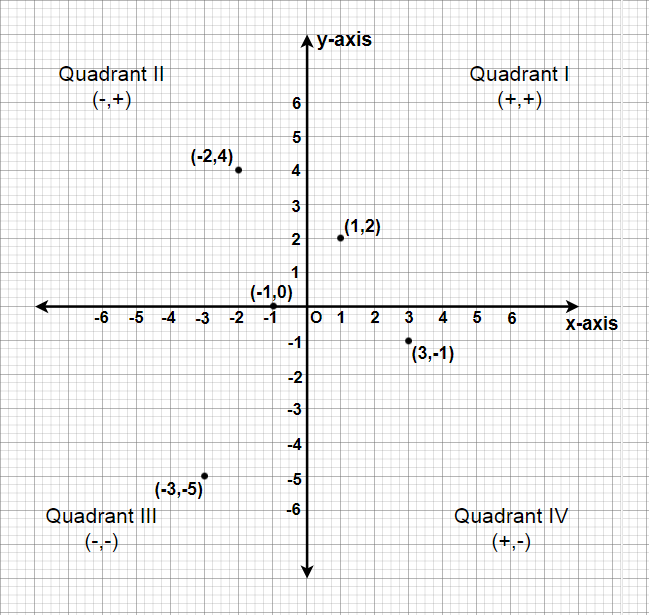
****(i)** The point (-2, 4) lies in IInd Quadrant in the Cartesian plane as x coordinate is negative and the y coordinate is positive.
****(ii)** The point (3, -1) lies in IVth Quadrant in the Cartesian plane as x coordinate is positive and the y coordinate is negative.
****(iii)** The point (-1, 0) lies on the negative x-axis and the value of x coordinate is negative.
****(iv)** The point (1, 2) lies in Ist Quadrant in the Cartesian as both x and y are positive.
****(v)** The point (-3,-5) lies in the IIIrd Quadrant in the Cartesian plane as both x and y are negative.
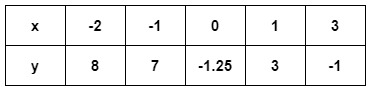
**Question 2: Plot the points (x, y) given in the following table on the plane, choosing suitable units of distance on the axes.
**Solution:
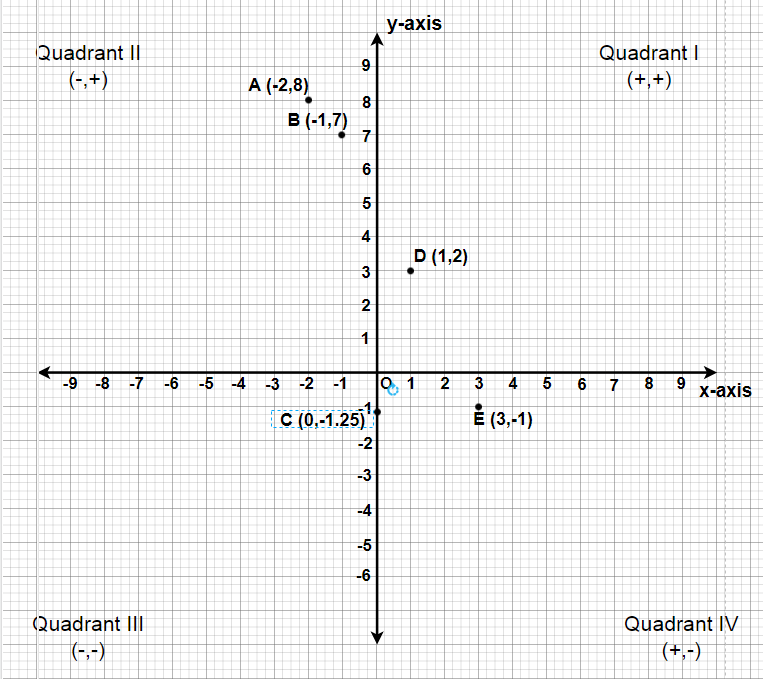
We have to plot these points A(-2, 8), B(-1, 7), C(0, -1.25), D(1, 3) and E(3, -1).
Steps we have to use to plot these points,
- Let 1 unit represents 1 cm.
- To plot (-2, 8), we take (-2) units on x-axis and (+8) units on y-axis. Now we can plot A (-2, 8), it will lie in quadrant-II.
- To plot (-1, 7), we take (-1) units on x-axis and (+7) units on y-axis. Now we can plot B(-1, 7), it will lie in quadrant-II.
- To plot (0, -1.25), we will proceed (-1.25) units under the x-axis on the y-axis and mark the plot as C(0, -1.25), it will lie on the negative side of y-axis.
- To plot (1, 3), we take (+1) unit on x-axis and (+3) units on y-axis. Now we can plot D(1, 3), it will lie in quadrant-I.
- To plot (3, -1), we take (+3) units on x-axis and (-1) unit on y-axis. Now we can plot the point E(3, -1), it will lie in quadrant-IV.
Important Points to Remember:
NCERT Solutions are created for each chapter including coordinate geometry.
These solutions provide in-depth solution to the problems encountered by students in their NCERT textbook.
All the provided solutions are comprehensive and step-by-step, so that students can learn solution with ease.
**Also Check,
Conclusion
Class 9 Chapter 3 Maths introduces you to Cartesian coordinates a 2D world with 'X' and 'Y' axes for precise point location. To assess your understanding, work through the exercises, and use the NCERT Solutions for Class 9 Maths Chapter 3. These expert-crafted NCERT Solutions Class 9 Maths Chapter 3 Coordinate Geometry clarify concepts and lay a strong foundation for advanced learning. Teachers have addressed common challenges faced by students, ensuring swift comprehension. These Class 9 Maths Chapter 3 Solutions help you efficiently solve exercises and offer support from top mathematics educators, guiding you to approach coordinate geometry problems effectively.