Introduction to Number System (original) (raw)
Last Updated : 21 Apr, 2026
**Number System is a method of representing numbers with the help of a set of symbols and rules; it is a mathematical notation used to represent quantities or values in various forms.
Please remember every piece of data in a computer—whether it’s text, images, sound, video, code, or memory addresses—is ultimately stored as binary, a string of 0s and 1s making numbers and number systems the core of computing.
- Humans understand decimal, and computers understand binary, so we have two different number systems.
- Binary can be long for large amount of data, so there are more systems like octal and hexadecimal that allow binary sequence to be broken into groups making it less error-prone and readable compared to binary.
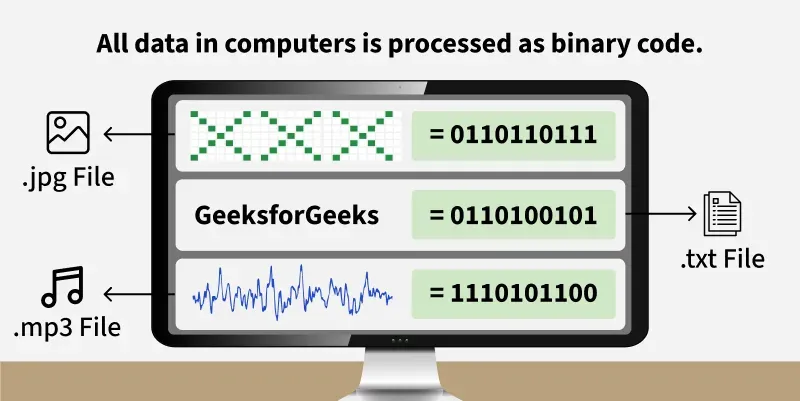
Fig: 1 Everything is stored in the computer in the form of binary.
As shown in Figure 1, binary is the foundation of all data representation in computers. Let’s now explore the different number systems that enable this process.
Number systems provide a structured way to represent numbers, enabling arithmetic operations and ensuring consistent, understandable notation.
- A number system uses a base (or radix) to represent values.
- The base refers to the number of unique digits, including zero, that a system uses to represent numbers.
- Each system has its own set of rules for representing.
Types of Number Systems
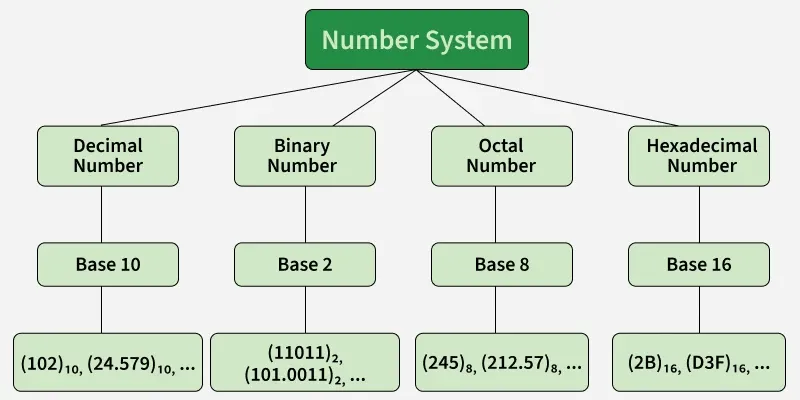
Number systems are of various types based on their base value and the number of allowed digits.
Decimal Number System
The Decimal Number System is the standard system for denoting numbers.
- It is also called the **base-10 system.
- Digits used in it are 0, 1, 2, 3, 4, 5, 6, 7, 8, 9.
- Each digit in the number is at a specific place value that is powers of 10.
- From right to left - units has the place value as 100, Tens has the place value as 101, Hundreds as 102, Thousands as 103, and so on.
**Example:
10285 can be written as
10285 = (1 × 10⁴) + (0 × 103) + (2 × 10²) + (8 × 101) + (5 × 100)
10285 = 1 × 10000 + 0 × 1000 + 2 × 100 + 8 × 10+ 5 × 1
10285 = 10000 + 0 + 200 + 80 + 5
10285 = 10285
Binary Number System
Binary Number System is the number system with base 2.
- The numbers are formed using two digits - 0 and 1.
- Binary number system is very useful in electronic devices and computer systems because it can be easily performed using just two state i.e. 0 and 1.
- Each digit in the number is at a specific place value that is powers of 2.
- From right to left - as powers of 2 i.e. 20, 21, 22, etc).
Binary Numbers can be converted to Decimal value by multiplying each digit with the place value and then adding the result.
**Example:
(1011)₂ can be written as
(1011)₂ = 1 × 2³ + 0 × 2² + 1 × 2¹ + 1 × 2⁰
(1011)₂ = 1 × 8 + 0 × 4 + 1 × 2 + 1 × 1
(1011)₂ = 11 (in decimal)
Octal Number System
Octal Number System is the number system with **base 8.
- The numbers are formed using 8 digits i.e. **0, 1, 2, 3, 4, 5, 6, 7.
- Octal number system is useful for representing file permissions in Unix/Linux operating systems.
- Each digit in the number is at a specific place value that is powers of 8.
- From right to left - as powers of 8 i.e. 80, 81, 82, etc.
Octal Numbers can be converted to Decimal value by multiplying each digit with the place value and then adding the result.
**Example:
(325)8 can be written as
(325)8 = 3 × 8² + 2 × 8¹ + 5 × 8⁰
(325)8 = 192 + 16 + 5
(325)8 = 213 (in decimal)
**Hexadecimal Number System
Hexadecimal Number System is the number system with **base 16.
- The numbers are formed using 16 digits i.e. **0, 1, 2, 3, 4, 5, 6, 7, 8, 9, A, B, C, D, E and F.
- Hexadecimal Numbers are useful for handling memory address locations.
- The digits from **0 to 9 are used as in the decimal system, but the numbers **10 to 15 are represented using the letters **A to F as follows: 10 is represented as **A, 11 as **B, 12 as **C, 13 as **D, 14 as **E, 15 as **F.
**Place Value: the position of the digit. Each digit in the number is at a specific place value that is powers of 16. (from right to left - as powers of 16 i.e. 160, 161, 162, etc)
Hexadecimal Number System can be converted to Decimal value by multiplying each digit with the place value and then adding the result.
**Example:
(2F)16 can be written as
(2F)16 = 2 × 16¹ + F × 16⁰
(2F)16 = 2 × 16 + 15 × 1
(2F)16 = 32 + 15
(2F)16= 47 (in decimal)
**Also Check:
**Conversion of Number Systems