Octagon (original) (raw)
Last Updated : 23 Jul, 2025
An octagon is an eight-sided, two-dimensional geometric figure with eight interior angles and eight exterior angles. The sum of its exterior angle is 360o and the sum of its interior angle is 1080o and it has 20 diagonals in it. Regular octagons have all sides and angles equal, while irregular octagons may have varying lengths and angles.
This shape is commonly found in various applications, such as architecture, design, and traffic signage, notably in stop signs. The symmetry and aesthetic appeal of octagons also make them popular in tiling and decorative patterns.
**Note: The word 'octagon' is derived from the Greek word 'okta' meaning eight and 'gon' meaning 'side or angle'. As it consists of eight sides and eight angles.

Properties of Octagon
Properties are generally considered for Regular octagons and their properties are given below :
- All 8 sides are equal and all 8 angles are also equal.
- There is a total of 20 diagonals in a regular octagon.
- All 8 interior angles are equal, measuring 135o each, and the sum of all interior angles is always 1080o.
- All 8 exterior angles are equal, measuring 45o each, and the sum of all exterior angles is always 360o.
- A regular octagon has 8 lines of symmetry. It also has rotational and reflective symmetry.
- A regular octagon can be inscribed in a circle (circumcircle) or circumscribed around a circle (incircle).
Angles of Octagon
The octagon has eight sides and consists of eight angles. It has both interior and exterior angles. Angles inside the octagon are interior angles. Similarly, the angles at the exterior side of the octagon are termed exterior angles. In an octagon, there are 8 exterior and 8 interior angles.
Interior Angles of Octagon
To find the measurement of each interior angle of any polygon, you can use the formula:
**Interior angle = [(n-2) x 180] / n
For a**n octagon, **n = 8
Substituting this value into the formula:**Interior angle = [ ( 8-2 ) x 180 ] / 8
So, each interior angle of a regular octagon measure up to **135 o .

The Sum of all the interior angles of an octagon, whether regular or irregular, is always 1080o.
Exterior angle of an Octagon
To find the measurement of each exterior angle, you can use the formula:
**Exterior angle = 360/n
For an octagon, n=8
Substituting this value into the formula :Exterior angle = 360/8 = 45o
So, each exterior angle of a regular octagon measure up to 45o.

Types of Octagon
Depending on the sides, angles, and vertices, an octagon is classified into the following categories:
- Regular and Irregular
- Concave and Convex
**Regular Octagon
An octagon has eight equal sides and eight equal angles, all the sides are equal in length, eight interior angles are measured to 135o and an exterior angle of 45o each can be termed a regular octagon.

**Irregular Octagon
An octagon that does not have all sides equal or all angles equal or we can also say whose sides and angles are not congruent is an irregular octagon. Even though its sides and angles are not equal the sum of interior angles is always 1080o. Irregular octagons can be either convex or concave.
**Concave Octagon
Octagons in which one of the angles is pointing inward and whose angle is greater than 180o are known as Concave octagons.
**Convex Octagon
Octagon which has all its interior angles less than 180o and all of its angles pointing outward is called Convex Octagon.

Octagon Formula
- Perimeter
- Area
- Number of Diagonals
- Length of Diagonal
Octagon Perimeter
The total length of the boundary of a Polygon is called as Perimeter of a Polygon. To calculate the perimeter of the octagon we must know the length of all sides of the octagon. We know that if the octagon is regular then knowing one side is enough as for a regular octagon all sides and angles are equal. Therefore, the formula that is used to find the Octagon perimeter is,
**Perimeter of an Octagon = Sum of all its sides
**Perimeter of a Regular octagon = 8 × s ( where s is length of one side of octagon )
Octagon Area
The area of an octagon is the total space occupied by it. The formula for calculating the area of a **Regular Octagon is :
**Area of Regular Octagon = 2s 2 × (1 + √2)
Where 's' is the length of one side of octagon.
**Note: For Irregular Octagon there is no such direct formula but we can calculate its area by subdividing the octagon into different shapes and then calculating the area of each sub-divided shape and then summing up the areas of all the sub-divided shapes.
Octagon Diagonal
The line segment between two non-adjacent vertices of the octagon is called diagonal. An octagon can consist of a total of 20 diagonals. The formula for calculating the number of diagonals in an n-sided polygon is given as: **n × (n - 3)/2.
**Calculating the number of diagonals in an Octagon using Formula
For Octagon, n = 8
_putting value of n into the formula, we getn **× (n - 3)/2 = 8 **× (8 - 3)/2 = 8 **× 5/2 = 20
Therefore, an octagon can contain a total of 20 diagonals.

Length of the Diagonal of the Octagon
The line segment between two non-adjacent vertices of the octagon is called a diagonal. There are 3 types of diagonals in regular octagon based on their length :
- Short Diagonal
- Medium Diagonal
- Long Diagonal
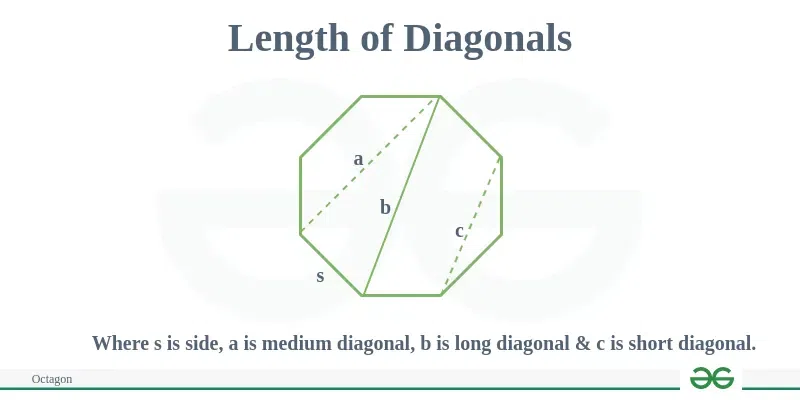
Here, 's' is the length of one side of a regular octagon, c is the short diagonal, a is the medium diagonal, and b is the long diagonal.
**Length of Octagon Diagonal Formula:
**Short Diagonal ( c ) = s √( 2 + √2 )
**Medium Diagonal ( a ) = s ( 1 + √2 )
**Long Diagonal ( b ) = s √( 4 + 2 √2 )
**Read More: **Octagon Formula
Lines of Symmetry in Octagon
A line of Symmetry is defined as a balanced proportionate similarity that is found in two halves of an object. Thus being an 8-sided polygon it has 8 lines of symmetry. These lines of symmetry can be drawn for an octagon and are drawn as given below :

Octagonal Pyramid
The Octagonal Pyramid is a 3D figure with one octagon as the base with eight connecting triangles. It has a total of 9 faces out of which 8 are triangles and 1 is octagons. It has 16 edges and 9 vertices. The vertex on top is the apex of the pyramid. The height of an octagonal pyramid is the length of the line segment that's perpendicular to the base which runs through the apex of the pyramid.

Octagonal Prism
Octagonal Prism is a 3D (Three-Dimensional ) solid consisting of two octagonal bases joined together by eight rectangular faces. It has a total of 10 faces out of which 8 are rectangular and 2 are octagonal. It has 24 edges and 16 vertices. Altogether, the octagon prism has 10 faces, combining the surfaces of octagonal bases and rectangular faces.

**Read More:
Solved Examples On Octagon
**Example 1. Calculate the longest Diagonal of a Regular Octagon, whose Perimeter is 40cm.
**Solution:
_Given that perimeter of Regular Octagon = 40cm. Therefore, Perimeter = 8 × s= 40 s = 40 /8s = 5 (length of each side)Now, length of longest Diagonal l = s √ (4+2√2) = 5 × 2.613 = 13.065 cm
Hence, the length of given diagonal is 13.065 cm.
**Example 2. Find the Area of the Regular Octagon whose side length is 10 cm.
**Solution:
Given, Length of side = 10cm
Area = 2s2 × (1+√2)
= 2 × 100 × 2.414 = 482.8 cm2
Area of the given octagon is 482.8 cm2
**Example 3. Find the Area of the regular octagon if its perimeter is 16 cm.
**Solution:
_Given, Perimeter = 16 cm
_8 × s = 16
_s = 16/8
_s = 2(length of side of Regular octagon)_Now, Area of Octagon= 2s _2_× (1+√2)= 2 × _2 2 × (1+√2)= 2 × 4 × 2.414= 19.312 cm 2
**Example 4. Given The Length Short Diameter 20cm. Find the Area of a Regular Octagon.
**Solution:
Given , Short Diagonal = s √( 2+√2 ) = 20cm, squaring both side ( s √( 2+√2 ) )2 = 400
s2 × (2+ √2) = 400
s2 = 400 / (2+ √2)
s = √ 117.157
s = 10.82 cmNow, Area = 2 × (1+√2)s2
Area = 2 × (1+√2) × (10.82)2
= 2 × 2.414 × 117.157
= 565.225 cm2Hence, the area of the given octagon is 565.225 cm2