OneSided Limits (original) (raw)
One-Sided Limits
Last Updated : 8 Jun, 2026
One-sided limits in calculus refer to the value a function approaches as the input gets closer to a particular point from either the left or the right. When we analyze the function from the left side, it is called the left-hand limit, denoted as limx→c−f(x), while from the right side, it's called the right-hand limit and is written as limx→c+.
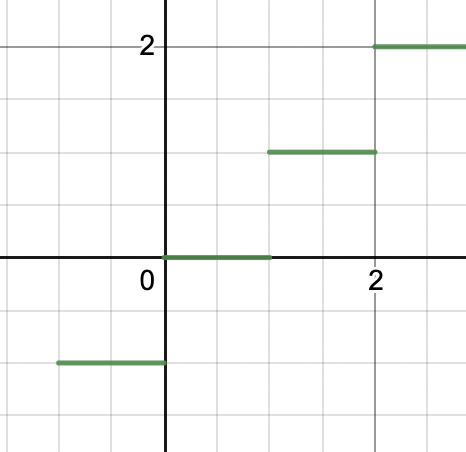
Types of One-Sided Limit
There are two types of one-sided limits, i.e.,
**1. Left-Hand Limit
The left-hand limit of a function f(x) as x approaches a is denoted as the following:
\lim_{x \to a^-} f(x)
This means that x approaches a from the left (values smaller than a).
**2. Right-Hand Limit
The right-hand limit of a function f(x) as x approaches a is denoted as the following:
\lim_{x \to a^+} f(x)
This means that x approaches a from the right (values larger than a).
If both one-sided limits exist and are equal at a point, then the two-sided limit at that point exists and is equal to the common value.
\lim_{x \to a} f(x) \quad \text{exists if and only if} \quad \lim_{x \to a^-} f(x) = \lim_{x \to a^+}
Consider the function: f(x) = \begin{cases} 2x + 1 & \text{if } x < 3 \\ x^2 - 4 & \text{if } x \geq 3 \end{cases}
To find the one-sided limits at x=3:
- Left-hand limit: limx→3−f(x) = 2(3) + 1 = 7
- Right-hand limit: limx→3+f(x)=32 − 4 = 5
Since the left-hand limit (7) and right-hand limit (5) are not equal, the limit does not exist at x = 3. However, the one-sided limits still exist separately.
Importance
- **Discontinuities: One-sided limits help in analyzing functions that have discontinuities (like jumps or breaks). If the left-hand and right-hand limits at a point are not equal, the overall limit at that point does not exist.
- **Piecewise Functions: One-sided limits are particularly useful for functions that have different definitions in different intervals, like piecewise functions.
Solved Examples
**Example 1: For f(x) = 3x - 1, find the left-hand limit as x approaches 2.
We need to evaluate \lim_{x \to 2^-} f(x).
f(x) = 3x - 1
Substituting x = 2 directly into the function:
f(2) = 3(2) - 1 = 6 - 1 = 5
Since the function is linear and continuous, the left-hand limit is:
\lim_{x \to 2^-} f(x) = 5
**Example 2: For f(x) = \frac{1}{x}, find the right-hand limit as x approaches 0.
We need to find \lim_{x \to 0^+} \frac{1}{x}
For values of x approaching 0 from the right (positive values), \frac{1}{x} grows infinitely large. Therefore:
\lim_{x \to 0^+} \frac{1}{x} = +\infty
**Example 3: For f(x) = \begin{cases} x + 2 & \text{if } x < 1 \\ 3x - 1 & \text{if } x \geq 1 \end{cases}, find the left-hand and right-hand limits as x approaches 1.
- For the left-hand limit:\lim_{x \to 1^-} f(x) = 1 + 2 = 3
- For the right-hand limit:\lim_{x \to 1^+} f(x) = 3(1) - 1 = 2
Since the left-hand limit (3) and the right-hand limit (2) are different, the two-sided limit does not exist at x = 1.
**Example 4: For f(x) = \begin{cases} 5 - x & \text{if } x < 0 \\ x^2 & \text{if } x \geq 0 \end{cases}, find the right-hand limit as x approaches 0.
For the right-hand limit:\lim_{x \to 0^+} f(x) = 0^2 = 0
**Example 5: For f(x) = \frac{1}{x - 2}, find the left-hand and right-hand limits as x approaches 2.
- For the left-hand limit:\lim_{x \to 2^-} \frac{1}{x - 2} = -\infty
- For the right-hand limit:\lim_{x \to 2^+} \frac{1}{x - 2} = + \infty
Since the limits from both sides are infinite but with opposite signs, the two-sided limit does not exist at x = 2.
Practice Questions
**Q1: f(x) = x²2 - 4x + 3, find \lim_{x \to 1^-}.
**Q2: f(x) = \frac{2}{x}, find \lim_{x \to 0^+} f(x).
**Q3: f(x) = 3x - 1, find \lim_{x \lim_{x \to 3^+} f(x).
**Q4: f(x) = \frac{1}{x - 1}, find \lim_{x \to 1^-} f(x).
**Q5: f(x) = \begin{cases} 2x + 1 & \text{if } x < 2 \\ x^2 - 4 & \text{if } x \geq 2 \end{cases}, find \lim_{x \to 2^+} f(x).
**Q6: f(x)=x3, find \lim_{x \to -1^-} f(x).
**Q7: f(x) = \frac{1}{x + 3}, find \lim_{x \to -3^+}.
**Answer Key
- f(1) = 0
- +\infty
- 8
- -\infty
- 0
- −1
- +\infty