Orthogonal Matrix (original) (raw)
Last Updated : 27 Nov, 2025
An orthogonal matrix is a square matrix whose transpose is equal to its inverse. It's all rows and columns are mutually orthogonal unit vectors, meaning that each row and column of the matrix is perpendicular to every other row and column, and each row or column has a magnitude of 1.
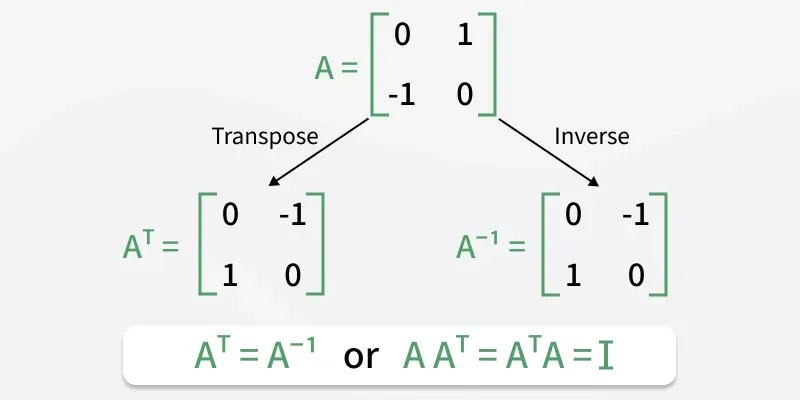
Figure 1 : Orthogonal Matrix
From Figure 1: A is an orthogonal matrix cause its transpose and inverse and equal to each other.
Where,
- AT is the transpose of the square matrix,
- A-1 is the inverse of the square matrix, and
- I is the identity matrix of the same order as A.
AT = A-1 (Condition for an Orthogonal matrix) ... (i)
Pre-multiply by A on both sides,
We get, AAT = AA-1,
We know this relation of the identity matrix, AA-1 = I, (of the same order as A).
So we can also write it as AAT = I. (From (i))
Similarly, we can derive the relation ATA = I.
So, from the above two equations, we get AAT = ATA = I.
**Condition for an Orthogonal Matrix
For any matrix to be an orthogonal Matrix, it needs to fulfil the following conditions:
- Every two rows and two columns have a dot product of zero, and
- Every row and every column has a magnitude of one.
Orthogonal Matrix in Linear Algebra
The condition of any two vectors to be orthogonal is when their dot product is zero. Similarly, in the case of an orthogonal matrix, every two rows and every two columns are orthogonal. Also, one more condition is that the length of every row (vector) or column (vector) is 1.
For Example, let's consider a 3×3 matrix, i.e., A = \begin{bmatrix} \frac{1}{3} & \frac{2}{3} & -\frac{2}{3}\\ -\frac{2}{3} & \frac{2}{3} & \frac{1}{3}\\ \frac{2}{3} & \frac{1}{3} & \frac{2}{3} \end{bmatrix}
Here, the dot product between vector 1 and vector 2 i.e. between row 1 and row 2
**Row 1 ⋅ Row 2 = (1/3)(-2/3) + (2/3)(2/3) + (-2/3)(1/3) = 0
So, **Row 1 and **Row 2 are Orthogonal.
Also, the **Magnitude of Row 1 = ((1/3)2 + (2/3)2 + (-2/3)2)0.5 = 1
Similarly, we can check for all other rows.
Thus, this matrix A is an example of Orthogonal Matrix.
Example of Orthogonal Matrix
If the transpose of a square matrix with real numbers or values is equal to the inverse matrix of the matrix, the matrix is said to be orthogonal.
Example of 2×2 Orthogonal Matrix
Let's consider the an 2×2 i.e., {A = \begin{bmatrix} \cos x & \sin x\\ -\sin x & \cos x \end{bmatrix}}.
Let's check this using the product of the matrix and its transpose.
\bold{A^T = \begin{bmatrix} \cos x & -\sin x\\ \sin x & \cos x \end{bmatrix}}
Thus, A\cdot A^T = \begin{bmatrix} \cos x & \sin x\\ -\sin x & \cos x \end{bmatrix}\cdot \begin{bmatrix} \cos x & -\sin x\\ \sin x & \cos x \end{bmatrix}
⇒ A\cdot A^T = \begin{bmatrix} \cos^2 x + \sin^2 x& \sin x \cos x - \sin x \cos x\\ \cos x \sin x - \cos x \sin x & \sin^2 x +\cos^2 x \end{bmatrix}
⇒ A\cdot A^T = \begin{bmatrix} 1 & 0 \\ 0 & 1 \end{bmatrix}
Which is an Identity Matrix.
Thus, A is an example of an Orthogonal Matrix of order 2×2.
Example of 3×3 Orthogonal Matrix
Let us consider 3D Rotation Matrix i.e., 3×3 matrix such that A = \begin{bmatrix} 1 & 0 & 0 \\ 0 & \cos(\theta) & -\sin(\theta) \\ 0 & \sin(\theta) & \cos(\theta) \end{bmatrix} ,
To check this matrix is an orthogonal matrix, we need to
- Verify that each column and row matrix is a unit vector, i.e., vector with unit magnitude, and
- Verify that the columns and rows are pairwise orthogonal i.e., the dot product between any two rows and columns is 0.
Let's check, from the matrix, we get
- **Column 1: [1, 0, 0]
- **Column 2: [0, cos(θ), sin(θ)]
- **Column 3: [0, -sin(θ), cos(θ)]
Now,
- ****|[1, 0, 0]| =** √(12 + 02 + 02) = 1,
- ****|[0, cos(θ), sin(θ)]|** = √(02 + cos2(θ) + sin2(θ)) = 1, and
- ****|[0, -sin(θ), cos(θ)]|** = √(02 + sin2(θ) + cos2(θ)) = 1
Thus, each column is a unit vector.
Column 1 ⋅ Column 2 = [1, 0, 0] ⋅ [0, cos(θ), sin(θ)] = 1*0 + 0*cos(θ) + 0*sin(θ) = 0
Similarly, we can check, other columns as well.
Thus, this satisfies all the conditions for a matrix to be orthogonal.
It follows that the provided matrix is an orthogonal matrix given the characteristics of orthogonal matrices.
Determinant of Orthogonal Matrix
Determinant of any Orthogonal Matrix is either +1 or -1. Here, let's demonstrate the same. Imagine a matrix A that is orthogonal.
For any orthogonal matrix A, we know **A · A T = I
Taking determinants on both sides,
det(A · AT) = det(I)
⇒ det(A) · det(AT) = 1As, determinant of identity matrix is 1 and det(A) = det(AT)
Thus, det(A) · det(A) = 1
⇒ [det(A)]2 = 1
⇒ det(A) = ±1
Inverse of Orthogonal Matrix
The inverse of the orthogonal matrix is also orthogonal as inverse is same transpose for orthogonal matrix. As for any matrix to be an orthogonal, inverse of the matrix is equal to its transpose.
For an Orthogonal matrix, we know that **A -1 = A T
Also A · AT = AT · A = I . . . (i)
Let two matrix A and B and if they are inverse of each other then,
A · B = B · A = I . . . (ii)
From (i) and (ii),
B = AT which is same as A = AT
So, we conclude that the transpose of an orthogonal matrix is its inverse only.
Properties of an Orthogonal Matrix
Some of the properties of Orthogonal Matrix are:
- Inverse and Transpose are equivalent. i.e., A-1 = AT.
- An identity matrix is the outcome of A and its transpose. That is, AAT = ATA = I.
- In light of the fact that its determinant is never 0, an orthogonal matrix is always non-singular.
- An orthogonal diagonal matrix is one whose members are either 1 or -1.
- AT is orthogonal as well. A-1 is also orthogonal because A-1 = AT.
- The eigenvalues of A are ±1 and the eigenvectors are orthogonal.
- As I × I = I × I = I, and IT = I. Thus, I an identity matrix (I) is orthogonal.
How to Identify Orthogonal Matrices?
If the transpose of a square matrix with real numbers or elements equals the inverse matrix, the matrix is said to be orthogonal. Or, we may argue that a square matrix is an orthogonal matrix if the product of the square matrix and its transpose results in an identity matrix.
Suppose A is a square matrix with real elements and of n x n order and AT is the transpose of A. Then according to the definition, if, AT = A-1 is satisfied, then,
**A ⋅ A T = I
Eigen Value of Orthogonal Matrix
The eigenvalues of an orthogonal matrix are always complex numbers with a magnitude of 1. In other words, if A is an orthogonal matrix, then its eigenvalues λ satisfy the equation |λ| = 1. Let's prove the same as follows:
Let A be an orthogonal matrix, and let λ be an eigenvalue of A. Also, let v be the corresponding eigenvector.
By the definition of eigenvalues and eigenvectors, we have:
Av = λv
Now, take the dot product of both sides of this equation with itself:
(Av) ⋅ (Av) = (λv) ⋅ (λv)
Since A is orthogonal, its columns are orthonormal, which means that AT (the transpose of A) is also its inverse:
**A T ⋅ A = I
Where **I is the identity matrix.
Thus, (vTAT) ⋅ Av = (λv)T ⋅ (λv)
⇒ vT (AT A) v = (λv)T (λv)
⇒ vT I v = (λv)T (λv)
⇒ vT v = (λv)T (λv)
⇒ |v|2 = |λ|2 |v|2
Now, divide both sides of the equation by |v|2:
1 = |λ|2
⇒ |λ| = 1
Multiplicative Inverse of Orthogonal Matrices
The orthogonal matrix's inverse is also orthogonal. It is the result of the intersection of two orthogonal matrices. An orthogonal matrix is one in which the inverse of the matrix equals the transpose of the matrix.
Orthogonal Matrix Applications
Some of the most common applications of Orthogonal Matrix are:
- Used in multivariate time series analysis.
- Used in multi-channel signal processing.
- Used in QR decomposition.
**Read More
Solved Examples on Orthogonal Matrix
**Example 1: Is every orthogonal matrix symmetric?
**Solution:
Every time, the orthogonal matrix is symmetric. Thus, the orthogonal matrix is a property of all identity matrices. An orthogonal matrices will also result from the product of two orthogonal matrices. The orthogonal matrix will likewise have a transpose that is orthogonal.
**Example 2: Check whether the matrix X is an orthogonal matrix or not?
\bold{\begin{bmatrix} \cos x & \sin x\\ -\sin x & \cos x \end{bmatrix}}
**Solution:
We know that the orthogonal matrix's determinant is always ±1.
The determinant of X = cos x · cos x - sin x · (-sin x)
⇒ |X| = cos2x + sin2x = 1
⇒ |X| = 1
Hence, X is an Orthogonal Matrix.
**Example 3: Prove orthogonal property that multiplies the matrix by transposing results into an identity matrix if A is the given matrix.
**Solution:
A = \begin{bmatrix} -1 & 0\\ 0 & 1 \end{bmatrix}
Thus, A^{T} = \begin{bmatrix} 1 & 0\\ 0 & -1 \end{bmatrix}
⇒ A \cdot A^{T} = \begin{bmatrix} 1 & 0\\ 0 & 1 \end{bmatrix}
Which is an identity matrix.
Thus, A is an Orthogonal Matrix.
Practice Problems on Orthogonal Matrix
**Question 1: Let A be a square matrix:
A = \begin{bmatrix} 0.6 & -0.8 \\ 0.8 & 0.6 \end{bmatrix}
Determine whether matrix A is orthogonal.
**Question 2: Given the matrix A:
A = \begin{bmatrix} 1 & 0 \\ 0 & -1 \end{bmatrix}
Is matrix A orthogonal?
**Question 3: Let Q be an orthogonal matrix. Prove that the transpose of Q is also its inverse, i.e., QT = Q-1
**Question 4: Consider the matrix C:
C = \begin{bmatrix} \frac{1}{\sqrt{3}} & -\frac{1}{\sqrt{3}} & \frac{1}{\sqrt{3}} \\ \frac{1}{\sqrt{2}} & 0 & -\frac{1}{\sqrt{2}} \\ -\frac{1}{\sqrt{6}} & \frac{2}{\sqrt{6}} & \frac{1}{\sqrt{6}} \end{bmatrix}
Is matrix C orthogonal?