Pairs of Angles (original) (raw)
Last Updated : 10 Jun, 2026
A pair of angles simply means two angles considered together based on a specific relationship between them. In geometry, when two angles are taken together and their positions or measures are related in some way, they are called a pair of angles.
**Example: If one angle is 60° and another is 40°, these two angles together form a pair of angles.
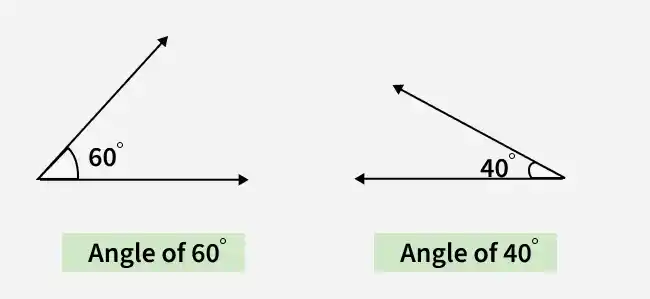
Pairs of angles are classified into different types based on the relationship between them, such as the following:
1. Complementary Angles
When we have two angles whose addition equals 90°, then the angles are called Complementary Angles.
**Example:
60° and 30° (60° + 30° = 90°)
70° and 20° (70° + 20° = 90°)
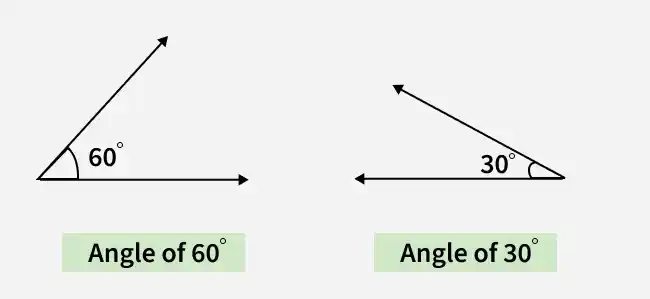
- If we have two angles as x° and y° and x° + y° = 90°, then x is called the complementary angle of y and y is called the complementary angle of x.
**Example: We have 20° and 70° then, 20° is a complementary angle of 70° and 70° is a complementary angle of 20°.
- If we have one angle as x°, then to find a complementary angle, we need to subtract it from 90°.
**Example: We have 30° then the complementary angle of it is 90° - 30° which is 60°
2. Supplementary Angles
When we have two angles whose addition equals 180°, then the angles are called Supplementary Angles.
**Example:
140° and 40° (140° + 40° = 180°)
70° and 110° (70° + 110° = 180°)
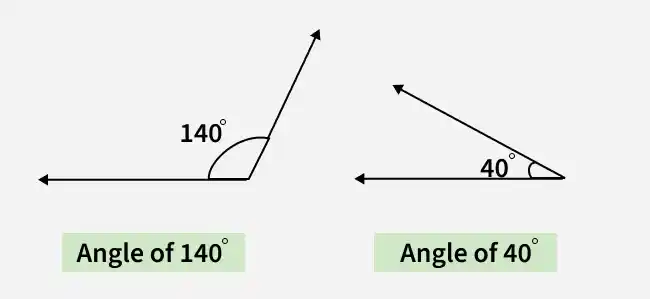
- If we have two angles as x° and y° and x° + y° = 180°, then x is called the supplementary angle of y and y is called the supplementary angle of x.
**Example: We have 100° and 80° then, 100° is the supplementary angle of 80° and 80° supplementary angle of 100°.
- If we have one angle as x°, then to find a supplementary angle, we need to subtract it from 180°.
**Example: We have 60° then the supplementary angle of it is 180° - 60° which is 120°
3. Adjacent Angles
When we have two angles with a common side and a common vertex without any overlap, we call them Adjacent Angles.
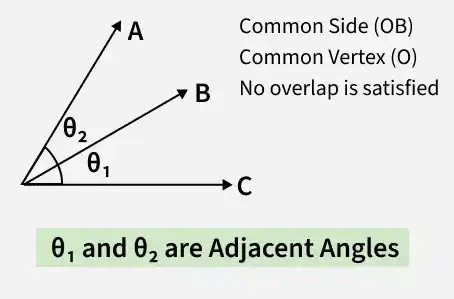
We know what conditions two angles need to fulfill to be Adjacent angles.
Let's see some of the cases where we might get confused about whether they are adjacent angles or not.
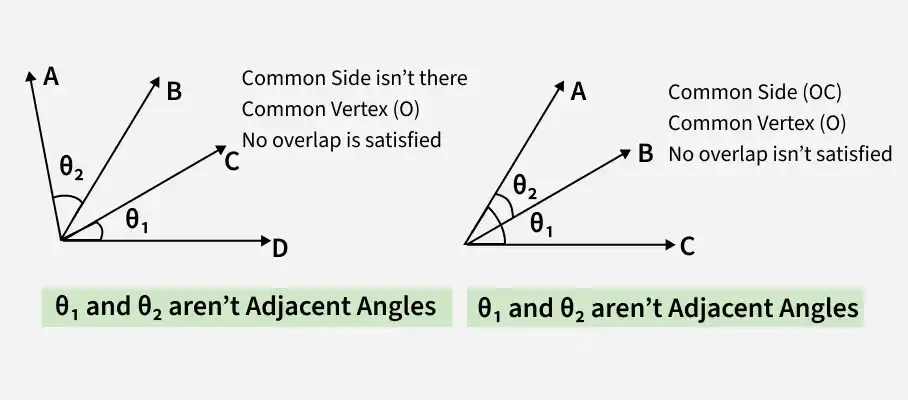
**Case 1: Not Adjacent Angles (No Common Side)
Here, θ₁ and θ₂ have a common vertex and do not overlap, but they do not share a common side, so they are not adjacent angles.
**Case 2: Not Adjacent Angles (Angles Overlap)
Here, θ₁ and θ₂ have a common vertex and share a common side, but they overlap, so they are not adjacent angles.
4. Linear Pair of Angles
A linear pair of angles is a pair of adjacent angles formed when two lines intersect such that the non-common sides of the angles form a straight line, and the sum of the two angles is 180°.
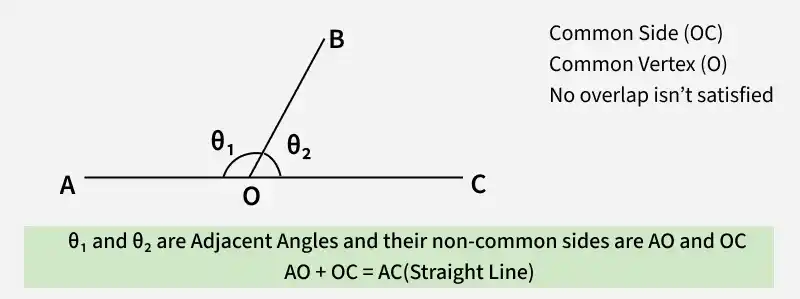
**Example 1:
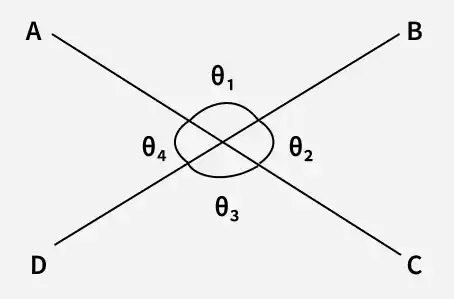
Let's call the intersection of line AC and BD to be O. Now we see four angles are there; let's try to observe them one by one.
- θ1 and θ2 are adjacent angles, and their non-common sides are AO and OC; AO + OC = AC is a Straight Line so both are linear pairs of angles.
- θ2 and θ3 are adjacent angles, and their non-common sides are BO and OD; BO + OD = BD is a Straight Line so both are linear pairs of angles.
- θ3 and θ4 are adjacent angles, and their non-common sides are CO and OA; CO + OA = CA is a Straight Line so both are linear pairs of angles.
- θ4 and θ1 are adjacent angles, and their non-common sides are D0 and OB; DO + OB = DB is a Straight Line so both are a linear pair of angles.
5. Vertical Angles
A vertical angle is a pair of non-adjacent angles that are formed by the intersection of two Straight Lines.
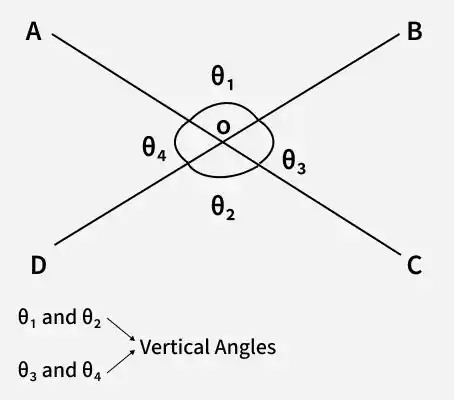
Here we see line AC and line BD intersect at one point, let's call it O and thus four angles are formed
∠AOB = θ1
∠DOC = θ₂
∠BOC = θ₃
∠AOD = θ₄
θ1 and θ2 are non-adjacent angles and formed by the intersection of lines AD and BC therefore they are Vertical Angles are always Equal so θ1 = θ2. Similarly, θ3 and θ4 are also vertical angles; therefore, θ3 = θ4.
**Example: Find the value of a and b
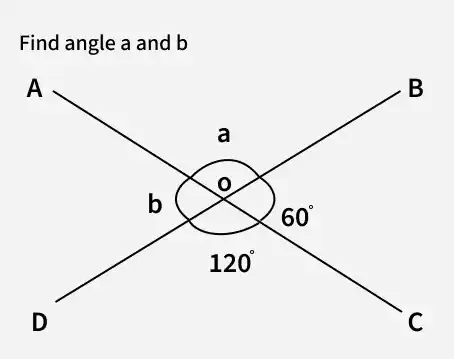
Here we see ∠BOC and b are vertically opposite angles; therefore,
b = ∠BOC = b = 60°
and we also see that ∠DOC and ∠A are vertically opposite angles; therefore,
a = ∠DOC = a = 120°
Solved Examples
**Question 1: Two adjacent angles are formed when a straight line intersects another line. One angle measures 65°. What is the measure of the other adjacent angle?
Given:
One angle is 65°.
The two angles are adjacent and form a straight line (sum of 180°).
Then,
By subtracting the given angle from 180°
180°−65°=115°
The other adjacent angle is 115°.
**Question 2: Two angles are complementary, and one angle measures 40°. Find the measure of the other angle.
Given:
One angle is 40°.
The two angles are complementary (sum of 90°).
then,
By subtracting the given angle form 90°
90°−40°=50°.
The other complementary angle is 50°.
**Question 3: Two angles are supplementary. One angle measures 120°. What is the measure of the other angle?
Given:
One angle is 120°.
The two angles are supplementary (sum of 180°).
then,
By subtracting 120° from 180°:
180°−120°=60°.
The other supplementary angle is 60°.
**Question 4: Two intersecting lines form vertical angles. If one of the angles is 75°, what is the measure of the opposite vertical angle?
Given:
One angle is 75°.
then,
As the angles are vertical, meaning they are equal.
The opposite vertical angle is also 75°.
Practices Questions
**Question 1. Two angles are complementary. If one angle is 35°, what is the measure of the other angle?
**Question 2. Two angles are supplementary. If one angle is 120°, what is the measure of the other angle?
**Question 3. If two lines intersect and form a pair of vertical angles, and one angle measures 75°, what is the measure of the other vertical angle?
**Question 4. Two adjacent angles form a straight line. If one angle measures 50°, what is the measure of the adjacent angle?
**Question 5. Two parallel lines are cut by a transversal. If one of the alternate interior angles is 110°, what is the measure of the other alternate interior angle?