Parallelogram Formulas (original) (raw)
Last Updated : 16 Feb, 2026
A parallelogram is a two-dimensional structure studied in geometry. The figure has its own properties as well as parameters. Hence, to determine these parameters, there are some standard formulas given.
The combined calculation of the area and perimeter of the parallelogram is known as the parallelogram formula.
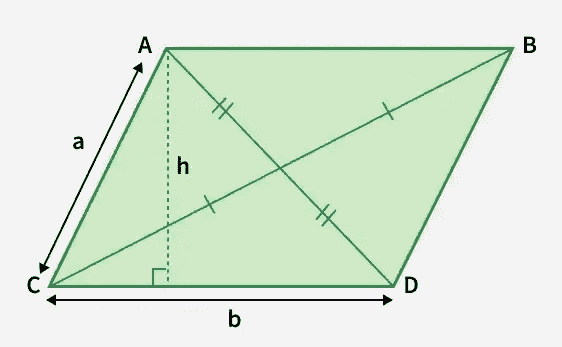
Parallelogram with sides a, b and height h
**Area of a parallelogram by height
Area is known as the total surface occupied by the figure, and the area of a parallelogram is the surface covered or occupied by it. For the calculation of the area of a parallelogram three different methods are provided. The area of a parallelogram can be determined by the means of the height of the figure, Sides lengths or the diagonals.
The area of a parallelogram by height is derived by the product of base and height.
Mathematically,
Area of parallelogram = b x h
where,
- b is the base of the parallelogram
- and h is the height of the parallelogram
**Area of parallelogram by side length
The area of a parallelogram by side length is derived by the length of its sides and an adjacent angle.
Mathematically,
Area of parallelogram = ab sinθ
where,
- a and b are the length of sides
- and θ is the adjacent angle
**Area of parallelogram diagonals
Diagonals are the two line segments intersecting at the center of the given figure. The area of a parallelogram is determined by the two diagonals and the angle between these diagonals.
Mathematically,
Area of parallelogram= 1/2 x d1 x d2 sin(x)
where,
- d1 and d2 are the diagonals
- and x is the angle between the diagonals
Perimeter of parallelogram
Perimeter is the total length or distance of the boundary of the given figure and perimeter of a parallelogram is the total length of the boundary of a parallelogram. The perimeter of a parallelogram is determined by its length and breadth.
Mathematically the formula of the perimeter is written as
Perimeter of a parallelogram = 2(a+b)
where,
a and b are the sides of the parallelogram
Sample Problems
**Problem 1. Calculate the perimeter of a parallelogram with sides measuring 6cm and 8cm by using the parallelogram formula.
Given
The sides of the parallelogram are 6cm and 8cm.
Let a=6cm and b=8cm
We have,
Perimeter=2(a+b)
=>2(6+8)
=>2 x 14
=>28cm
**Problem 2. Calculate the perimeter of a parallelogram with sides measuring 5cm and 4cm by using the parallelogram formula.
Given
The sides of the parallelogram are 5cm and 4cm.
Let a=5cm and b=4cm.
We have,
Perimeter=2(a+b)
=>2(5+4)
=>2 x 9
=>18cm
**Problem 3. Calculate the perimeter of a parallelogram with sides measuring 12cm and 8cm by using the parallelogram formula.
Given
The sides of the parallelogram are 12cm and 8cm.
Let a=12cm and b=8cm
We have,
Perimeter=2(a+b)
=>2(12 +8)
=>40cm.
**Problem 4. Calculate the area of a parallelogram with abase of5cm and aheight of8cm by using the parallelogram formula.
Given
The base is 5cm
The height is 8cm
We have,
Area = b x h
=>5 x 8
=>40cm2
**Problem 5. Calculate the area of a parallelogram with a base of 20cm and aheight of 10cm by using the parallelogram formula.
Given
The base is 20cm
The height is 10cm
We have,
Area = b x h
=>20 x 10
=>200cm2
Practice Problems
**Question 1. A parallelogram has diagonals of lengths 11 cm and 13 cm. The angle between the diagonals is 60°. Use the formula for the area of a parallelogram in terms of the diagonals to calculate its area.
**Question 2. The base of a parallelogram is 12 cm, and its height is 8 cm. Calculate the area of the parallelogram.
**Question 3. A parallelogram has sides of lengths 6 cm and 9 cm. The angle between these two sides is 45°. Calculate the area of the parallelogram using the formula that involves the side lengths and the angle.
**Question 4. A parallelogram has side lengths of 7 cm and 10 cm. Find the perimeter of the parallelogram.
**Answer:-
- 54.47 cm2
- 96 cm2
- 38.2 cm2
- 34 cm