Pipes and Cistern (original) (raw)
Last Updated : 7 Apr, 2026
**Pipe and Cistern deal with calculating the **time taken to fill or empty a tank (cistern) using pipes or taps.
It involves **Inlet Pipes (which fill the tank with water) and **Outlet Pipes/Leaks (which drain the tank).
Pipes and Cistern Concept - Fundamentals
- The problems of pipes and cisterns usually have two kinds of pipes: Inlet pipe, Outlet pipe / Leak. The inlet pipe is the pipe that fills the tank/reservoir/cistern, and the Outlet pipe / Leak is the one that empties it.
- If a pipe can fill a tank in ‘n’ hours, then in 1 hour, it will fill ‘1 / n’ parts. For example, if a pipe takes 6 hours to fill a tank completely, say 12 liters, then in 1 hour, it will fill 1 / 6 th of the tank, i.e., 2 liters.
- If a pipe can empty a tank in ‘n’ hours, then in 1 hour, it will empty ‘1 / n’ parts. For example, if a pipe takes 6 hours to empty a tank completely, say 18 liters, then in 1 hour, it will empty 1 / 6 th of the tank, i.e., 3 liters.
- If we have several pipes such that some fill the tank and some empty it, and we open all of them together, then in one hour, part of the tank filled/emptied = ∑ (1 / mi) – ∑ (1 / nj), where ‘mi’ is the time taken by inlet pipe ‘i’ to fill the tank completely if only it were open and ‘nj’ is the time taken by outlet pipe ‘j’ to empty the tank completely if only it were open. If the sign of this equation is positive, the tank would be filled, and if the sign is negative, the tank would be emptied.
Pipes and Cisterns Formula
Quantitative aptitude formulas are important to help you solve pipes and cistern-based questions quickly and accurately. These formulas include,
- If you need x hours to fill up a tank, then part filled in 1 hr =1/x
- If y hours are required to empty the tank, then part emptied in 1 hour = 1/y
- If one pipe can fill the tank in x hours and another can empty it in y hours (assuming y is greater than x), then the net part of the tank filled in 1 hour is equal to { (y-x)/(xy) }.
- If one pipe can fill the tank in x hours and another can empty it in y hours (assuming x is greater than y), then the net part of the tank filled in 1 hour is equal to {(x-y)/(xy) }.
- Net Work Done = (Total Sum of Work Done by Inlets) – (Total Sum of Work Done by Outlets)
- If you have two inlets that can fill a certain tank, one taking x hours and the other taking y hours respectively, the total time taken to fill the tank is calculated with the formula {(x y)/(x+y)}
Shortcut Tricks for Pipe and Cistern
This below image illustrates a shortcut trick for solving pipe and cistern problems, which involve calculating the time taken to fill or empty a tank using inlet and outlet pipes.
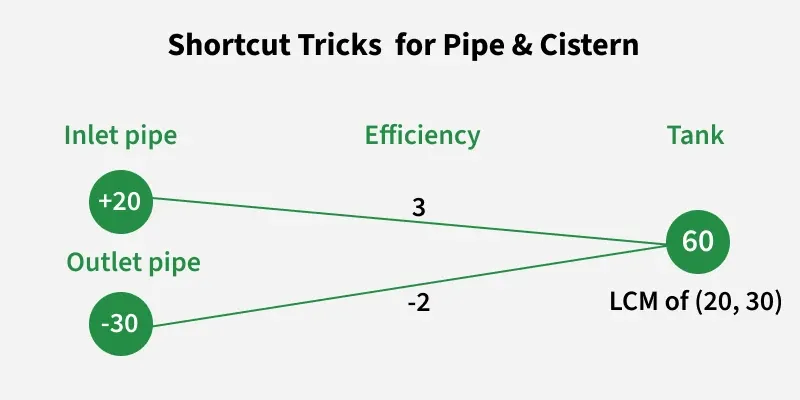
Here's a breakdown:
- **Inlet Pipe: Represented with a value of +20, indicating it fills the tank at a rate of 20 units per unit of time.
- **Outlet Pipe: Represented with a value of -30, indicating it empties the tank at a rate of 30 units per unit of time.
**Efficiency:
- **Inlet Pipe's efficiency is represented as 3 units.
- **Outlet Pipe's efficiency is represented as -2 units.
**Tank:
- The tank's capacity is given as 60 units, and it mentions the LCM (Least Common Multiple) of (20, 30), which is 60.
The formula used to find the combined time taken by inlet and outlet pipe to empty the tank is:
- Time = Total Work / (Efficiency of A + Efficiency of B)
- Substituting the values: Time = 60 / (3 + (-2)) = 60 / 1 = 60 hours.
**Example:
**Problem Statement 1: Two pipes, X and Y, can fill a tank separately in 10 hours and 15 hours, respectively. If both pipes are opened together when the tank is initially empty, how much time will it take to completely fill the tank?
**Solution:
Part of tank filled by pipe A in one hour working alone = 1/10
Part of tank filled by pipe B in one hour working alone = 1/15⇒ Part of tank filled by pipe A and pipe B in one hour working together = (1/10 + 1/15) = (3+2)/30= 5/30
Therefore, time taken to completely fill the tank if both A and B work together = 30/5 = 6 hours
The tank will be completely filled in approximately 6 hours when both pipes A and B work together.
**Problem Statement 2: Two pipes, A and B, can fill a tank in 8 hours and 12 hours, respectively. A third pipe, C, can empty the tank in 10 hours. If all three pipes are opened together, how long will it take to fill the tank?
**Solution:
Part of tank filled by pipe A in one hour working alone = 1/8
Part of tank filled by pipe B in one hour working alone = 1/12
Part of tank emptied by pipe C in one hour working alone = 1/10⇒ Part of tank filled by pipes A and B and emptied by pipe C in one hour working together = (1/8 + 1/12 − 1/10)
Finding a common denominator (120):
(15/120 + 10/120 − 12/120) = (15 + 10 - 12)/120 = 13/120
Therefore, time taken to completely fill the tank if all pipes are opened simultaneously = 120/13 hours ≈ 9.23 hours
The tank will be completely filled in approximately 9.23 hours when all three pipes A, B, and C are opened together.
Pipes and Cisterns - Questions and Answers
**Question 1: Two pipes A and B can fill a tank separately in 12 and 16 hours respectively. If both of them are opened together when the tank is initially empty, how much time will it take to completely fill the tank?
**Solution:
Part of tank filled by pipe A in one hour working alone = 1 / 12
Part of the tank filled by pipe B in one hour working alone = 1 / 16
Part of tank filled by pipe A and pipe B in one hour working together = (1 / 12) + (1 / 16) = 7 / 48
Therefore, time is taken to completely fill the tank if both A and B work together = 48 / 7 hours
**Question 2: Three pipes A, B and C are connected to a tank. Out of the three, A and B are the inlet pipes and C is the outlet pipe. If opened separately, A fills the tank in 10 hours, B fills the tank in 12 hours and C empties the tank in 30 hours. If all three are opened simultaneously, how much time does it take to fill/empty the tank?
**Solution:
Let the capacity of tank be LCM (10, 12, 30) = 60 units
=> Efficiency of pipe A = 60 / 10 = 6 units / hour
=> Efficiency of pipe B = 60 / 12 = 5 units / hour
=> Efficiency of pipe C = - 60 / 30 = - 2 units / hour (Here, '-' represents outlet pipe)
=> Combined efficiency of pipes A, B and C = 6 + 5 - 2 = 9 units / hour
Therefore, time taken to completely fill the tank = 60 / 9 = 6 hours 40 minutes
**Question 3: Three pipes A, B and C are connected to a tank. Out of the three, A is the inlet pipe and B and C are the outlet pipes. If opened separately, A fills the tank in 10 hours, B empties the tank in 12 hours and C empties the tank in 30 hours. If all three are opened simultaneously, how much time does it take to fill/empty the tank?
**Solution:
Part of tank filled by pipe A in one hour working alone = 1 / 10
Part of tank emptied by pipe B in one hour working alone = 1 / 12
Part of tank emptied by pipe C in one hour working alone = 1 / 30
=> Part of tank filled by pipes A, B and C in one hour working together = (1 / 10) - (1 / 12) - (1 / 30) = -1 / 60
Therefore, time is taken to completely empty the tank if all pipes are opened simultaneously = 60/1 = 60 hours
**Question 4: A cistern has two pipes. Both working together can fill the cistern in 12 minutes. The first pipe is 10 minutes faster than the second pipe. How much time would it take to fill the cistern if the only second pipe is used?
**Solution:
Let the time taken by first pipe working alone be 't' minutes.
=> Time is taken by second pipe working alone = t + 10 minutes.
Part of tank filled by pipe A in one hour working alone = 1 / t
Part of tank filled by pipe B in one hour working alone = 1 / (t + 10)
=> Part of tank filled by pipe A and B in one hour working together = (1 / t) + (1 / t+10) = (2t + 10) / [t x (t + 10)]
But we are given that it takes 12 minutes to completely fill the cistern if both pipes are working together.
=> (2t + 10) / [t x (t + 10)] = 1 / 12
=> t x (t + 10) / (2t + 10) = 12
=> t2 + 10t = 24t + 120
=> t2 - 14t - 120 = 0
=> (t - 20) (t + 6) = 0
=> t = 20 minutes (Time cannot be negative)
Therefore, time taken by second pipe working alone = 20 + 10 = 30 minutes
**Question 5: Three pipes A, B and C are connected to a tank. Out of the three, A and B are the inlet pipes and C is the outlet pipe. If opened separately, A fills the tank in 10 hours and B fills the tank in 30 hours. If all three are opened simultaneously, it takes 30 minutes extra than if only A and B are opened. How much time does it take to empty the tank if only C is opened?
**Solution:
Let the capacity of tank be LCM (10, 30) = 30 units
=> Efficiency of pipe A = 30 / 10 = 3 units / hour
=> Efficiency of pipe B = 30 / 30 = 1 units / hour
=> Combined efficiency of pipes A and B = 4 units/hour
Therefore, time is taken to completely fill the tank if only A and B are opened = 30 / 4 = 7 hours 30 minutes
=> Time is taken to completely fill the tank if all pipes are opened = 7 hours 30 minutes + 30 minutes = 8 hours
=> Combined efficiency of all pipes = 30 / 8 = 3.75 units / hour
Now, the efficiency of pipe C = Combined efficiency of all three pipes - Combined efficiency of pipes A and B
Therefore, efficiency of pipe C = 4 - 3.75 = 0.25 units / hour
Thus, time taken to empty the tank if only C is opened = 30 / 0.25 = 120 hours