What is the Point of Intersection of Two Lines Formula? (original) (raw)
Last Updated : 23 Jul, 2025
If we consider two lines **a 1 x + b 1 y + c 1 = 0 and **a 2 x + b 2 y + c 2 = 0, the point of intersection of these two lines is given by the formula:
(x, y) = \left( \frac{b_1 c_2 \ - \ b_2 c_1}{a_1 b_2 \ - \ a_2 b_1}, \frac{c_1 a_2 \ - \ c_2 a_1}{a_1 b_2 \ - \ a_2 b_1} \right),
The given illustration shows the interaction of two lines, along with the formula to calculate the point of interaction.
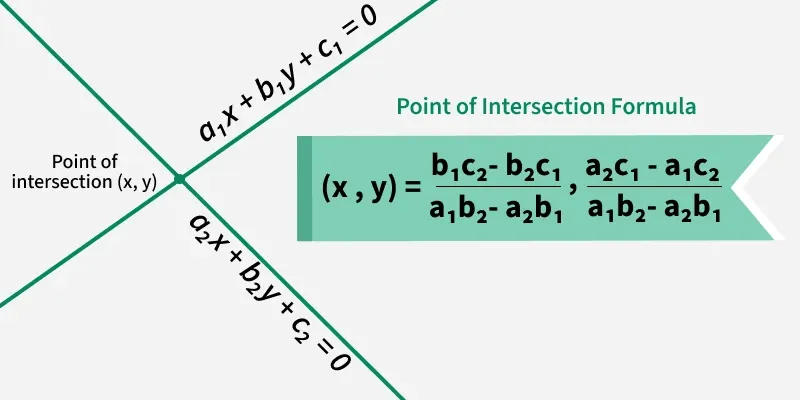
General formula for the point of intersecton of two lines
The point of intersection is the point where two lines intersect each other in a plane.
**For example: Find the point of intersection of lines
- 3x + 4y + 5 = 0,
- 2x + 5y + 7 = 0.
**Solution:
The point of intersection of two lines is given by :
(x, y) = \left( \frac{b_1 c_2 \ - \ b_2 c_1}{a_1 b_2 \ - \ a_2 b_1}, \frac{c_1 a_2 \ - \ c_2 a_1}{a_1 b_2 \ - \ a_2 b_1} \right)
a1 = 3, b1 = 4, c1 = 5
a2 = 2, b2 = 5, c2 = 7(x,y) = ((28-25)/(15-8), (10-21)/(15-8))
(x,y) = (3/7,-11/7)
➣ **Learn more about lines:
**Derivation of the point of intersection of two lines
**Given equations:
→ a1x + b1y + c1 = 0 -> eq-1
→ a2x + b2y + c2 = 0 -> eq-2**Solving the equations using cross multiplication method:
x y 1
b1 c1 a1 b1
b2 c2 a2 b2**On cross-multiplying the constants we obtain:
→ x/(b1*c2 - b2* c1) = y/(c1*a2-c2*a1) = 1/(a1*b2-a2*b1)
**Solving for x:
→ x/(b1*c2 - b2* c1) = 1/(a1*b2-a2*b1)
→ x = (b1*c2 - b2* c1)/(a1*b2-a2*b1)**Solving for y:
→ y/(c1*a2-c2*a1) = 1/(a1*b2-a2*b1)
→ y=(c1*a2−c2*a1)/(a1*b2−a2*b1)Hence point of intersection:
****(x, y) = ((b** 1 ×c 2 **− b 2 ×c 1 )/(a 1 ×b 2 **− a 2 ×b 1 ), (c 1 ×a 2 **− c 2 ×a 1 )/(a 1 ×b 2 **− a 2 ×b 1 ))
If two lines are parallel, they never intersect each other:
Condition for two lines a1x + b1y + c1 = 0, a2x + b2y + c2 = 0 to be parallel
a1/b1 = a2/b2.
Sample Problems on Point of Intersection of Two Lines Formula
Given below are some related questions from the above topic.
**Question 1: Find the point of intersection of the lines: 9x + 3y + 3 = 0 and 4x + 5y + 6 = 0.
**Solution:
The point of intersection of two lines is given by :
(x,y) = ((b1*c2−b2*c1)/(a1*b2−a2*b1), (c1*a2−c2*a1)/(a1*b2−a2*b1))
a1 = 9, b1 = 3, c1 = 3
a2 = 4, b2 = 5, c2 = 6(x, y) = ((18-15)/(45-15), (54-12)/(45-15))
(x, y) = (1/10, 7/5)
**Question 2: Check if the two lines are parallel or not: 2x + 4y + 6 = 0 and 4x + 8y + 6 = 0.
**Solution:
To check whether the lines are parallel or not we need to check a1/b1 = a2/b2
a1 = 2, b1 = 4
a2 = 4, b2 = 82/4 = 4/8
1/2 = 1/2Since the condition is satisfied the lines are parallel and can't intersect each other.
**Question 3: Check if the two lines are parallel or not: 3x + 4y + 8 = 0 and 4x + 8y + 6 = 0.
**Solution:
To check whether the lines are parallel or not we need to check a1/b1 = a2/b2
a1 = 3, b1 = 4
a2 = 4, b2 = 83/4 is not equal to 4/8
Since the condition is not satisfied the lines are not parallel.
**Question 4: Check whether the point (3, 5) is the point of intersection of lines: 2x + 3y - 21 = 0 and x + 2y - 13 = 0.
**Solution:
A point to be a point of intersection it should satisfy both the lines.
Substituting (x,y) = (3,5) in both the lines
Check for equation 1: 2*3 + 3*5 - 21 =0 ----> satisfied
Check for equation 2: 3 + 2* 5 -13 =0 ----> satisfiedSince both the equations are satisfied it is a point of intersection of both the lines.
**Question 5: Check whether the point (2, 5) is the point of intersection of lines: x + 3y - 17 = 0 and x + y - 13 = 0.
**Solution:
A point to be a point of intersection it should satisfy both the lines.
Substituting (x,y) = (2,5) in both the lines
Check for equation 1: 2+ 3*5 - 17 =0 ----> satisfied
Check for equation 2: 7 -13 = -6 --->not satisfiedSince both the equations are not satisfied it is not a point of intersection of both the lines.
Practice Problems on Point of Intersection of Two Lines Formula
**Question 1: Find the point of intersection of the lines represented by the equations: 2x + 3y - 6 = 0 and 4x − y + 8 = 0.
**Question 2: Determine the point of intersection for the following pair of lines: 5x − y − 4 = 0 and 3x + 2y − 7 = 0.
**Question 3: Calculate the intersection point of these lines: x − 2y + 1 = 0 and 2x + y − 5 = 0.
**Question 4: Find the point of intersection of the given lines: 3x + 4y − 12 = 0 and 6x − y + 2 = 0.
**Question 5: Find the point of intersection of lines: x = -2 and 3x + y + 4 = 0.
**Question 6: Check whether the point (3, 5) is the point of intersection of lines: 2x + 3y - 21 = 0 and x + 2y - 13 = 0.