Polygons | Formula, Types, and Examples (original) (raw)
Last Updated : 4 Dec, 2025
A polygon is a closed 2-dimensional shape made up of straight line segments. These line segments are called sides, and the points where they meet are called vertices (corners).
Parts of a Polygon
A Polygon comprises three fundamental components:
- **Sides of a Polygon: Sides of a polygon are the boundary of the polygons that define the closed region.
- **Vertices: The point at which two sides meet is known as a vertex.
- **Angles: The Polygon contains both interior and exterior angles. An interior angle is formed within the enclosed region of the polygon by the intersection of its sides.
Types of Polygon
**Polygons based on side length:
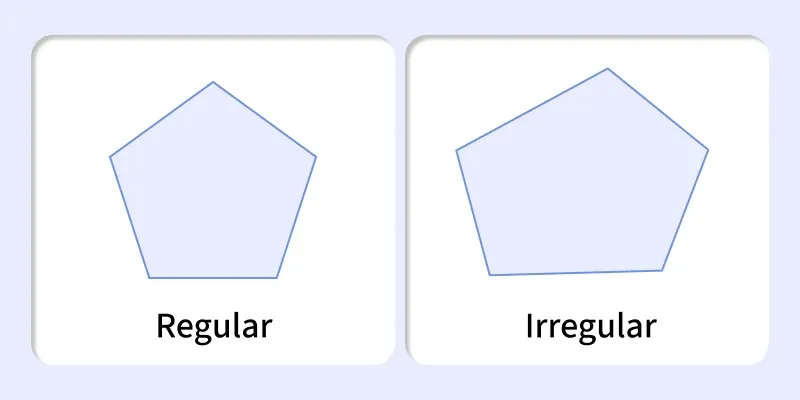
- **Regular Polygon: A Regular Polygon is distinguished by having all sides of equal length and all interior angles with equal measurements. It can be both equilateral and equiangular. Examples of regular polygons include the triangle, quadrilateral, pentagon, and hexagon.
- **Irregular Polygon: An Irregular Polygon has unequal-length sides and angles of varying measures. Any polygon that does not conform to the criteria of a regular polygon is classified as irregular. Common examples of irregular polygons are the scalene triangle, quadrilaterals like rectangles, trapezoids, or kites, as well as irregular pentagon and hexagon structures.
**Polygons based on angles:
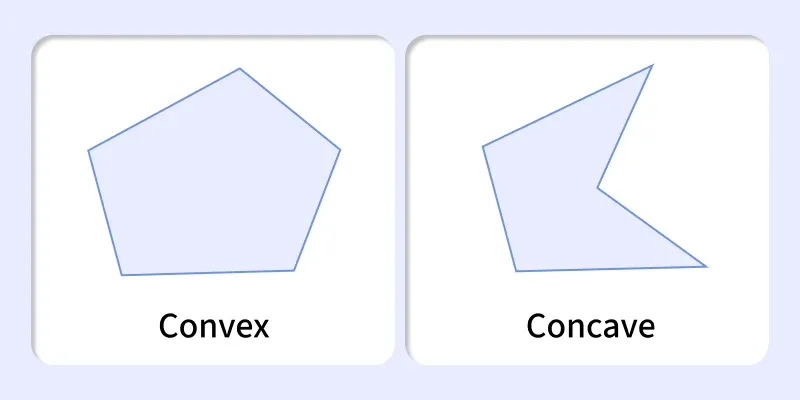
- **Convex Polygon: A convex polygon has no interior angle that measures more than 180°. Convex polygons can have three or more sides. In convex polygons, all diagonals lie inside the closed figure. Common examples of convex polygons are triangles, all convex quadrilaterals, as well as regular pentagons and hexagons.
- **Concave Polygon: A concave polygon has at least one interior angle that is a reflex angle and points inwards. Concave polygons have a minimum of four sides. This type of polygon features at least one interior angle measuring more than 180°. In concave polygons, some diagonals extend outside the enclosed figure. Examples of concave polygons include a dart or an arrowhead in quadrilaterals, as well as certain irregular pentagons and hexagons.
Polygon Names
Below is the Polygon chart based on the number of sides:
| Name | Number of Sides | Number of diagonals | Interior Angle |
|---|---|---|---|
| Triangle | 3 | 0 | 60° |
| Quadrilateral | 4 | 2 | 90° |
| Pentagon | 5 | 5 | 108° |
| Hexagon | 6 | 9 | 120° |
| Heptagon | 7 | 14 | 128.571° |
| Octagon | 8 | 20 | 135° |
| Nonagon | 9 | 27 | 140° |
| Decagon | 10 | 35 | 144° |
| Hendecagon | 11 | 44 | 147.273° |
| Dodecagon | 12 | 54 | 150° |
Area and Perimeter of Polygons
The Area of a Polygon represents the total space it occupies in a two-dimensional plane, is determined by specific formulas based on the number of sides and the polygon's classification. Whereas the Perimeter of a two-dimensional shape represents the total length of its outer boundary. The area and perimeter formulas for different polygons are as follows:
| Polygon | Area | Perimeter |
|---|---|---|
| Triangle | 1/2 × Base × Height | The sum of the Three Sides |
| Parallelogram | Base × Height | 2(Sum of Adjacent Sides) |
| Rectangle | Length × Breadth | 2(length + breadth) |
| Square | (Side)2 | 4 × Side |
| Rhombus | 1/2 × diagonal1 × diagonal2 | 4 × Side |
| Trapezium | 1/2 × Height × Sum of Parallel Sides | Sum of Parallel Sides + Sum of Non-Parallel Sides |
| Pentagon | (5/2) × side length × Apothem | 5 × Side |
| Hexagon | {(3√3)/2}side2 | 6 × Side |
| Heptagon | 3.643 × Side2 | 7 × Side |
**The formula for the Diagonals of a Polygon
A Diagonal of a Polygon is a line segment formed by connecting two vertices that are not adjacent.
Number of Diagonals in a Polygon = n(n − 3)/2,
Where 'n' represents the number of sides the Polygon possesses.
- Read More about the Diagonal of the Polygon Formula.
Angles in Polygons
In geometry, angles in polygons refer to the angles formed by the sides of a polygon, both in the interior and exterior of the polygon. Thus, there can be both angles in the polygon, i.e.,
- Interior Angles
- Exterior Angles
Interior Angle Formula of Regular Polygons
The Interior Angles of a Polygon are those formed between its adjacent sides and are equal in the case of a regular polygon. The count of interior angles corresponds to the number of sides in the polygon.
The sum of the interior angles 'S' in a polygon with 'n' sides is calculated as
**S = (n – 2) × 180°
Where 'n' represents the number of sides.
Exterior Angle Formula of Polygons
Each Exterior Angle of a Regular Polygon is formed by extending one of its sides (either clockwise or anticlockwise) and measuring the angle between this extension and the adjacent side. In a regular polygon, all exterior angles are equal.
**Total sum of exterior angles in any polygon is fixed at 360°
Therefore,
**Each exterior angle is given by 360°/n
Where 'n' is the number of sides.
The sum of the interior and corresponding exterior angles at any vertex in a polygon is always 180 degrees, expressing a supplementary relationship:
**Interior angle + Exterior angle = 180°
**Exterior angle = 180° – Interior angle
Properties of Polygons
The properties of Polygons identify them easily. The following properties contribute to knowing the Polygons easily:
- A polygon is a closed shape, devoid of open ends. The origin and endpoint should be the same.
- It assumes a planar form, consisting of line segments or straight lines that collectively shape the figure.
- As a two-dimensional entity, a polygon exists only in the dimensions of length and width, lacking depth or height.
- It possesses three or more sides to make a polygon.
- Angles in the Polygon can vary. It shows a distinct configuration.
- The length of the sides of a Polygon can vary; it may or may not be equal across the Polygon.
**Related Articles:
Solved Examples of a Polygon in Maths
**Example 1: Consider a quadrilateral with four sides. Find the sum of all trapezoid interior angles of a quadrilateral.
**Solution:
Formula for the sum of interior angles in an n-sided regular polygon = (n − 2) × 180°
The sum of all the interior angles of the quadrilateral = (4 – 2) × 180°
The sum of all the interior angles of the quadrilateral = 2 × 180°
The sum of all the interior angles of the quadrilateral = 360°Therefore, the sum of all the interior angles of the quadrilateral is 360°.
**Example 2: Consider a Regular Polygon with a given exterior and interior angle ratio of 7:3. Determine the type of polygon.
**Solution:
The ratio of the exterior and interior angle is 7:3.
Assume the exterior and interior angle of a polygon as 7x and 3x.
The sum of the exterior and interior angles of any polygon is 180°.7x + 3x = 180°
10x = 180°
x = 18°Exterior angle = 18°
Number of sides = 360°/exterior angle
= 360°/18°
= 20Therefore, the given polygon is an icosagon, as it has 20 sides.
**Example 3: Each Exterior Angle of a Polygon measures 90 degrees. Determine the type of Polygon.
**Solution:
As per the formula, each exterior angle = 360°/n
Here n = number sides.
90°= 360°/n
n = 360°/90°= 4Hence, the Polygon in question is a quadrilateral, as it possesses four sides.
**Example 4: The sides are 10m, 10m, 8m, 8m, 5m, 5m, 9m, 9m. How many meters of rope will be needed for the Perimeter?
**Solution:
In order to find the length of the rope needed for the perimeter, we must sum the lengths of all the sides:
Perimeter = 10 m + 10 m + 8 m + 8 m + 5 m + 5 m + 9 m + 9 m
Perimeter = 64 m.Therefore, a total of 64 meters of rope will be needed for the Perimeter.