Practice Questions on Pythagoras Theorem (original) (raw)
Last Updated : 23 Jul, 2025
Pythagorean Theorem is one of the most fundamental principles in mathematics, forming the foundation of geometry. This ancient theorem, attributed to the Greek mathematician Pythagoras, establishes a relationship between the sides of a right triangle.
In this article, we are going to study about an important chapter of school mathematics. This article will explain concepts related to Pythagoras theorem and have solved questions and unsolved questions.
What is Pythagoras' Theorem?
The Pythagorean theorem is a fundamental principle in geometry that relates to right-angled triangles. It states that in a right triangle, the square of the length of the hypotenuse (the side opposite the right angle) is equal to the sum of the squares of the lengths of the other two sides.
Mathematically, it can be expressed as:
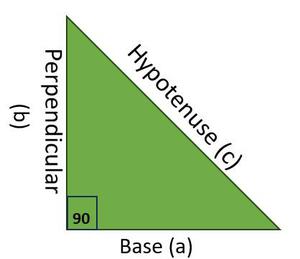
a right- angled triangle (90°)
**Hypotenuse 2 = Perpendicular 2 +Base 2
**c 2 = a 2 + b 2
**Where,
- c is the length of the hypotenuse, and
- a and b are the lengths of the other two sides of a right triangle.
Other formulas to calculate a
**a 2 = c 2 - b 2
to calculate b
**b 2 = c 2 - a 2
For any given integer m, ****(m** 2 – 1, 2m, m 2 + 1) is the **Pythagorean Triplet.
Solved problems on Pythagoras Theorem
**Q1: The height of a triangle is 8km and the base of a triangle is 6km. Find the hypotenuse of the triangle?
**Solution:
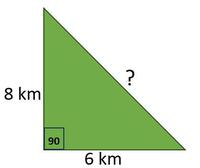
Height = 8km
Base = 6km
(Hypotenuse)2 = (height)2 + (base)2
⇒ (Hypotenuse)2 = 8 × 8 + 6 × 6
⇒ (Hypotenuse)2 = 64 + 36
⇒ (Hypotenuse)2 = 100
⇒ Hypotenuse = 10
So, the hypotenuse of the triangle is 10km.
Q2: Krishna and Ranjan started walking from the same point. Krishna walks 400 meters west. While Ranjan walks 300 meters south. So, how far are they from each other?
**Answer:
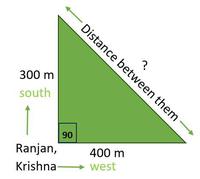
So, the distance between Krishna and Ranjan will be
d2 = (300)2 + (400)2
⇒ d2 = 90000 + 160000
⇒ d2 = 250000
⇒ d = 500m
So, Krishna and Ranjan are 500 meters away from each other.
Q3: In a right-angled triangle, the measures of the perpendicular sides are 6 cm and 11 cm. Find the length of the third side.
**Solution:
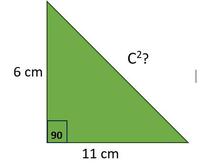
We are given two sides
a = 6cm and b = 11cm
To calculate the third side,
c2 = 6 × 6 + 11 × 11
⇒ c2 = 36 + 121
⇒ c2 = 157
⇒ c = 12.52cm
So, the third side is 12.52cm.
Q4: We are given the sides of a triangle. The sides are 3cm, 4cm and 5cm. Check whether the given triangle is a right angle triangle.
**Solution:
We are given three sides of a triangle
a = 3cm, b = 4cm and c = 5cm
To check whether the given triangle is a right angled triangle,
the following conditions needs to be true
c2 = a2 + b2
⇒ 5 × 5 = 3 × 3 + 4 × 4
⇒ 25 = 9 + 16
⇒ 25 = 25
So, the given triangle is a right angled triangle.
Q5: We are given the sides of a triangle. The sides are 14cm, 8 cm and 17cm. Check whether the given triangle is a right angle triangle.
**Solution:
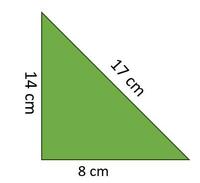
**We are given three sides of a triangle
**a = 14cm, b = 8cm and c = 17cm
**To check whether the given triangle is a right angled triangle,
**the following conditions needs to be true
**c 2 = a 2 + b 2
**⇒ 14 × 14 = 8 × 8 + 17 × 17
**⇒ 156 = 64 + 289
**⇒ 156 = 353
**these two values are not equal
**So, the given triangle is a not a right angled triangle.
Q6: Find the Pythagorean triplet with in which the given number is 6.
**Solution:
Formula of Pythagorean Triplet
(m2 – 1, 2m, m2 + 1) where m is a integer
So, 2m = 6
m = 3,
m2 + 1 = 9 +1 = 10, and
m2 - 1 = 9-1 = 8.
So, the Pythagorean triplet is (6, 8, 10).
Q7: We are given a square. The diagonal of the square is 8cm. Find the sides of the square
**Solution:
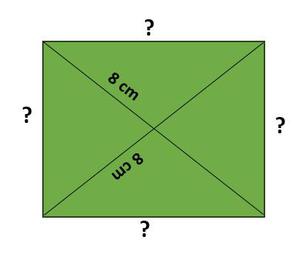
Square
We are given diagonal of the square
d = 8cm
Let s be the side of the square.
To find the sides of the square apply the formula,
d2 = s2 + s2
⇒ 8 × 8 = 2s2
⇒ s = 4√2.
So, the sides of the square is 4√2cm.
Q8: We are given a square. The diagonal of the square is 24cm. Find the area of the square
**Solution:
We are given diagonal of the square
d = 24cm
Let s be the side of the square.
To find the sides of the square apply the formula,
d2 = s2 + s2
⇒ 24 × 24 = 2s2
⇒ s2 = 24 × 24 /2
⇒ s2 = 24 × 12 ⇒ 288
⇒ s = √288 ⇒ 16√2 cm.
So, the sides of the square is 16√2 cm..
Now to calculate area of the square apply the formula
Area of square = s × s
⇒ Area of square = 12√2 × 12√2.
⇒ Area of square = 12× 12 × 2
⇒ Area of square = 288 cm2
Thus, area of the square is 288cm2.
Q9: Find the width of a rectangle whose length is 144 cm and the length of the diagonal 145 cm.
**Solution:
We are given diagonal of the rectangle, and the length of the rectangle
d = 145cm and length = 144cm
Let w be the base of the rectangle.
To find the width of the rectangle apply the formula,
d2 = l2 + w2
⇒ 145 × 145 = 144 × 144 + w2
⇒ w2 = 145 × 145 - 144 × 144
⇒ w2 = 21025 - 20736
⇒ w × w = 289
⇒ w = 17cm
⇒ s = 4√2.
So, the width of the rectangle is 17cm.
Q10: Find the area of a rectangle whose length is 144 cm and the length of the diagonal 145 cm.
**Solution:
We are given diagonal of the rectangle, and the length of the rectangle
d = 145cm and length = 144cm
Let w be the base of the rectangle.
To find the width of the rectangle apply the formula,
d2 = l2 + w2
⇒ 145 × 145 = 144 × 144 + w2
⇒ w2 = 145 × 145 - 144 × 144
⇒ w2 = 21025 - 20736
⇒ w × w = 289
⇒ w = 17cm
So, the width of the rectangle is 17cm.
Now, to calculate the area of the rectangle, apply the formula
Area = l × w
⇒ Area = 144 × 17
⇒ Area = 2448 cm2
So, the area of the rectangle is 2448cm2.
Unsolved Practice Questions on Pythagoras Theorem : Unsolved
- **Q1: The height of a triangle is 10 km and the base of the triangle is 8 km. Find the hypotenuse of the triangle?
- **Q2: Ravi and Sunita started walking from the same point. Ravi walks 500 meters west. While Sunita walks 400 meters south. So, how far are they from each other?
- **Q3: In a right-angled triangle, the measures of the perpendicular sides are 7 cm and 24 cm. Find the length of the third side.
- **Q4: We are given the sides of a triangle. The sides are 5 cm, 12 cm, and 13 cm. Check whether the given triangle is a right-angle triangle.
- **Q5: We are given the sides of a triangle. The sides are 9 cm, 12 cm, and 15 cm. Check whether the given triangle is a right-angle triangle.
- **Q6: Find the Pythagorean triplet in which the given number is 9.
- **Q7: We are given a square. The diagonal of the square is 10 cm. Find the sides of the square.
- **Q8: We are given a square. The diagonal of the square is 30 cm. Find the area of the square.
- **Q9: Find the width of a rectangle whose length is 120 cm and the length of the diagonal is 169 cm.
- **Q10: The perimeter of the rectangle whose length is 60 cm and a diagonal is 61 cm.
- **Q11: A ladder leans against a wall. The distance from the base of the ladder to the wall is 9 feet, and the ladder is 15 feet long. Find the height at which the ladder touches the wall.
- **Q12: A right-angled triangle has a hypotenuse c and one side a. The other side is (a+5). Express c in terms of a.
- **Q13: Given points A(2,3) and B(7,6) are two vertices of a right-angled triangle, and the third vertex C is at the origin(0,0). Find the length of hypotenuse AB.
- **Q14: In a right-angled triangle, the hypotenuse is twice as long as one of the sides. Find the ratio of the lengths of the two sides.
- **Q15: A circle with a diameter of 20 cm has a chord 12 cm long. Find the distance from the center of the circle to the chord.
- **Q16: The length of the diagonal of a rectangular box is 15 cm, and its base is a square with a side length of 9 cm. Find the height of the box.
- **Q17: Two similar right-angled triangle having hypotenuse 10 cm and 5 cm. Find the ratio of the lengths of their corresponding legs.
- **Q18: In a right-angled triangle, the altitude to the hypotenuse divides the hypotenuse into segments of lengths 6 cm and 8 cm. Find the length of the altitude.
- **Q:19 The sides of a right-angled triangle are in the ratio 3:4:5. Find the hypotenuse if the shorter side is 9 cm.
| Answers to Unsolved Questions | |||
|---|---|---|---|
| **1: 12.806... km. | **2: 640 meters. | **3. 25 cm. | **4. Yes. |
| **5. Yes, it is right-angled triangle | **6. 9,12,15. | **7. 7.07 cm (approximately) | **8. 450 cm 2 . |
| **9. 119 cm. | **10. 142 cm. | **11: 12 feet. | **12: c = (√2a 2 + 10a +25) . |
| **13: √34 units. | **14: 1 : √3 or√3 : 1. | **15: 8 cm. | **16: 12 cm. |
| **17: 2:1. | **18: 4.8 cm | **19: 15 cm. |
**Also Read: