Prime Factorization (original) (raw)
Last Updated : 26 Jan, 2026
Prime factorization means breaking a number down into the prime numbers that multiply together to make it.
- A prime number is a number greater than 1 that can only be divided by 1 and itself (like 2, 3, 5, 7, 11…).
- Prime Factorization involves only the prime numbers, as every composite number can be written as the product of primes.
**More Examples of Prime Factorization:
**12 can be written as 2 × 6
6 can be further factorized as 2 × 3.
So 12 can be rewritten as 2 × 2 × 3
No more factorization possible as 2 and 3 cannot be divide further, so 2 × 2 × 3 is our prime factorization**54 can written as 2 × 27.
27 can be further factorized as 3 × 9.
So we rewrite 54 as 2 × 3 × 9
9 can be further factorized as 3 × 3.
So we rewrite 54 as 2 × 3 × 3 × 3.
No more factorization possible, so 2 × 3 × 3 × 3 is our prime factorization
When a number is expressed as a product of its prime factors, it is said to be in its prime factorization form.Prime Factorization Example Table
Prime factorization of some of the common composite numbers are:
| Numbers | Prime Factorization | Numbers | Prime Factorization |
|---|---|---|---|
| 36 | 22 × 32 | 40 | 23 × 5 |
| 24 | 23 × 3 | 50 | 2 × 52 |
| 60 | 22 × 3 × 5 | 48 | 24 × 3 |
| 18 | 2 × 32 | 30 | 2 × 3 × 5 |
| 72 | 23 × 32 | 42 | 2 × 3 × 7 |
| 45 | 32 × 5 | 20 | 22 × 5 |
Prime Factorization Methods
Two common methods of Prime Factorization are:
- Division Method
- Factor Tree Method
Prime Factorization by Division Method
In this method, the number is successively divided by prime numbers until the quotient becomes 1****,** with each division identifying a prime factor.
**Steps to identify the prime factors of a number by the Division Method :
- **Step 1: Divide the number by the smallest prime number (i.e. 2) until we are able to divide the given number without leaving any remainder.
- **Step 2: Move on to the next prime number and repeat the division until the quotient becomes 1.
- **Step 3: The prime factors are the divisors used in the division process.
Examples of Prime Factorization by Division Method
**Example 1: Find the Prime Factorization of 60 using the Division Method.

**Example 2: Find the Prime Factorization of 210 using the Division Method.

**Example 3: Express 56 as the product of its Prime Factors.

Prime Factorization by Factor Tree Method
The Factor Tree Method involves breaking down a number into its prime factors by constructing a tree-like structure called a factor tree.
**Steps to identify the prime factors of a number by the Factor Tree Method:
- **Step 1: Identify two factors of the number that are not prime.
- **Step 2: Write these two factors as branches of the factor tree.
- **Step 3: Repeat steps 1 and 2 for each non-prime factor until all branches end with prime numbers.
- **Step 4: The prime factors are the numbers at the end of the branches.
Examples of Prime Factorization by Factor Tree Method
**Example 1: Find the factorization of 60 by the Factor Tree Method.

**Example 2: Make the Factor Tree of 210.

Prime Factorization of Numbers
Some examples of prime factorization are listed below:
| Number | Prime Factorization |
|---|---|
| 72 | 2 × 2 × 2 × 3 × 3 |
| 36 | 2 × 2 × 3 × 3 |
| 48 | 2 × 2 × 2 × 2 × 3 |
| 12 | 2 × 2 × 3 |
| 100 | 2 × 2 × 5 × 5 |
| 84 | 2 × 2 × 3 × 7 |
| 8 | 2 × 2 × 2 |
| 32 | 2 × 2 × 2 × 2 × 2 |
| 24 | 2 × 2 × 2 × 3 |
| 91 | 7 × 13 |
| 15 | 3 × 5 |
Finding HCF and LCM by Prime Factorization
HCF and LCM can be easily calculated by the method of prime factorization:
Finding HCF
For the HCF, take the lowest power of each common prime factor from both numbers.
For Example:
- Common prime factors: 2 and 3
- For 2: min(2, 4) = 2
- For 3: min(1, 1) = 1
So, the HCF is:
HCF = 22 × 31 = 4 × 3 = 12
Finding LCM
For the LCM, take the highest power of each prime factor present in either number.
For Example:
- Prime Factors: 2, 3, and 5
- For 2: max(2, 4) = 4
- For 3: max(1, 1) = 1
- For 5: max(1, 0) = 1
So, the LCM is:
LCM = 24 × 31 × 51 = 16 × 3 × 5 = 240
Applications of Prime Factorization
- **Finding HCF and LCM: Prime factorization helps determine the Highest Common Factor (HCF) and Lowest Common Multiple (LCM) of numbers, essential for simplifying fractions and finding common denominators.
- **Cryptography: It is crucial in public key cryptography, such as RSA, where the difficulty of factoring large composite numbers ensures secure communication.
- **Simplifying Fractions: By factoring numerators and denominators into prime factors, common factors can be canceled out, simplifying fractions effectively.
- **Divisibility Rules: Prime factorization aids in applying divisibility rules, quickly indicating whether one number is divisible by another.
- **Data Compression: Techniques based on prime factorization can optimize data storage and transmission in computer science, enhancing efficiency.
- **Network Security: Algorithms based on prime factorization enhance data security during network transfers, protecting sensitive information.
Related Articles:
Prime Factorization Solved Examples
**Problem 1: What is the Prime Factorization of 80?
**Solution:
To find the prime factorization of 80, we can start by dividing it by the smallest prime number, which is 2.
- 80 divided by 2 equals 40.
- 40 divided by 2 equals 20.
- 20 divided by 2 equals 10.
- 10 divided by 2 equals 5.
Now, since 5 is a prime number, we can stop dividing. Therefore, the prime factorization of 80 is: 2 × 2 × 2 × 2 × 5.
**Problem 2: Prime factorization of 120.
**Solution:
Starting with the smallest prime number, which is 2.
- 120 divided by 2 equals 60.
- 60 divided by 2 equals 30.
- 30 divided by 2 equals 15.
- Now, since 15 is not divisible by 2, we move on to the next prime number (i.e, 3)
- 15 divided by 3 equals 5.
Now, since 5 is a prime number, we can stop dividing. Therefore, the prime factorization of 120 is: 2 × 2 × 2 × 3 × 5
**Problem 3: What is the Factor Tree of 56?
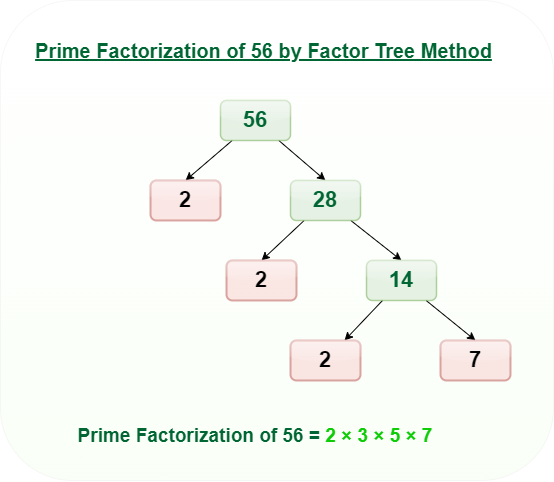
Prime Factorization Unsolved Examples
**Example 1. Find the prime factorization of 36.
**Example 2. Determine the prime factorization of 90.
**Example 3. What is the prime factorization of 48?
**Example 4. Find the prime factorization of 105.
**Example 5. What is the prime factorization of 84?
**Example 6. Determine the prime factorization of 100.
**Example 7. Find the prime factorization of 2310.
**Example 8. What is the prime factorization of 56?
**Example 9. Determine the prime factorization of 150.
**Example 10. What is the prime factorization of 1250?